CBSE Composite Skill Labs Introduced Under NEP 2020
CBSE Composite Skill Labs: Advancing Hands-On Learning in Schools Under NEP 2020
In a transformative step towards redefining classroom learning in India, the Central Board of Secondary Education (CBSE) has introduced Composite Skill Labs across affiliated schools, signalling a decisive shift from rote-based instruction to experiential, skill-oriented education. Rooted firmly in the vision of the National Education Policy (NEP) 2020 and aligned with the National Curriculum Framework for School Education (NCF-SE) 2023, this initiative reflects a broader reimagination of how knowledge is imparted, absorbed, and applied in contemporary schooling. At its core, the introduction of Composite Skill Labs is not merely an infrastructural addition but a philosophical reorientation of education itself, one that prioritises practical engagement, multidisciplinary exposure, and real-world readiness over passive memorisation.
Reimagining Education: From Theory to Practice
For decades, the Indian education system has been criticised for its overemphasis on theoretical learning, often at the expense of practical understanding. Students, though academically proficient, frequently lack the hands-on skills necessary to navigate real-world challenges. The introduction of Composite Skill Labs seeks to address this long-standing imbalance.
These labs are designed to foster experiential learning, enabling students to engage directly with tools, technologies and problem-solving scenarios. By integrating vocational education into mainstream schooling, CBSE aims to cultivate a generation of learners who are not only knowledgeable but also capable, adaptable and innovative.
The initiative represents a deliberate move away from textbook-centric pedagogy, encouraging students to learn by doing, a method widely acknowledged as more effective in developing critical thinking and long-term retention.
What Are Composite Skill Labs?
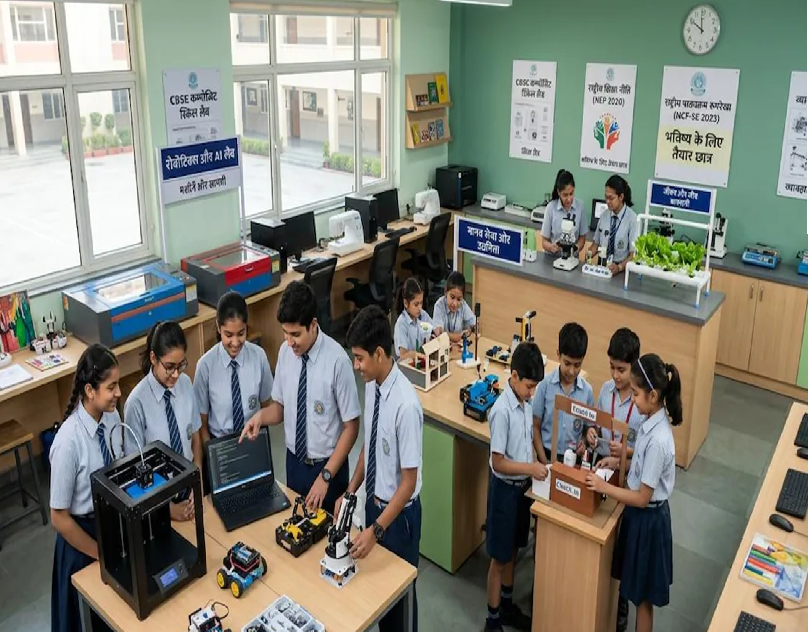
Composite Skill Labs are multidisciplinary spaces within schools that facilitate practical learning across a range of skill domains. These labs are structured to encompass three broad areas of work:
- Life forms
- Machines and materials
- Human services
This categorisation ensures that students are exposed to diverse fields, from biological sciences and environmental studies to engineering concepts and service-oriented professions. The aim is to provide a holistic learning environment that mirrors the complexity and interconnectedness of the real world.
Schools are encouraged to tailor the specific subjects and activities within these domains based on local context, available resources, and potential industry linkages. This flexibility allows institutions to design programmes that are both relevant and responsive to regional needs.
Infrastructure and Implementation Guidelines
To ensure uniformity and adequacy of facilities, CBSE has outlined clear infrastructure requirements for the establishment of Composite Skill Labs. Schools are required to set up either:
- A single lab of approximately 600 square feet, catering to Classes 6–12, or
- Two separate labs of 400 square feet each for different grade groups
Importantly, the establishment of these labs has been made mandatory for all schools seeking fresh affiliation with CBSE. Existing schools have been provided a defined timeline to comply, with full implementation expected by August 2027.
This structured approach ensures that the initiative is not merely aspirational but enforceable, with clear benchmarks for compliance.
Integration with NEP 2020: A Strategic Alignment
The introduction of Composite Skill Labs is deeply aligned with the broader objectives of NEP 2020, which advocates for a holistic, flexible, and multidisciplinary approach to education. One of the policy’s central tenets is the integration of vocational education into mainstream curricula from an early stage.
By embedding skill-based learning within the school system, CBSE is operationalising this vision in a tangible and impactful manner. The labs serve as conduits through which theoretical concepts are translated into practical applications, thereby bridging the gap between knowledge and skill.
Moreover, the initiative supports the policy’s emphasis on competency-based education, where the focus shifts from rote memorisation to the development of critical thinking, creativity and problem-solving abilities.
Preparing Students for a Changing World
The contemporary global landscape is characterised by rapid technological advancement and evolving workforce demands. According to emerging trends, fields such as artificial intelligence, data analytics, and digital technologies are set to dominate the future job market.
Recognising this shift, CBSE has encouraged schools to integrate technology-driven learning within Composite Skill Labs. Institutions may leverage existing facilities such as Atal Tinkering Labs and mechatronics labs to introduce students to cutting-edge tools and concepts.
This forward-looking approach ensures that students are not merely passive consumers of technology but active creators and innovators. By exposing them to emerging fields at an early stage, the initiative equips learners with the skills necessary to thrive in a dynamic and competitive environment.
Enhancing Career Readiness and Employability
One of the most compelling aspects of Composite Skill Labs is their potential to enhance employability. By providing hands-on training aligned with industry needs, these labs enable students to acquire practical competencies that are directly relevant to the workplace.
This is particularly significant in a country where the transition from education to employment often presents challenges. By introducing vocational skills within the school curriculum, CBSE is creating pathways for students to explore diverse career options beyond traditional academic trajectories.
Furthermore, the emphasis on entrepreneurship within these labs encourages students to think creatively and independently, fostering a spirit of innovation and self-reliance.
A Shift Towards Multidisciplinary Learning
Another noteworthy dimension of the initiative is its emphasis on multidisciplinary education. Traditional subject boundaries are increasingly being dissolved in favour of integrated learning experiences that reflect real-world complexities.
Composite Skill Labs facilitate this shift by bringing together concepts from science, technology, humanities, and vocational studies within a single framework. Students are encouraged to approach problems from multiple perspectives, thereby developing a more nuanced and comprehensive understanding.
This approach not only enriches the learning experience but also prepares students for higher education and professional environments where interdisciplinary collaboration is increasingly valued.
Challenges and Considerations
While the introduction of Composite Skill Labs represents a significant step forward, it is not without its challenges. The successful implementation of this initiative will depend on several factors, including:
- Availability of resources and infrastructure
- Training and capacity-building of teachers
- Integration with existing curricula and assessment systems
Schools, particularly those in rural or under-resourced areas, may face difficulties in meeting the infrastructural and financial requirements. Additionally, teachers will need to adapt to new pedagogical approaches, requiring comprehensive training and support.
Despite these challenges, the long-term benefits of the initiative are likely to outweigh the initial hurdles, particularly if implementation is supported by adequate policy measures and institutional commitment.
The Role of Educators and Institutions
The success of Composite Skill Labs will ultimately depend on how effectively they are utilised within the educational ecosystem. Teachers play a pivotal role in facilitating experiential learning, guiding students through hands-on activities, and fostering a culture of inquiry and innovation. Schools, in turn, must embrace this initiative not merely as a compliance requirement but as an opportunity to enhance educational quality. By investing in infrastructure, training, and curriculum integration, institutions can transform these labs into vibrant centres of learning.
A Paradigm Shift in Indian Education
The introduction of Composite Skill Labs marks a paradigm shift in Indian school education. It reflects a growing recognition that knowledge alone is insufficient in a rapidly changing world; what matters equally is the ability to apply that knowledge in meaningful ways. By prioritising experiential learning, vocational skills, and technological integration, CBSE is laying the foundation for a more dynamic and responsive education system, one that is aligned with global standards and future demands.
Conclusion
The CBSE’s initiative to introduce Composite Skill Labs under NEP 2020 is both timely and transformative. It addresses longstanding gaps in the education system while paving the way for a more holistic and practical approach to learning. As schools across the country begin to implement this mandate, the true impact of the initiative will unfold over time. If executed effectively, it has the potential to redefine the educational experience for millions of students, equipping them with the skills, confidence, and adaptability required to succeed in an increasingly complex world. In essence, Composite Skill Labs represent more than just a policy directive; they embody a vision of education that is inclusive, innovative and deeply attuned to the realities of the 21st century.