CBSE Curriculum Reform: 3-Language Rule, Dual Maths & Science Levels
CBSE’s Curriculum Overhaul: A Transformative Shift Towards Multilingualism and Academic Flexibility
The Central Board of Secondary Education (CBSE) has unveiled one of its most significant curriculum reforms in recent years, signalling a decisive move towards a more flexible, inclusive and future-oriented education system. Rooted in the vision of the National Education Policy (NEP) 2020 and guided by the National Curriculum Framework for School Education (NCFSE) 2023, the changes are set to be implemented from the 2026–27 academic session.
At the heart of this transformation lie two major structural shifts: the introduction of a three-language formula beginning in Class 6, and a dual-level system in Mathematics and Science for students in Class 9. Together, these reforms reflect a broader attempt to align Indian schooling with global educational standards while remaining deeply anchored in the country’s linguistic and cultural diversity.
Reimagining Language Learning: The Three-Language Formula
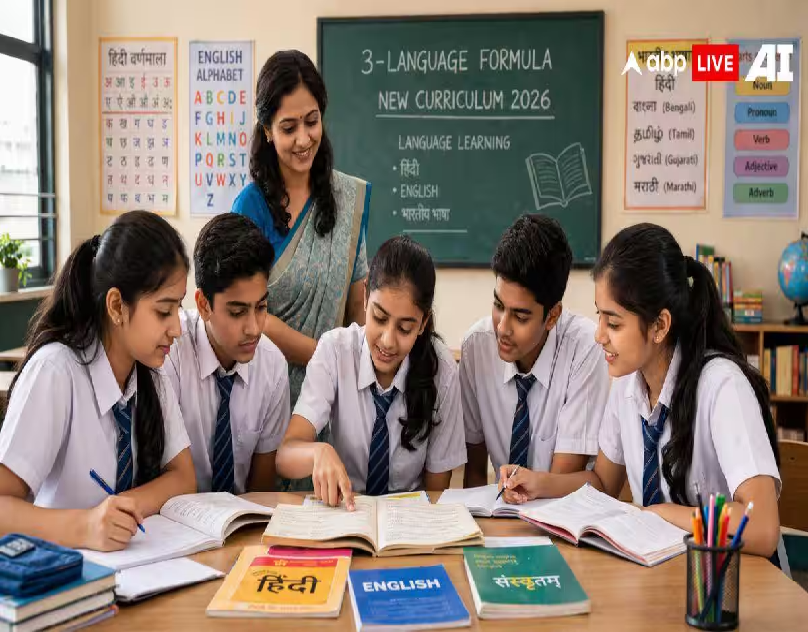
One of the most prominent features of the new framework is the structured implementation of the three-language formula. Under this model, students will study three languages, categorised as R1, R2 and R3, ensuring both linguistic diversity and cognitive enrichment. Notably, at least two of these languages must be native to India, reinforcing the policy’s emphasis on preserving and promoting indigenous languages.
From the 2026–27 academic session, the third language (R3) will become mandatory from Class 6 onwards. This marks a departure from earlier practices in which the third language was often treated as optional or assessed less rigorously. The phased implementation ensures that students currently entering middle school will be the first cohort to fully experience this multilingual framework throughout their academic journey.
The rationale behind this shift is both pedagogical and cultural. Research consistently indicates that multilingual education enhances cognitive flexibility, improves problem-solving skills and fosters a deeper appreciation of diverse cultures. By mandating the study of at least two Indian languages, the policy seeks to strengthen national integration while equipping students with essential communication skills in an increasingly interconnected world.
Importantly, the CBSE has also introduced a degree of flexibility within the framework. Students returning from international schools, where certain languages may not be available domestically, may be granted exemptions under specific conditions. However, such students will still be required to fulfil the overall subject requirements laid down by the board.
While the full impact of the three-language formula will only be realised when the current Class 6 cohort reaches board examinations in 2031, its early introduction represents a foundational shift in how language education is perceived, not merely as a subject, but as a tool for holistic development.
Dual-Level Mathematics and Science: Catering to Diverse Aptitudes
Equally significant is the introduction of a two-tier system in Mathematics and Science at the secondary level. Beginning in Class 9, students will be required to undertake a standard-level examination and may also attempt an advanced-level paper for deeper engagement with the subject.
The structure is designed to accommodate varying levels of aptitude and interest among students. The standard examination, comprising 80 marks over three hours, will be mandatory for all learners. In addition, students who wish to pursue a more rigorous academic trajectory may opt for an advanced paper carrying 25 marks, intended to assess higher-order thinking and conceptual understanding.
This dual-level approach represents a departure from the traditional ‘one-size-fits-all’ model that has long characterised Indian secondary education. By offering differentiated pathways, the CBSE aims to reduce academic pressure while simultaneously nurturing excellence among students with a strong inclination towards STEM subjects.
Notably, the marks obtained in the advanced paper will not contribute to the overall aggregate score. Instead, successful candidates will receive a separate certification, thereby recognising their advanced proficiency without penalising those who choose not to opt for the additional assessment.
Such a system aligns closely with global best practices, where tiered assessments are commonly used to accommodate diverse learner profiles. It also resonates with the NEP’s emphasis on personalised learning pathways and competency-based evaluation.
A Broader Pedagogical Shift: From Rote Learning to Conceptual Understanding
Beyond these headline reforms, the new curriculum signals a deeper transformation in the philosophy of education. The CBSE’s revised framework places a strong emphasis on conceptual clarity, experiential learning and real-world application of knowledge.
Subjects such as Mathematics and Science are being reoriented to prioritise inquiry-based learning, encouraging students to explore, question and analyse rather than merely memorise. Similarly, language education will focus on developing comprehensive communication skills across listening, speaking, reading and writing.
The curriculum is also structured around eight key learning areas, including languages, sciences, social sciences, vocational education, art education and physical well-being. This holistic design underscores the shift from a purely academic focus to a more balanced and interdisciplinary approach to education.
In addition, emerging domains such as computational thinking and artificial intelligence are being integrated into the curriculum, reflecting the growing importance of digital literacy in the modern world. These subjects are expected to become increasingly prominent in the coming years, further enhancing students’ readiness for future careers.
Challenges in Implementation: Bridging the Gap Between Policy and Practice
While the reforms have been widely welcomed as progressive and forward-looking, their implementation is not without challenges. One immediate concern pertains to the availability of updated textbooks aligned with the new curriculum. Reports indicate that schools may initially have to rely on draft syllabi and supplementary materials until official textbooks are released.
Such transitional issues highlight the complexities involved in rolling out large-scale educational reforms across a diverse and expansive system like India’s. Teachers will require adequate training to adapt to new pedagogical approaches, while schools will need to ensure that their infrastructure and resources align with the revised framework.
Moreover, the success of the three-language formula will depend significantly on the availability of qualified language teachers and appropriate learning materials, particularly for less commonly taught languages.
Implications for Students, Parents and Educators
For students, these changes herald a more personalised and less rigid learning experience. The option to choose advanced-level subjects allows learners to pursue their interests without being constrained by uniform expectations. At the same time, the emphasis on multilingualism equips them with valuable skills that extend beyond the classroom.
Parents, on the other hand, may need to recalibrate their expectations and support systems, recognising that academic success will increasingly be defined by competencies and skills rather than rote performance.
Educators will play a pivotal role in translating policy into practice. Their ability to adopt innovative teaching methods, foster critical thinking and create inclusive learning environments will ultimately determine the effectiveness of these reforms.
Looking Ahead: A Step Towards Future-Ready Education
The CBSE’s curriculum overhaul represents more than just a set of structural changes; it embodies a paradigm shift in the way education is conceptualised in India. By embracing multilingualism, flexibility and competency-based learning, the board is laying the groundwork for a system that is both globally relevant and locally rooted.
While implementation challenges are inevitable, the long-term vision is clear: to create an education system that nurtures well-rounded individuals capable of thriving in a complex and rapidly evolving world.
As the 2026–27 academic session approaches, all stakeholders, i.e. - students, parents, educators and policymakers, will need to collaborate closely to ensure a smooth transition. If executed effectively, these reforms have the potential to redefine the contours of secondary education in India, setting a benchmark for innovation and inclusivity in the years to come.