JEE Main 2026 Paper 2 Final Answer Key Released by NTA
JEE Main 2026 Paper 2 Final Answer Key Released: Implications, Process and What Lies Ahead
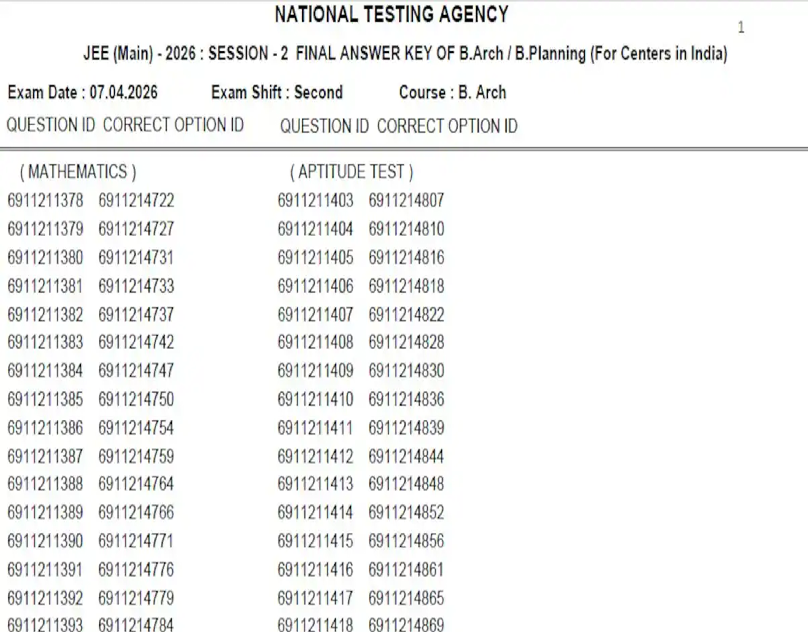
In a significant update for architecture and planning aspirants across the country, the National Testing Agency (NTA) has released the final answer key for JEE Main 2026 Session 2 Paper 2. This development marks a decisive step in the examination cycle, bringing clarity to candidates who appeared for the B.Architecture and B.Planning papers and are now awaiting their results.
The publication of the final answer key is not merely procedural; it is a critical milestone that directly influences score computation, ranking and eventual admission outcomes. For thousands of candidates, it provides both closure on the examination phase and a clearer sense of their academic standing.
Understanding the Role of the Final Answer Key
The final answer key serves as the authoritative reference against which candidates’ responses are evaluated. Unlike the provisional key, which is open to scrutiny and challenge, the final version reflects the conclusions drawn after a rigorous review process by subject experts.
In the case of JEE Main 2026 Paper 2, the NTA released the final answer key after carefully examining objections raised by candidates against the provisional version. Notably, no changes were made in the final iteration, indicating that the challenges submitted did not warrant revisions.
This outcome underscores the robustness of the initial evaluation and signals the closure of the objection phase. Once the final answer key is published, it becomes binding and no further grievances or re-evaluations are entertained.
Accessing the Final Answer Key
Candidates can access the final answer key through the official NTA JEE Main portal. The document is typically made available in PDF format, allowing for easy download and reference.
The process of accessing the answer key is straightforward. Candidates need to navigate to the official website, locate the relevant notification under the public notices section, and download the document. This accessibility ensures that all candidates, regardless of location, can verify their answers with minimal difficulty.
Importantly, the answer key can be used independently of login credentials, enabling quick and open access. This approach reflects the NTA’s broader emphasis on transparency and user-friendly digital processes.
The Journey from Provisional to Final Key
The release of the final answer key is preceded by a structured sequence of steps designed to ensure fairness and accuracy. Initially, the provisional answer key is published, accompanied by candidates’ response sheets.
This stage allows candidates to cross-check their answers and raise objections if discrepancies are identified. Typically, a nominal fee is charged for each challenge submitted, ensuring that objections are serious and substantiated.
Once the objection window closes, a panel of subject matter experts reviews all submissions. Valid objections may lead to corrections, while invalid ones are dismissed. The outcome of this review is reflected in the final answer key.
In the case of JEE Main 2026 Paper 2, the absence of changes in the final key suggests that the provisional version was largely accurate and no challenges met the threshold for modification.
Significance for Score Calculation
The final answer key plays a central role in determining candidates’ scores. JEE Main follows a standard marking scheme, where correct answers are awarded marks and incorrect ones incur penalties.
By comparing their responses with the final answer key, candidates can estimate their probable scores with a high degree of accuracy. This exercise is particularly valuable in the interim period before the official results are declared.
Moreover, since the final answer key is definitive, the scores derived from it form the basis for generating percentile scores, ranks and eligibility for subsequent stages such as JEE Advanced or institutional admissions.
Examination Overview: Paper 2 in Focus
JEE Main Paper 2 caters specifically to candidates aspiring for undergraduate programmes in architecture (B.Arch) and planning (B.Planning). Unlike Paper 1, which focuses on engineering disciplines, Paper 2 assesses a distinct set of competencies.
The examination typically includes sections on mathematics, aptitude, and drawing or planning-based questions, depending on the specific course. This multidimensional structure ensures that candidates are evaluated not only on analytical ability but also on creativity and spatial understanding.
In 2026, a substantial number of candidates registered for Paper 2, reflecting sustained interest in architecture and planning as academic and professional pathways. The examination witnessed a significant participation rate, further underscoring its importance in the higher education landscape.
Transparency and Trust in the Evaluation Process
The release of the final answer key exemplifies the NTA’s commitment to transparency in large-scale examinations. By allowing candidates to challenge the provisional key and by publishing the final version openly, the agency fosters trust in the evaluation process.
Such measures are particularly important in competitive examinations like JEE Main, where even minor discrepancies can have significant implications for candidates’ futures. The structured approach, provisional release, objection window, expert review and final publication ensure that the process is both fair and accountable.
Furthermore, the digital dissemination of answer keys eliminates logistical barriers, enabling candidates across the country to access information simultaneously.
What Comes Next: Results and Admissions
With the final answer key now released, the next step in the examination cycle is the declaration of results. The NTA prepares results based on the final answer key, ensuring that all candidates are evaluated against a uniform standard.
The results will include crucial details such as raw scores, percentile scores, and All India Ranks. These metrics play a pivotal role in determining candidates’ eligibility for admission to prestigious institutions, including National Institutes of Technology (NITs), Indian Institutes of Information Technology (IIITs) and other centrally funded technical institutions.
For architecture aspirants, scores from Paper 2 are instrumental in securing admission to B.Arch programmes, while planning candidates rely on their performance in B.Planning assessments.
Candidates are advised to monitor the official website regularly for updates regarding result announcements, counselling schedules and admission procedures.
Broader Implications for Aspirants
The release of the final answer key also offers candidates an opportunity for reflection and planning. For those who perform well, it marks the beginning of the next phase, choosing institutions, participating in counselling and preparing for academic transitions.
For others, it provides valuable insights into performance gaps, which can inform future preparation strategies. Competitive examinations often serve as learning experiences and the ability to analyse one’s performance is crucial for long-term success.
Additionally, the transparency of the process reinforces confidence among aspirants, encouraging them to engage with the system more actively and responsibly.
Digital Efficiency in Modern Examination Systems
The JEE Main 2026 process highlights the increasing role of digital infrastructure in examination management. From online applications and computer-based testing to digital answer keys and result dissemination, technology has streamlined every stage of the process.
This digital transformation not only enhances efficiency but also reduces the scope for errors and delays. It enables real-time updates, quick access to information, and seamless communication between the examination authority and candidates.
The availability of answer keys in downloadable formats, for instance, allows candidates to engage with their performance independently, without relying on intermediaries.
Final Reflections
The release of the JEE Main 2026 Paper 2 final answer key marks a defining moment in the examination timeline. It represents the culmination of a meticulous evaluation process and sets the stage for the declaration of results. For candidates, it offers both clarity and direction, clarity in terms of performance and direction in terms of future steps. Whether it leads to admission into a preferred institution or serves as a stepping stone for further preparation, the significance of this milestone cannot be overstated. As the academic landscape continues to evolve, processes such as these, transparent, structured and digitally enabled, will play an increasingly vital role in shaping educational outcomes. For now, aspirants can turn their attention to the forthcoming results, carrying forward both the insights and aspirations that this journey has yielded.