NTA JIPMAT 2026 Registration Ends Today for IIM Admissions
NTA Closes JIPMAT 2026 Registration Window Today for IIM Jammu and IIM Bodh Gaya Admissions
The National Testing Agency (NTA) is set to close the registration process for the Joint Integrated Programme in Management Admission Test (JIPMAT) 2026 today, May 13, bringing the application window to an end for students aspiring to secure admission into the five-year Integrated Programme in Management (IPM) offered by the Indian Institute of Management Jammu and the Indian Institute of Management Bodh Gaya. Candidates who have not yet completed their applications have been advised to do so through the official JIPMAT portal before the deadline expires.
The entrance examination, conducted annually by the NTA, has steadily emerged as one of the most significant undergraduate management admission tests in India. Designed specifically for students seeking direct entry into integrated management programmes immediately after Class 12, JIPMAT has increasingly attracted candidates aiming to begin professional management education at an early stage of their academic journey.
This year’s registration process, which commenced in April, witnessed considerable attention from management aspirants across the country, reflecting the growing popularity of integrated management programmes among higher secondary students.
JIPMAT Continues to Gain Importance in India’s Management Education Landscape
The Joint Integrated Programme in Management Admission Test serves as the gateway for admission into the five-year IPM programmes offered by IIM Jammu and IIM Bodh Gaya. These integrated courses combine undergraduate and postgraduate management education within a single academic structure, allowing students to progress directly from school-level education into advanced management studies.
Unlike traditional MBA pathways that require graduation before admission into management education, IPM programmes are specifically designed for students completing Class 12. The structure aims to develop managerial aptitude, analytical reasoning, communication skills and leadership orientation from an early academic stage.
Over the past decade, integrated management programmes have gained substantial prominence within India’s evolving higher education ecosystem. Initially popularised by IIM Indore, the IPM model has since expanded across several Indian Institutes of Management, gradually emerging as an alternative route into elite management education.
The increasing competitiveness surrounding JIPMAT reflects this broader transformation. Students today are no longer waiting until graduation to pursue management-oriented careers. Instead, many are opting for specialised programmes immediately after school, driven by changing industry expectations and growing awareness regarding early professional development.
Registration Window Ends Today
According to the official schedule, the application portal for JIPMAT 2026 will remain active only until the end of the day on May 13. Candidates who complete the registration process before the deadline will still be able to finalise fee payment transactions until May 14.
Additionally, the NTA has announced that a correction window will remain open from May 15 to May 17, allowing applicants to rectify errors in submitted forms.
The examination itself is scheduled to be conducted on June 7, 2026, in computer-based mode across multiple centres nationwide. The test will be held in a single shift from 3:00 PM to 5:30 PM.
Students are being advised not to delay the submission process until the final hours, as official examination portals frequently experience heavy traffic close to deadlines. Educational experts often note that technical slowdowns and payment gateway delays become increasingly common during the final stages of major national-level registrations.
Examination Pattern and Structure
JIPMAT 2026 will consist of 100 multiple-choice questions carrying a total of 400 marks. The examination will assess candidates across three broad sections: Quantitative Aptitude, Data Interpretation and Logical Reasoning, and Verbal Ability with Reading Comprehension.
The examination will be conducted entirely in English and will follow a computer-based testing format.
The structure of the examination reflects the competencies generally expected within management education frameworks. Quantitative Aptitude evaluates mathematical reasoning and numerical problem-solving ability, while the logical reasoning component assesses analytical thinking and decision-making skills. The verbal ability section, meanwhile, focuses on language proficiency, comprehension and communication aptitude.
Education specialists frequently point out that integrated management entrance examinations are increasingly designed not merely to test memorisation but to evaluate cognitive flexibility, interpretative ability and analytical thinking.
Eligibility and Application Process
Candidates who have completed or are appearing for Class 12 examinations in 2026 are eligible to apply for JIPMAT, subject to fulfilling the criteria prescribed by participating institutes.
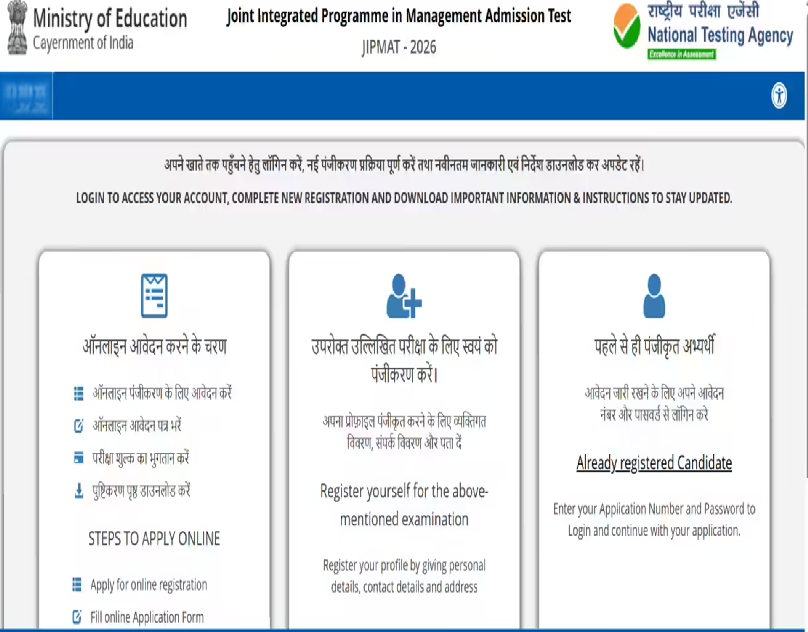
The application process is conducted entirely online through the official NTA examination portal. Students are required to complete registration, upload necessary documents, fill in academic details and submit examination fees digitally.
As per the official guidelines, the application fee for General and OBC category candidates is ₹2200, while candidates belonging to SC, ST, PwD, PwBD, Gen-EWS and transgender categories are required to pay ₹1100.
The fee payment can be completed through debit cards, credit cards, internet banking or UPI-enabled digital platforms.
Educational counsellors have repeatedly advised applicants to carefully verify uploaded documents, spelling of personal details and category information before final submission, as discrepancies can create complications during later admission stages.
Why Integrated Programmes Are Becoming Increasingly Popular
The growing interest in JIPMAT also reflects changing perceptions surrounding management education in India.
Traditionally, management studies were viewed primarily as postgraduate pursuits pursued after engineering, commerce or humanities degrees. However, evolving corporate structures and increasing professional specialisation have altered this trajectory considerably.
Integrated management programmes now attract students seeking long-term academic continuity, institutional prestige and structured managerial training immediately after school education.
One of the major attractions of IPM programmes lies in their multidisciplinary academic design. Students are exposed not only to business and management subjects but also to economics, statistics, communication, behavioural sciences and liberal arts during the initial years of study.
This broader educational framework aligns with contemporary higher education philosophies emphasising interdisciplinary learning and skill diversification.
For many students, the possibility of entering the IIM ecosystem directly after Class 12 also carries considerable aspirational value. Admission into prestigious institutions at an early stage often provides access to stronger academic networks, internship opportunities and professional exposure.
Intensifying Competition Among Aspirants
The popularity of JIPMAT has simultaneously intensified competition levels.
Although only two IIMs currently participate through the JIPMAT route, the number of applicants has steadily increased over recent years. Reports suggest that the combined seat availability across IIM Jammu and IIM Bodh Gaya remains relatively limited in comparison to the growing applicant pool.
As a result, aspirants frequently begin preparation months in advance, often alongside Class 12 board examination preparation. Coaching institutions and online education platforms have also expanded specialised IPM entrance preparation modules in response to rising demand.
Education analysts note that undergraduate management admissions are gradually beginning to mirror the competitive intensity traditionally associated with engineering and medical entrance examinations.
This trend reflects broader shifts in career aspirations among younger students, many of whom are prioritising business leadership, entrepreneurship and corporate careers earlier than previous generations.
Digital Examination Ecosystem Expands Further
The JIPMAT registration process also highlights the increasing digitisation of India’s examination infrastructure.
From application submission and fee payment to admit card downloads and result publication, almost every stage of the examination cycle is now managed online. This transition has improved accessibility for students across different regions while significantly reducing procedural delays.
However, the digitalisation of entrance examinations has also increased expectations surrounding cybersecurity, server reliability and platform efficiency, particularly at a time when national examination systems are facing heightened scrutiny over transparency and operational management.
Given recent controversies surrounding examination integrity in other national-level tests, authorities are likely to remain under pressure to ensure the smooth and credible conduct of JIPMAT 2026.
What Candidates Should Focus on Next
With the registration deadline concluding today, aspirants are now expected to shift attention fully towards examination preparation.
Academic mentors often recommend that candidates maintain balanced preparation strategies covering all three sections rather than focusing disproportionately on any single area. Time management, mock tests and comprehension-based practice continue to remain central components of effective preparation for management entrance examinations.
Equally important is maintaining consistency during the final weeks before the examination. Since JIPMAT evaluates aptitude rather than rote learning, candidates are generally encouraged to prioritise conceptual clarity and problem-solving efficiency over excessive memorisation.
Students should also continue monitoring the official NTA portal for updates regarding examination city intimation slips, admit cards and additional procedural instructions.
A Defining Opportunity for Young Management Aspirants
For thousands of students across India, JIPMAT 2026 represents more than a competitive entrance test. It serves as an early gateway into some of the country’s most prestigious management institutions and reflects the growing transformation of India’s undergraduate education landscape.
As the registration window closes and preparations intensify, the coming weeks are likely to determine the academic direction of a new generation of aspiring business leaders, analysts and management professionals.
In many ways, the growing prominence of examinations such as JIPMAT signals a larger shift within Indian higher education, one where students are increasingly making specialised career decisions earlier, navigating competitive environments sooner and seeking professional pathways that align with rapidly evolving economic and institutional realities.