JNCU Releases BA, BSc, BCom Part I, II, III and BBA Results 2026 Under NEP Framework
The declaration of undergraduate results often marks a defining moment in a student’s academic journey, and the recent announcement by Jananayak Chandrashekhar University (JNCU), Ballia is no exception. The university has released the results for B.A, B.Sc, B.Com Part I, II, III and BBA examinations conducted under the framework of the National Education Policy (NEP) for March 2026. This development brings both clarity and closure for thousands of students awaiting their academic outcomes.
For many, these results signify not merely the culmination of an examination cycle but a transition point, whether towards higher studies, professional pursuits, or the next academic phase.
Understanding JNCU and Its Academic Framework
Jananayak Chandrashekhar University, located in Ballia, Uttar Pradesh, has steadily emerged as a significant institution within the state’s higher education landscape. With a growing network of affiliated colleges and a diverse range of undergraduate and postgraduate programmes, the university plays a vital role in shaping academic trajectories across the region.
In recent years, the adoption of the National Education Policy (NEP) 2020 has introduced a transformative shift in the university’s academic structure. The NEP framework emphasises multidisciplinary learning, continuous assessment, and flexibility in course progression. JNCU’s examination and result processes are increasingly aligned with these principles, reflecting a more holistic approach to evaluation.
Result Declaration: Timeline and Phased Approach
The release of results for March 2026 examinations is part of a broader, phased declaration process undertaken by the university. According to available updates, JNCU began releasing results for various undergraduate and postgraduate courses from late January 2026, with announcements continuing through February and March.
This staggered approach allows the university to ensure accuracy and thorough verification of results before publication. It also reflects the complexity of managing examinations across multiple courses, semesters, and affiliated institutions.
The inclusion of programmes such as B.A, B.Sc, B.Com, and BBA within the March release underscores the university’s ongoing efforts to streamline its evaluation and reporting systems under the NEP framework.
Accessing Results: A Digital-First Approach
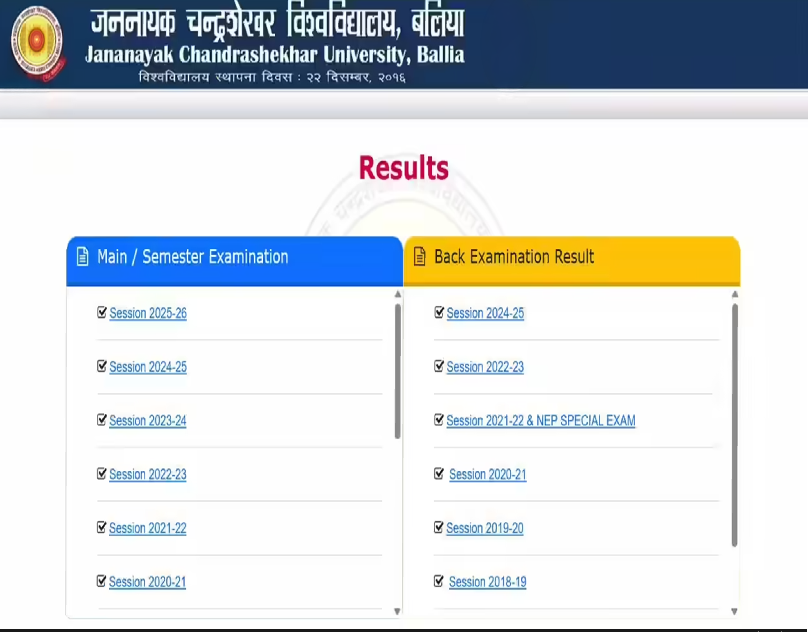
Students who appeared for the examinations can access their results through the official university portal by entering their roll numbers and other required credentials. The digital interface is designed to provide seamless access, enabling students to view and download their scorecards with ease.
The university’s result portal accommodates both current and previous examination sessions, ensuring continuity and accessibility for students across academic cycles.
This digital-first approach aligns with broader trends in higher education, where institutions are increasingly leveraging technology to enhance transparency, efficiency, and student convenience.
NEP and the Changing Nature of Assessment
One of the most notable aspects of the March 2026 results is their alignment with the National Education Policy 2020. The NEP introduces a paradigm shift in how students are assessed, moving away from purely examination-centric models towards continuous and comprehensive evaluation.
At JNCU, this is reflected in the integration of internal assessments, semester-based evaluations, and credit-based progression systems.
Such an approach ensures that students are evaluated not only on their performance in final examinations but also on their consistent engagement throughout the academic term. It encourages deeper learning, critical thinking, and skill development, attributes that are increasingly valued in both academic and professional contexts.
Implications for Students Across Courses
For students enrolled in B.A, B.Sc, B.Com, and BBA programmes, the declaration of results carries varied implications depending on their stage of study.
- Part I students gain insight into their foundational academic performance, which will shape their approach in subsequent years.
- Part II students find themselves at a midpoint, where results often influence decisions regarding specialisation and future planning.
- Part III students, on the other hand, stand at the threshold of graduation, with their results playing a decisive role in determining career or postgraduate opportunities.
For BBA students, in particular, the results hold added significance, as the programme is closely aligned with industry-oriented skills and professional readiness.
Ensuring Accuracy and Addressing Discrepancies
While the release of results is a moment of anticipation and relief, it also necessitates careful scrutiny on the part of students. Candidates are advised to verify all details on their scorecards, including personal information, subject-wise marks, and overall grades.
In instances where discrepancies are identified, students must promptly contact the university or their respective colleges to initiate corrective measures. The availability of formal channels for grievance redressal ensures that such concerns can be addressed in a structured and timely manner.
The Broader Context: Higher Education in Transition
The release of JNCU’s March 2026 results must also be viewed within the larger context of India’s evolving higher education ecosystem. Universities across the country are undergoing significant transformation, driven by policy reforms, technological advancements, and changing student expectations.
The adoption of the NEP framework, in particular, has catalysed a shift towards flexibility, interdisciplinarity, and skill-based learning. Institutions like JNCU are at the forefront of implementing these changes, adapting their academic and administrative processes to align with contemporary educational paradigms.
Opportunities Beyond Results
For many students, the announcement of results is closely followed by decisions regarding the next phase of their journey. Graduating students may explore postgraduate programmes, competitive examinations, or entry into the workforce. Others may seek internships, skill development courses, or entrepreneurial ventures.
The evolving job market places increasing emphasis on adaptability, critical thinking, and domain-specific expertise. As such, students are encouraged to view their results not as an endpoint but as a stepping stone towards broader aspirations.
Staying Informed: The Role of Official Updates
In an environment where information is constantly evolving, it is imperative for students to rely on official sources for updates related to results, re-evaluation processes, and academic schedules. The university’s official website serves as the primary platform for such announcements, ensuring authenticity and accuracy.
Regular engagement with these updates allows students to remain informed and proactive, particularly during transitional phases such as admissions, examinations, and result declarations.
Conclusion
The release of B.A, B.Sc, B.Com Part I, II, III and BBA results for March 2026 by Jananayak Chandrashekhar University represents a significant academic milestone for students across its affiliated institutions. Beyond the immediate outcomes, it reflects the university’s commitment to timely evaluation, transparency, and alignment with national educational reforms.
As students reflect on their performance and chart their future paths, the emphasis must remain on continuous learning, resilience, and adaptability. In an era of rapid change, these qualities will prove indispensable, not only in academic pursuits but in the broader journey of personal and professional growth.
Ultimately, the results are not merely a measure of past effort but a foundation upon which future ambitions can be built.