KEAM 2026 Results Declared: Check Engineering Scores Online
KEAM 2026 Results Declared: Kerala’s Engineering Aspirants Prepare for the Next Academic Leap
The declaration of the Kerala Engineering, Architecture and Medical (KEAM) 2026 results has marked a significant moment for thousands of students across Kerala and beyond, bringing an end to weeks of anticipation surrounding one of the state’s most prominent entrance examinations. Conducted by the Commissioner for Entrance Examinations (CEE), Kerala, the KEAM examination remains a critical gateway for admission into engineering, architecture and pharmacy programmes offered by institutions across the state.
With scorecards now officially available on the CEE Kerala portal, candidates are preparing for the next and perhaps most decisive phase of the admission cycle, the engineering rank list, counselling procedures and eventual seat allotment.
The release of the KEAM results is more than a procedural academic announcement. For students, it represents the culmination of months of rigorous preparation, competitive pressure and emotional endurance. For families, it signals the beginning of important educational decisions that may shape professional trajectories for years to come.
A Crucial Examination in Kerala’s Higher Education Ecosystem
KEAM has long occupied a central position within Kerala’s higher education structure. Administered by the Commissioner for Entrance Examinations, the examination facilitates admission into several professional degree programmes, particularly engineering and pharmacy courses, across government, aided and private institutions in the state.
Unlike many national-level entrance tests that operate within a single evaluation framework, KEAM follows a more nuanced admission model, particularly for engineering aspirants. While the entrance examination plays a crucial role, the final engineering rank list is prepared through a combination of normalised entrance scores and Plus Two marks in Mathematics, Physics and Chemistry. This dual-weightage system attempts to balance aptitude demonstrated in competitive examinations with consistency in school-level academics.
This year, the KEAM 2026 examinations for Engineering and Pharmacy courses were conducted between April 17 and April 22 across multiple centres within Kerala and outside the state. The examination witnessed participation from a substantial number of aspirants seeking admission into highly competitive professional courses.
Digital Accessibility and Streamlined Result Distribution
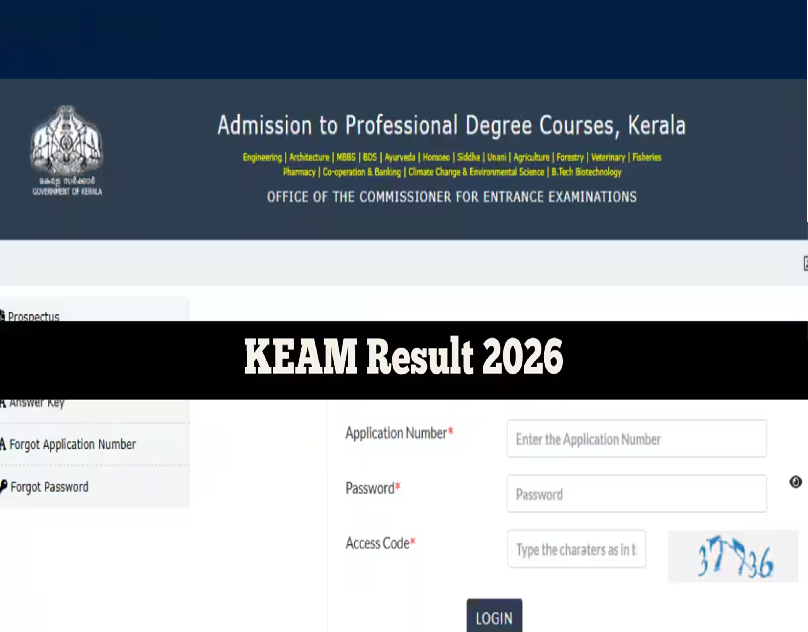
The results have been published online through the official CEE Kerala portal, enabling candidates to download their scorecards using their application numbers, passwords and security credentials. The scorecards contain important details, including the candidate’s normalised score, qualifying status, category information and application details.
The increasing digitisation of examination systems in India has transformed the way educational boards and entrance authorities communicate with students. In previous decades, candidates often relied on physical notices, newspapers or institutional announcements to access examination outcomes. Today, digital portals provide instantaneous access to results, counselling schedules, answer keys and admission updates.
This transformation reflects a broader shift within India’s education administration ecosystem, where efficiency, transparency and accessibility are increasingly prioritised. By integrating online scorecards and digital candidate dashboards, examination authorities are significantly reducing administrative delays and simplifying communication processes.
At the same time, students are advised to verify every detail mentioned in the scorecard carefully. Errors in category details, marks or personal information can create complications during counselling and admission stages. Educational experts, therefore, continue to stress the importance of reviewing official documents meticulously before proceeding with future admission formalities.
The Significance of the Engineering Rank List
While the result declaration is undoubtedly an important milestone, the publication of the KEAM engineering rank list remains the most decisive stage for engineering aspirants. The rank list is expected to be released separately after the submission and standardisation of Class 12 marks.
The preparation of the engineering rank list follows a 50:50 weightage model, where equal importance is assigned to KEAM entrance scores and qualifying examination marks. This methodology is intended to ensure that admissions are not determined solely by performance in a single competitive examination.
Such hybrid evaluation systems have increasingly gained attention within educational policy discussions. Critics of purely entrance-based admissions often argue that one-day examinations may not accurately reflect a student’s overall academic capabilities. Incorporating school-level performance attempts to create a more balanced framework that rewards sustained academic consistency alongside competitive aptitude.
However, the model also introduces additional complexity into the admission process. Students must ensure the timely submission of Plus Two marks and remain attentive to official notifications regarding standardisation procedures and rank publication timelines.
Counselling and Seat Allotment: The Next Critical Phase
Following the publication of the rank list, qualified candidates will participate in the KEAM counselling and seat allotment process, expected to commence in July. During counselling, candidates will be required to register preferences, select institutions and courses, upload necessary documents and participate in multiple allotment rounds.
For many students, this stage can prove equally stressful as the examination itself. Admission decisions involve careful consideration of numerous factors, including institutional reputation, branch preference, career prospects, geographical convenience and financial affordability.
Engineering remains one of the most sought-after professional pathways in Kerala, particularly in disciplines such as Computer Science, Electronics, Artificial Intelligence and Data Science. Simultaneously, emerging fields linked to sustainability, robotics and interdisciplinary technology programmes are gradually attracting increased student interest.
The counselling process, therefore, represents more than a mechanical allocation exercise; it is effectively a transition point where students begin shaping their professional identities and long-term career trajectories.
The Psychological Weight of Competitive Examinations
Behind every entrance examination statistic lies a deeply human story of ambition, anxiety and perseverance. Competitive examinations in India continue to carry immense emotional significance, particularly within households where education is closely associated with upward mobility and financial stability.
For many KEAM aspirants, preparation involves months of coaching classes, intensive revision schedules and constant performance evaluation. The declaration of results consequently evokes a wide range of emotions: relief, celebration, disappointment and uncertainty.
Educational psychologists increasingly caution against allowing examination outcomes to define personal worth or future potential. While entrance examinations undoubtedly influence academic opportunities, they cannot fully capture creativity, resilience, adaptability or emotional intelligence, qualities that have become equally important in modern professional environments.
Parents and educators, therefore, play a crucial role in ensuring that students interpret results constructively rather than catastrophically. A healthy educational ecosystem must recognise achievement while simultaneously fostering emotional balance and long-term perspective.
Kerala’s Educational Reputation and Competitive Culture
Kerala has historically maintained a strong reputation for educational attainment, literacy and academic participation. Competitive entrance examinations such as KEAM form an integral component of this broader educational culture, where students often demonstrate high levels of academic engagement and discipline.
The state’s emphasis on technical and professional education has contributed significantly to the growth of engineering institutions and technology-oriented career pathways. Consequently, KEAM continues to occupy a highly respected position within Kerala’s academic framework.
At the same time, discussions surrounding entrance examinations have evolved considerably in recent years. Increasing attention is now being directed towards student well-being, examination pressure and the need for more holistic educational models.
The National Education Policy 2020 has further intensified conversations regarding competency-based learning, flexibility in higher education and reduced dependence on rote memorisation. While competitive examinations remain essential components of admission systems, educational reforms increasingly advocate broader definitions of merit and capability.
Technology, Transparency and the Future of Entrance Examinations
The administration of KEAM 2026 also reflects the growing technological modernisation of entrance examinations in India. From digital candidate portals and online answer keys to automated score normalisation and electronic counselling systems, technology has become central to examination governance.
Such systems enhance transparency and operational efficiency while reducing procedural ambiguity. Candidates today have greater access to information regarding answer keys, score calculations, counselling schedules and admission guidelines than ever before.
However, digital transformation also introduces new responsibilities. Students must remain digitally aware, regularly monitor official portals and ensure careful handling of login credentials and documentation throughout the admission cycle.
As India’s higher education ecosystem becomes increasingly technology-driven, digital literacy is gradually becoming an essential component of academic preparedness itself.
Beyond Scores: The Beginning of New Academic Journeys
The declaration of the KEAM 2026 results represents both an ending and a beginning. It concludes a demanding examination cycle while simultaneously initiating the next chapter in thousands of students’ academic journeys.
For some candidates, the results will affirm months of disciplined preparation and open pathways into prestigious engineering institutions. For others, the outcome may require reassessment, alternative planning or renewed determination. Yet in either case, the significance of the examination extends beyond numerical scores alone.
Education is ultimately a continuous process of growth, adaptation and discovery. Competitive examinations may determine immediate opportunities, but they cannot singularly define intelligence, ambition or future success.
As Kerala’s students prepare for counselling and admission procedures, the KEAM 2026 result stands as a reminder of both the intensity and possibility embedded within India’s educational landscape, a landscape increasingly shaped by digital innovation, academic aspiration and evolving definitions of merit.