KVS and NVS Tier-2 Answer Key 2026 Released Online
KVS and NVS Tier-2 Answer Key 2026 Released as Recruitment Process Enters Crucial Phase
The release of provisional answer keys often marks one of the most closely scrutinised stages in any large-scale recruitment examination. For thousands of aspirants who appeared for the Kendriya Vidyalaya Sangathan (KVS) and Navodaya Vidyalaya Samiti (NVS) Tier-2 recruitment examinations in 2026, that moment has now arrived. Both institutions have officially published the provisional answer keys along with scanned OMR response sheets, enabling candidates to review their performance and raise objections where necessary.
The objection window has been opened until May 17, giving candidates a limited but significant opportunity to challenge discrepancies in the provisional responses before final answer keys are issued. The development has intensified activity among aspirants preparing for the subsequent stages of recruitment, particularly as both KVS and NVS appointments remain among the most sought-after opportunities within India’s school education system.
Importance of KVS and NVS Recruitment Examinations
Recruitment drives conducted by Kendriya Vidyalaya Sangathan and Navodaya Vidyalaya Samiti occupy a distinctive place within India’s educational employment landscape. Both institutions operate extensive school networks under the Ministry of Education and are widely regarded for their structured academic systems, national reach and relatively stable employment conditions.
KVS manages centrally funded schools primarily catering to children of transferable central government employees, while NVS oversees residential Jawahar Navodaya Vidyalayas designed to provide quality education to talented rural students across the country.
Consequently, recruitment examinations for teaching and non-teaching positions within these institutions attract massive participation from graduates, educators and administrative aspirants nationwide. The Tier-2 examination forms a particularly important component of the selection process for several posts, making the release of provisional answer keys a development of considerable relevance.
Provisional Answer Keys Now Available
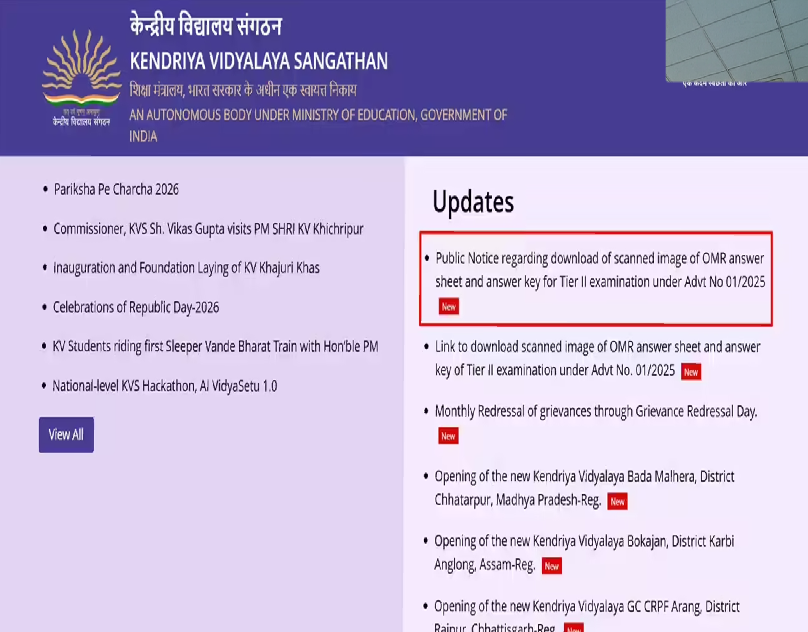
According to the official notification, candidates who appeared for the Tier-2 examinations can now access the provisional answer key and their individual scanned OMR sheets through the official recruitment portal.
The publication of answer keys serves multiple purposes within competitive recruitment systems. Most immediately, it allows candidates to estimate probable scores before the official declaration of results. Equally importantly, it introduces a mechanism for transparency by enabling aspirants to scrutinise the correctness of officially proposed answers.
Candidates are required to log in using their credentials in order to view and download the documents. Authorities have advised applicants to carefully review both the answer key and their recorded responses before submitting objections.
Objection Window Open Until May 17
One of the most significant aspects of the current notification is the opening of the objection submission window. Candidates who identify discrepancies or believe that particular answers have been incorrectly evaluated may challenge the provisional responses until May 17.
The objection mechanism has become an increasingly standard feature of competitive examinations in India over the past decade. Recruitment authorities now routinely allow candidates to contest provisional answers to strengthen procedural transparency and reduce disputes after the result declaration.
However, experts frequently caution candidates against filing objections impulsively. Successful challenges generally require strong academic justification, credible supporting references and precise identification of disputed questions. Frivolous objections not only increase administrative burden but may also result in financial penalties where objection fees are involved.
The final answer key is expected to be published after all submitted objections are reviewed by subject experts and examination authorities.
Transparency and the Evolving Recruitment Process
The release of scanned OMR sheets alongside provisional answer keys reflects broader changes in the administration of competitive examinations across India. Recruitment bodies increasingly face public scrutiny regarding procedural fairness, evaluation accuracy and transparency in result preparation.
By allowing candidates to view their recorded responses directly, institutions reduce ambiguity and increase confidence in the evaluation process. Such measures have become especially important in high-volume recruitment examinations where even minor discrepancies can generate widespread concern among aspirants.
Educational recruitment authorities across India have gradually adopted more digitised and transparent systems, including online application management, computer-based examinations, biometric verification and digital result publication. These changes reflect the growing scale and complexity of national recruitment exercises.
Why These Posts Continue to Attract Aspirants
The sustained popularity of KVS and NVS recruitment examinations cannot be understood merely in terms of employment numbers. Positions within these institutions continue to attract candidates because they are associated with several long-term professional advantages.
Teaching posts under KVS and NVS offer structured salary frameworks, institutional accommodation benefits in certain cases, pension-related provisions and opportunities for career progression within central educational systems. Additionally, both organisations enjoy reputations for relatively strong academic environments and administrative organisation compared to many regional school systems.
For aspirants seeking long-term careers in education, appointments within KVS and NVS often represent professional stability combined with national institutional recognition.
Moreover, the prestige associated with central government educational institutions continues to hold considerable social significance across India, particularly among first-generation graduates and candidates from smaller towns.
Tier-2 Examination and Selection Complexity
The Tier-2 examination stage is typically more specialised and competitive than preliminary screening phases. Depending on the post, candidates may be evaluated on pedagogical aptitude, subject-specific expertise, reasoning ability, language proficiency and administrative understanding.
Teaching-related examinations increasingly assess not only theoretical knowledge but also familiarity with contemporary educational frameworks, classroom methodology and child-centred pedagogical approaches.
As educational systems evolve in response to digital learning, competency-based curricula and policy reforms such as the National Education Policy (NEP) 2020, recruitment examinations have similarly adapted their assessment structures.
This growing complexity has significantly transformed preparation strategies among candidates. Many aspirants now combine conventional textbook study with mock examinations, online coaching platforms and subject-specific interview preparation.
Digitalisation of Educational Recruitment
The current recruitment cycle also illustrates the accelerating digitalisation of educational recruitment processes in India. From application submission to answer key publication and objection management, nearly every stage now operates through online systems.
This shift has improved efficiency and accessibility while reducing delays associated with paper-based administration. However, it has also increased dependence on digital infrastructure and internet access, creating challenges for candidates in regions with limited connectivity.
The publication of scanned OMR sheets online represents a particularly important development because it enables candidates to independently verify evaluation accuracy rather than relying solely on institutional declarations.
Recruitment analysts note that such transparency mechanisms are gradually reshaping candidate expectations regarding fairness and accountability within public examinations.
Pressure and Anxiety Among Aspirants
For many candidates, the release of answer keys is accompanied by considerable psychological pressure. Aspirants often spend months and in some cases years preparing for competitive examinations associated with stable government employment.
Consequently, even preliminary score estimation exercises can generate intense anxiety. Candidates frequently compare expected scores against unofficial cut-off predictions, discussion forums and coaching institute analyses in an attempt to gauge selection probability.
Experts in examination psychology often caution against excessive speculation during this phase. Since final answer keys and official cut-offs remain subject to revision, premature assumptions can unnecessarily heighten stress among candidates.
At the same time, the objection window provides a limited but meaningful opportunity for aspirants to participate in the evaluation process itself, reinforcing the principle that recruitment systems should remain open to scrutiny and correction.
The Broader Educational Employment Context
The release of the KVS and NVS Tier-2 answer keys also arrives within a wider national conversation regarding teacher recruitment, educational quality and institutional staffing across India.
Government school systems continue to face significant challenges relating to teacher shortages, uneven regional staffing and evolving pedagogical expectations. Recruitment exercises conducted by central educational institutions, therefore, carry importance beyond individual employment opportunities.
Appointments made through KVS and NVS recruitment processes influence classroom instruction, residential schooling environments and educational access for students across diverse socio-economic backgrounds.
Consequently, maintaining integrity and credibility within these recruitment systems remains essential not only for candidates but also for the broader educational ecosystem.
What Candidates Should Do Next
With the provisional answer keys now available, candidates are expected to focus on three immediate priorities: verifying responses, submitting objections where necessary and preparing for subsequent recruitment stages.
Applicants are advised to carefully review all instructions issued by the recruitment authorities while ensuring that objections, if any, are supported by credible academic references and submitted within the stipulated deadline.
Equally importantly, aspirants should remain attentive to further notifications regarding final answer keys, result announcements and document verification procedures.
As the objection window remains open until May 17, the current phase represents a critical transitional stage within the recruitment process. For thousands of candidates across India, the coming weeks may ultimately determine entry into two of the country’s most prominent central educational institutions.