Rangsons Aerospace and Exide Energy to Employ Over 600 Skilled GTTC Graduates in Karnataka
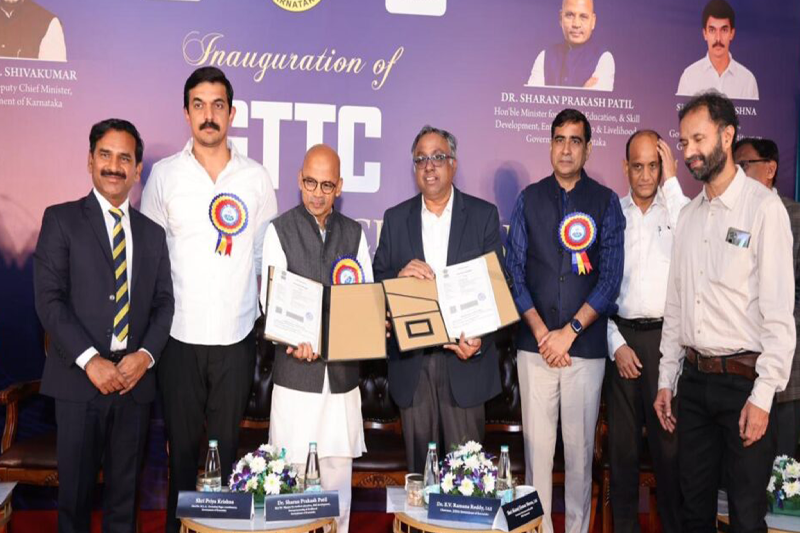
The Government Tool Room and Training Centre (GTTC) in Rajajinagar, Karnataka, has strengthened its position as a hub for skilled workforce development by signing multiple Memorandums of Understanding (MoUs) with leading industry players. During the GTTC Alumni Meet, several companies committed to hiring its graduates, with Rangsons Aerospace and Exide Energy together planning to employ more than 600 students. The event was graced by Medical Education and Skill Development Minister Sharan Prakash Patil, highlighting the government’s support for industry-aligned skill development initiatives.
The MoUs aim to bridge the gap between technical training and industry requirements, ensuring that GTTC students are ready to contribute to high-demand sectors immediately after completing their courses. The agreements reflect a growing trend of companies seeking skilled, job-ready talent from technical institutes rather than investing in lengthy onboarding or retraining programs.
Rangsons Aerospace: 200 Skilled Professionals Across 35 Trades
Rangsons Aerospace, a leading manufacturer in the aerospace sector, has committed to recruiting nearly 200 GTTC graduates. The company, known for its expertise in producing hoses, tubes, ducts for fluid distribution, satellite communication systems, thermal management solutions, AI-driven software, and embedded systems for defense and aerospace applications, cited GTTC graduates as a perfect match for its technical needs.
Sandesh P Satish, Chief Human Resources Officer at Rangsons Aerospace, explained, “We are looking to recruit professionals across 35 trades, including welding, CNC operations, setting and programming, laser cutting, fitting, sheet metal, tooling and design engineering, quality control, and non-destructive testing. GTTC students are trained comprehensively in all these skills, which means they can integrate into our workflows with minimal additional training.”
This recruitment drive reflects the growing demand for highly specialized talent in sectors such as aerospace and defense, where precision, adherence to standards, and technical competence are critical. By partnering with GTTC, Rangsons Aerospace is not only securing a ready talent pool but also ensuring that their workforce is equipped with cutting-edge industry practices.
Exide Energy: 400 Industry-Ready Mechanical and Electronics Graduates
In parallel, Exide Energy, a leading manufacturer of batteries and energy storage solutions, announced plans to employ around 400 GTTC students. Subhash Srinivas, Head of Manufacturing Engineering at Exide Energy, emphasized that the company was particularly interested in students trained in mechanical engineering, high-end automation, electronics, and electrical streams.
“GTTC produces graduates who are immediately industry-ready,” Srinivas said. “These students bring a blend of technical knowledge and hands-on experience that aligns with our operational requirements. Recruiting from GTTC allows us to maintain high productivity standards from day one.”
Exide Energy’s focus on mechanical and electronics expertise reflects the growing importance of battery technology and automation in India’s energy sector. The collaboration with GTTC ensures that the company can meet the demands of a rapidly evolving market while providing graduates with employment opportunities in cutting-edge technology sectors.
GTTC’s Growing Industry Partnerships
The recent MoUs with Rangsons Aerospace and Exide Energy are part of a broader trend of companies collaborating with GTTC to access a skilled workforce. Several other organizations have also signed agreements to recruit GTTC students, particularly those trained in advanced, industry-oriented skills.
GTTC’s comprehensive training programs emphasize both theoretical knowledge and practical application. Students are exposed to industry-standard equipment, software tools, and processes across various trades, including manufacturing, mechanical design, electronics, automation, and quality control. This ensures that graduates are not only technically proficient but also capable of adapting quickly to professional environments.
Officials at GTTC highlighted that such partnerships play a critical role in enhancing employability. “Our goal is to create graduates who are not just trained but fully prepared to excel in their respective industries,” said a GTTC spokesperson. “These MoUs are proof that the skills taught here meet global standards and are valued by leading companies.”
Global Skills Benchmarking and Faculty Development
Beyond immediate employment opportunities, GTTC’s collaborations also focus on elevating teaching standards and aligning curricula with international benchmarks. Gagan Aggarwal, Head of the UK-based NPTC Group of Colleges, explained that the MoU signed with GTTC aims to strengthen advanced manufacturing and engineering skills while introducing faculty upskilling programs.
“By benchmarking against global standards and training our educators in advanced methodologies, we ensure that students gain exposure to the latest technologies and practices,” Aggarwal said. “This approach benefits not only the students but also the industries that rely on their skills.”
Faculty development is an essential component of GTTC’s strategy. By continually updating teaching methods and course content, the institution ensures that students remain competitive in a fast-changing technological landscape. The collaboration with international academic groups further supports this effort, fostering innovation and global best practices in Indian technical education.
Government Support and Industry Integration
The presence of Minister Sharan Prakash Patil at the Alumni Meet underscored the state government’s commitment to fostering skill development initiatives that directly contribute to employment generation. By supporting collaborations between technical institutes like GTTC and private companies, the government aims to address both unemployment and the need for highly skilled talent in key sectors.
Minister Patil noted that such partnerships are crucial for Karnataka’s economic growth. “Our students are gaining the right skills at the right time, and our industries are accessing talent that can drive innovation and efficiency,” he said. “This is a win-win situation for both education and industry.”
Empowering the Next Generation of Professionals
For GTTC students, these MoUs represent more than just job opportunities—they offer a pathway to professional growth in some of India’s most dynamic sectors. Aerospace, defense, energy, and advanced manufacturing are all areas poised for rapid expansion, and graduates with specialized, hands-on training are uniquely positioned to thrive.
The collaboration between GTTC and companies like Rangsons Aerospace and Exide Energy reflects a shift in how technical education is perceived. By integrating industry requirements into training programs and creating direct pipelines to employment, GTTC is redefining the standard for vocational and diploma education in India.
Conclusion
The GTTC Alumni Meet has showcased the institution’s capability to produce industry-ready graduates and strengthen the link between education and employment. With over 600 students now set to join Rangsons Aerospace, Exide Energy, and other companies, the initiative represents a significant step toward building a skilled workforce capable of meeting India’s technological and industrial ambitions.
As partnerships between educational institutions and industry continue to grow, GTTC’s model could serve as a benchmark for other technical training centers nationwide, proving that strategic skill development can create opportunities for students while driving innovation and efficiency across sectors.