RRB ALP CBT 1 Answer Key 2026 Released: Response Sheet Review and Objection Window Open
RRB ALP CBT 1 Answer Key 2026 Released: Response Review Window Opens a Crucial Phase in Recruitment
The release of the provisional answer key for the Assistant Loco Pilot (ALP) Computer-Based Test (CBT) 1, conducted by the Railway Recruitment Board (RRB), marks a pivotal juncture in one of India’s most competitive public recruitment processes. With the response review window now officially open, candidates are afforded a critical opportunity to scrutinise their performance and actively participate in the evaluation mechanism.
In a recruitment landscape increasingly shaped by demands for transparency and procedural fairness, this development represents more than a routine administrative step. It underscores a deliberate effort by the RRB to ensure accountability, accuracy and candidate engagement at every stage of the selection process.
A Defining Moment in the Examination Cycle
The RRB ALP CBT 1 examination, held earlier this year, attracted an immense number of aspirants vying for positions within the Indian Railways. As one of the most sought-after roles in the technical workforce of the railways, the Assistant Loco Pilot position carries both prestige and responsibility.
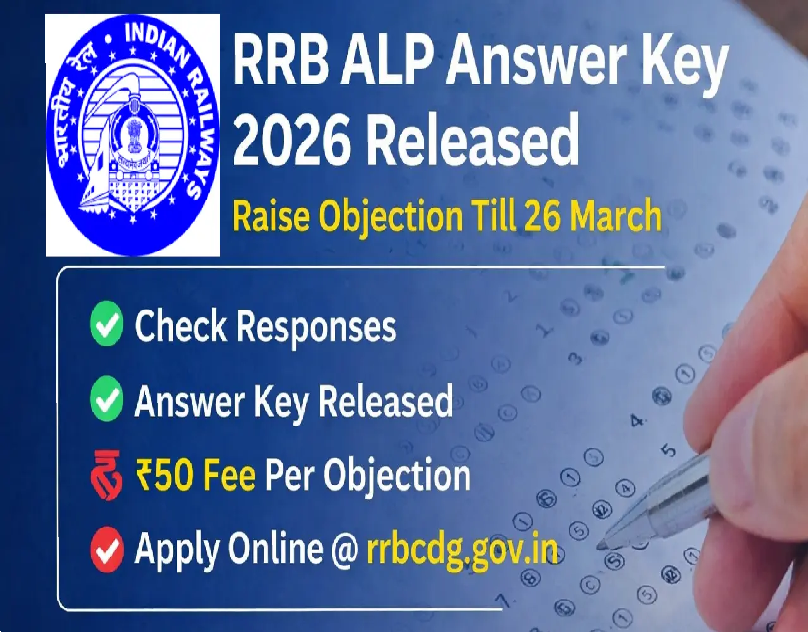
Following the successful conduct of the examination, the release of the provisional answer key and candidate response sheets enables examinees to revisit their attempts in a structured and transparent manner. According to official updates, the response review window was activated on March 20, 2026, at 5 PM, and will remain open until March 26, 2026, at 5 PM.
This limited yet crucial timeframe places the onus on candidates to act promptly and judiciously in evaluating their responses.
The Purpose and Value of the Provisional Answer Key
The provisional answer key serves as a preliminary framework against which candidates can measure their performance. By comparing their recorded responses with the officially released answers, candidates gain valuable insight into their likely scores.
However, the significance of this stage extends beyond mere score estimation. The provisional nature of the answer key implies that it is open to scrutiny and correction. It acknowledges the possibility of inadvertent errors and invites candidates to contribute to refining the evaluation.
This participatory approach reflects a progressive shift in examination governance, where candidates are not passive recipients but active stakeholders in the process.
Response Sheets: A Window into Performance
Alongside the answer key, the release of individual response sheets enhances the depth of analysis available to candidates. These documents provide a detailed record of each question attempted and the corresponding answers selected during the examination.
The integration of response sheets with the answer key enables a comprehensive review, allowing candidates to identify not only correct and incorrect responses but also patterns in their performance. Such insights can prove invaluable, particularly for those who may progress to subsequent stages or prepare for future examinations.
Raising Objections: A Structured Mechanism for Redressal
One of the most consequential aspects of this phase is the facility to raise objections. Candidates who identify discrepancies in the provisional answer key are permitted to challenge specific questions or answers within the designated review window.
The objection process is carefully structured to maintain both efficiency and integrity. Candidates must submit their challenges through the official portal, ensuring that each objection is accompanied by valid justification. This requirement serves to filter out frivolous claims while enabling genuine concerns to be addressed.
The existence of such a mechanism is emblematic of a broader commitment to fairness. It ensures that the evaluation process is not only transparent but also responsive to legitimate candidate feedback.
Timeliness and Responsibility
The narrow duration of the objection window, spanning just six days, highlights the importance of timely action. Candidates are expected to carefully review their responses and submit any objections within the stipulated deadline.
Failure to do so may result in missed opportunities to rectify potential errors, underscoring the need for diligence and attentiveness during this phase. The structured timeline also enables the RRB to efficiently process objections and proceed towards the finalisation of results.
Ensuring Transparency in Public Recruitment
The release of answer keys and the provision for objections are integral to maintaining transparency in large-scale examinations. In a system where even minor discrepancies can have far-reaching implications, such measures serve as essential safeguards.
By allowing candidates to independently verify their performance and challenge inaccuracies, the RRB reinforces confidence in the integrity of its processes. This approach aligns with broader trends in public recruitment, where openness and accountability are increasingly prioritised.
Moreover, the transparency afforded by this process helps mitigate uncertainty among candidates. Rather than relying on speculation, aspirants can engage with concrete data, fostering a more informed and rational outlook.
What Lies Ahead: From Objections to Final Results
Once the response review window closes, the RRB will undertake a comprehensive evaluation of all submitted objections. Each challenge will be examined on its merits, with subject experts assessing the validity of the claims.
If an objection is deemed valid, the necessary corrections will be incorporated into the final answer key. This ensures that the ultimate evaluation reflects the highest standards of accuracy and fairness.
The final answer key will subsequently form the basis for the declaration of results. This marks the transition from preliminary assessment to definitive evaluation, bringing candidates closer to the next stage of the recruitment process.
Candidate Empowerment Through Participation
The response review window represents a significant step towards empowering candidates. By granting them the ability to engage directly with the evaluation process, the RRB fosters a sense of agency and accountability.
This participatory model not only enhances the credibility of the examination system but also encourages a culture of critical engagement among aspirants. Candidates are prompted to analyse, question and substantiate their claims, skills that are valuable far beyond the examination context.
A Reflection of Evolving Examination Practices
The structured release of answer keys and response sheets, coupled with a clearly defined objection mechanism, reflects the evolution of examination practices in India. Increasingly, examination bodies are adopting measures that prioritise transparency, efficiency and candidate-centric design.
In the context of high-stakes recruitment, such as the ALP examination, these measures assume even greater significance. They ensure that the selection process is not only merit-based but also perceived as fair and trustworthy by all stakeholders.
Conclusion: A Step Towards Trust and Accountability
The opening of the response review window for the RRB ALP CBT 1 Answer Key 2026 is a critical milestone in the recruitment journey. It embodies the principles of transparency, participation and accountability that are essential to modern examination systems.
For candidates, this phase offers an invaluable opportunity to engage with their performance, challenge discrepancies and gain clarity regarding their prospects. For the RRB, it represents a reaffirmation of its commitment to fair and credible recruitment.
As the process advances towards the finalisation of results, the significance of this stage remains undeniable. It is here, in the careful scrutiny of answers and the resolution of objections, that the foundations of trust are laid, ensuring that the eventual outcomes are both accurate and just.