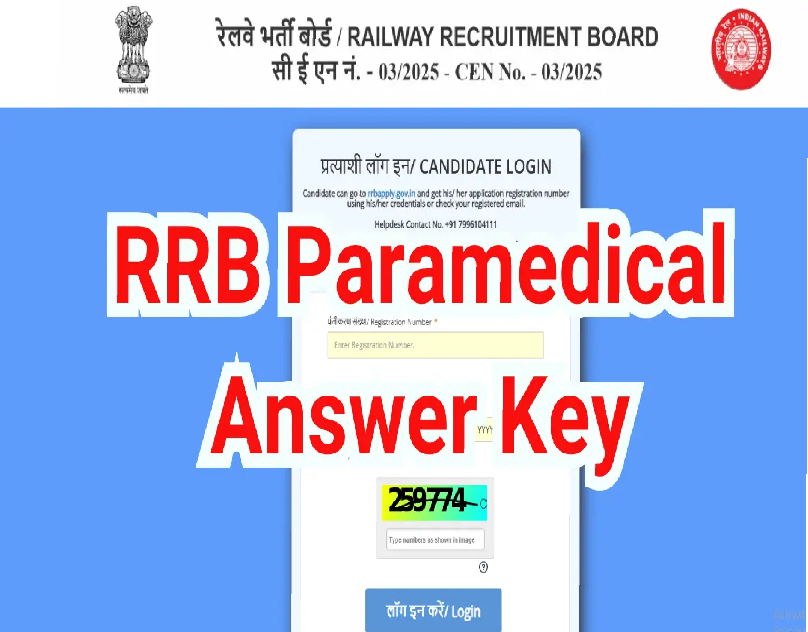
RRB Paramedical Answer Key 2026 Released: Check Response Sheet and Raise Objections Online
RRB Paramedical Answer Key 2026 Released: A Crucial Milestone in Transparent Recruitment
The release of the RRB Paramedical Answer Key 2026 marks a significant moment in the ongoing recruitment process conducted by the Railway Recruitment Board (RRB). For thousands of aspirants who appeared for the examination, this development offers not only clarity regarding their performance but also an opportunity to engage with the evaluation process in a transparent and participatory manner.
In an era where competitive examinations are increasingly scrutinised for fairness and accountability, the publication of provisional answer keys has emerged as a vital mechanism to uphold institutional credibility. The RRB’s latest announcement reflects this evolving ethos, reinforcing both transparency and candidate empowerment within the public recruitment framework.
Understanding the Context of the Examination
The RRB Paramedical recruitment examination is a highly anticipated event, drawing candidates from across the country who aspire to secure positions in various healthcare-related roles within the Indian Railways. These roles, which include nursing staff, pharmacists, and other allied health professionals, are integral to the functioning of one of the world’s largest railway networks.
Conducted as a Computer-Based Test (CBT), the examination assesses candidates on a range of subjects relevant to their respective disciplines. Following the successful completion of the exam, the release of the answer key represents the next critical stage in the selection process.
According to official updates, the answer key has now been made available on the designated RRB portals, enabling candidates to review their responses and compare them with the officially provided solutions.
The Role of the Provisional Answer Key
The answer key released at this stage is provisional in nature. This distinction is important, as it allows room for scrutiny, correction, and refinement before the final results are declared.
Candidates can utilise the provisional key to estimate their scores by matching their recorded responses with the correct answers. This process not only helps in gauging performance but also reduces the uncertainty that typically accompanies large-scale competitive examinations.
More importantly, the provisional answer key serves as an invitation for candidates to participate in the verification process. By identifying potential discrepancies, aspirants can actively contribute to ensuring the accuracy of the final evaluation.
Raising Objections: A Structured and Transparent Process
One of the most noteworthy aspects of the RRB’s approach is the provision for raising objections. Candidates who identify inconsistencies or errors in the answer key are permitted to challenge specific questions or answers within a stipulated timeframe.
The process is structured to maintain both efficiency and seriousness. Candidates are required to submit their objections through the official portal, accompanied by supporting evidence or justification. Additionally, a nominal fee is levied for each objection raised, a measure intended to discourage frivolous claims while ensuring that genuine concerns are addressed.
This mechanism reflects a broader shift in examination governance, where candidate feedback is not merely tolerated but actively encouraged. It underscores the principle that accuracy in evaluation is a shared responsibility between the examining authority and the examinees.
Step-by-Step Access to the Answer Key
Accessing the answer key has been designed to be a straightforward process, ensuring that candidates across varying levels of digital proficiency can navigate the system with ease.
Typically, candidates are required to visit the official RRB website corresponding to their region. Upon logging in using their credentials, such as registration number and date of birth, they can view their response sheet alongside the provisional answer key.
This integrated display of responses and correct answers enables candidates to conduct a detailed comparison, question by question. The system often includes options to directly raise objections from within the same interface, thereby streamlining the entire process.
Such user-centric design reflects an increasing emphasis on accessibility and efficiency in public examination systems.
The Significance of Transparency in Recruitment
The publication of answer keys and the facilitation of objections are not merely procedural steps; they represent a deeper commitment to transparency in recruitment.
In large-scale examinations, where even minor errors can impact thousands of candidates, the availability of a review mechanism is indispensable. By allowing candidates to verify and challenge the evaluation, the RRB mitigates the risk of oversight and reinforces trust in the system.
This approach aligns with global best practices in examination management, where openness and accountability are regarded as essential pillars of credibility.
Moreover, the transparency afforded by the answer key process helps to alleviate anxiety among candidates. By providing a clear understanding of performance, it reduces speculation and fosters a more informed and rational response to the outcome.
What Happens After the Objection Window?
Once the objection window closes, the RRB undertakes a thorough review of all submitted challenges. Each objection is evaluated on its merits, with subject matter experts examining the validity of the claims.
If an objection is found to be valid, the necessary corrections are incorporated into the final answer key. In some cases, this may involve awarding marks to all candidates for a particular question, especially if the ambiguity is deemed significant.
Following this review process, the final answer key is released. This version serves as the definitive basis for result preparation, leaving no scope for further modification.
The results are then declared, typically within a few weeks, marking the culmination of the examination cycle.
Empowering Candidates Through Information
The availability of the answer key represents more than just a procedural milestone; it is a tool of empowerment.
For candidates, it offers the ability to independently assess their performance, identify strengths and weaknesses, and make informed decisions about future steps. Whether it involves preparing for subsequent stages of the recruitment process or exploring alternative opportunities, the clarity provided by the answer key is invaluable.
Furthermore, the process encourages a culture of critical engagement. By inviting candidates to scrutinise the evaluation, it fosters analytical thinking and reinforces the importance of evidence-based reasoning.
Broader Implications for Public Examinations
The RRB’s approach to releasing answer keys and handling objections reflects a broader trend in public examinations across India. Increasingly, examination bodies are adopting measures that prioritise transparency, accountability, and candidate participation.
This shift is particularly significant in the context of high-stakes recruitment, where the consequences of evaluation extend beyond individual careers to the functioning of public institutions.
By embracing these principles, organisations such as the RRB are setting a benchmark for others to follow. The emphasis on openness not only enhances the credibility of the examination process but also contributes to a more equitable and merit-based system.
A Step Towards Greater Trust
Ultimately, the release of the RRB Paramedical Answer Key 2026 is more than a routine administrative update. It is a reaffirmation of the principles that underpin fair and transparent recruitment.
For candidates, it represents an opportunity to engage actively with the evaluation process. For the institution, it is a demonstration of accountability and responsiveness.
As the recruitment cycle progresses towards its conclusion, the focus will now shift to the resolution of objections and the declaration of results. Yet, the significance of this stage cannot be overstated.
In fostering transparency, encouraging participation, and upholding fairness, the answer key process serves as a cornerstone of trust, one that is essential for the integrity of public examinations and the confidence of those who undertake them.


