Japan LOTUS Programme 2026 Invites 1,000 Indian Students, Offers ₹25.6 Lakh Funding
Japan Invites 1,000 Indian Master's, PhD Students For LOTUS 2026 Programme, Offers Up To Rs 25.6 Lakh
The announcement of the LOTUS Programme 2026 by the Government of Japan marks a significant step in strengthening academic and research collaboration between India and Japan. At a time when global knowledge exchange is increasingly central to innovation, this initiative offers a compelling opportunity for Indian Master’s students, PhD scholars and postdoctoral researchers to gain international exposure while contributing to cutting-edge research.
With up to 1,000 positions available, the programme is not merely a scholarship but a structured pathway into the global research ecosystem, one that combines financial support, institutional collaboration and long-term academic development.
A Strategic Push Towards Bilateral Academic Collaboration
The LOTUS Programme, short for “Linking Overseas Talent with University Systems”, is a Japanese government-backed initiative aimed at fostering joint research between India and Japan. It is designed to bring promising researchers to Japan, enabling them to work alongside leading academics and access advanced research infrastructure.
This initiative reflects a broader geopolitical and academic alignment between the two nations. As both countries continue to invest in science, technology and innovation, collaborative programmes such as LOTUS serve as crucial bridges, facilitating the exchange of ideas, methodologies and expertise.
For Indian researchers, participation in such programmes signifies more than international mobility; it represents an opportunity to integrate into a global network of scientific inquiry.
Who Can Apply: Eligibility and Scope
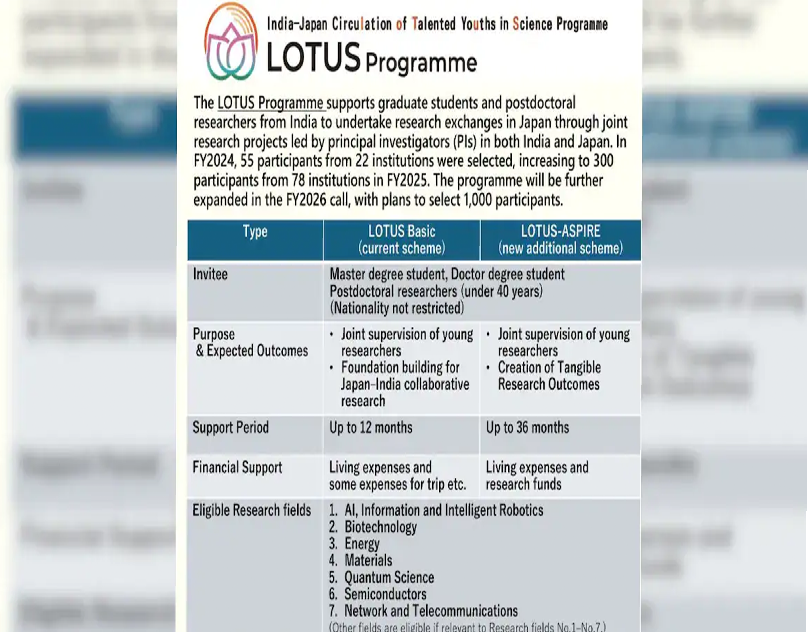
The LOTUS Programme 2026 is open to a wide spectrum of early-career researchers, including Master’s students, PhD scholars, and postdoctoral fellows. The initiative is particularly targeted at individuals who demonstrate academic promise and a strong inclination towards research.
Applicants must typically be under 40, ensuring the programme remains focused on nurturing emerging talent. While nationality restrictions are flexible, the programme is primarily geared towards Indian candidates, reflecting its bilateral focus.
However, one of the most distinctive aspects of the application process is that candidates cannot apply independently. Instead, applications must be routed through a Principal Investigator (PI) affiliated with a Japanese university or research institution. This requirement ensures that each application is anchored in a concrete research proposal and supported by institutional collaboration from the outset.
Programme Structure: Basic and Aspire Tracks
The LOTUS Programme is structured into two distinct tracks, Basic and Aspire, each catering to different levels of research engagement and funding requirements.
The Basic track is designed for shorter-term research stays, typically lasting up to 12 months. It provides a monthly stipend of approximately ₹1.4 lakh to cover living expenses, including accommodation. In addition, it offers financial support for joint supervision, covering travel within Japan, research materials and related costs.
The Aspire track, on the other hand, represents a more intensive and long-term engagement. Extending up to 36 months, it not only offers the same monthly stipend but also significantly higher funding for research collaboration and supervision.
Under this track, the total annual financial assistance can reach up to ₹25.6 lakh, making it one of the most lucrative international research opportunities currently available to Indian scholars.
This dual-track structure allows candidates to align their participation with their academic goals, whether they seek short-term exposure or sustained research collaboration.
Financial Support: Beyond a Conventional Scholarship
One of the defining features of the LOTUS Programme 2026 is its comprehensive financial support system. Unlike traditional scholarships that primarily cover tuition or living expenses, LOTUS adopts a holistic approach that addresses multiple facets of the research experience.
The monthly stipend ensures that participants can focus on their research without financial strain, while additional funding supports collaborative activities, including joint supervision and academic exchange.
Importantly, the programme also facilitates travel and accommodation for supervisors, fostering a truly collaborative research environment. This emphasis on joint supervision underscores the programme’s commitment to building enduring academic partnerships rather than isolated research engagements.
Such an integrated funding model not only enhances the quality of research but also ensures that participants derive maximum value from their time in Japan.
Research Areas and Academic Scope
The LOTUS Programme 2026 focuses on a range of high-impact and future-oriented research fields. These include artificial intelligence, biotechnology, energy, materials science, quantum technologies, semiconductors and telecommunications.
By prioritising these domains, the programme aligns itself with global research priorities and technological advancements. It also reflects Japan’s strategic focus on innovation-driven growth and its commitment to addressing complex global challenges through scientific research.
For Indian scholars, this presents an opportunity to engage with advanced research methodologies and contribute to fields that are shaping the future of technology and society.
Application Process and Key Dates
The application process for the LOTUS Programme 2026 is both structured and time-bound. Interested candidates must collaborate with a Principal Investigator in Japan, who will submit the application on their behalf.
The submission deadline is June 9, 2026, with the selection process expected to take place between June and August. Final results are likely to be announced by late August, with selected candidates commencing their research programmes in October 2026.
This timeline provides applicants with a clear framework, enabling them to plan their academic and professional commitments accordingly. However, it also underscores the importance of early preparation, particularly in identifying a suitable research supervisor and developing a compelling proposal.
The Significance for Indian Researchers
The LOTUS Programme 2026 holds considerable significance for India’s academic and research community. By facilitating access to world-class institutions and resources, it enables Indian scholars to enhance their research capabilities and broaden their academic horizons.
Moreover, the programme contributes to the development of a globally competitive research workforce. Exposure to international research environments fosters critical thinking, innovation and cross-cultural collaboration, skills that are increasingly essential in today’s interconnected world.
At a broader level, initiatives such as LOTUS play a vital role in strengthening bilateral ties between India and Japan. By promoting academic exchange and joint research, they lay the foundation for long-term collaboration in science and technology.
Preparing a Strong Application
Given the competitive nature of the programme, prospective applicants must approach the application process with diligence and strategic planning. Identifying a suitable Principal Investigator is a critical first step, as the application's success largely depends on the strength of the proposed collaboration.
Equally important is the formulation of a well-defined research proposal that aligns with the programme’s focus areas. Candidates must demonstrate not only academic competence but also a clear vision of how their research will contribute to the programme's broader objectives.
Attention to detail, accuracy in documentation and timely submission are essential components of a successful application.
A Transformative Opportunity
In essence, the LOTUS Programme 2026 is more than a funding initiative; it is a platform for intellectual growth, international collaboration, and professional development. For Indian scholars, it offers a rare opportunity to engage with global research communities while contributing to meaningful scientific advancements.
As the deadline approaches, the programme is expected to attract a large number of applications from across the country. Those who succeed will not only gain access to substantial financial support but also embark on a transformative academic journey that can shape their careers and contribute to the global research landscape.
In an era defined by rapid technological progress and global interdependence, such opportunities are invaluable. The LOTUS Programme 2026 stands as a testament to the power of collaboration, offering a pathway for the next generation of researchers to explore, innovate and excel on an international stage.