DU PG Admissions 2026-27 Open Through CSAS-PG Portal
DU Opens PG Admissions 2026-27: A Complete Guide to CSAS, Eligibility and Key Changes
The University of Delhi has officially commenced admissions for its postgraduate programmes for the academic session 2026-27, opening yet another intensely competitive chapter in India’s higher education calendar. Widely regarded as one of the country’s most prestigious public universities, Delhi University continues to attract lakhs of applicants annually across disciplines ranging from humanities and social sciences to commerce, sciences and interdisciplinary studies.
This year’s postgraduate admission cycle arrives at a particularly significant moment for Indian higher education. As universities continue adapting to the National Education Policy (NEP) 2020, admission frameworks are becoming increasingly digitised, centralised and integrated with national entrance systems such as the Common University Entrance Test for Postgraduate programmes (CUET-PG).
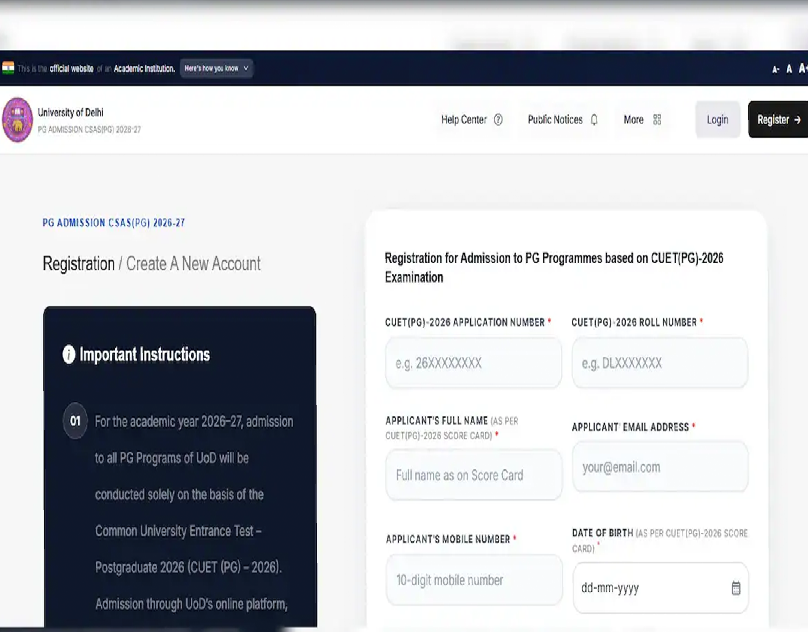
Delhi University’s latest admission process reflects precisely this transformation. Admissions to two-year postgraduate programmes for 2026-27 are now being conducted through the Common Seat Allocation System for Postgraduate admissions, commonly referred to as CSAS-PG. Applications are open through the official portal, with June 7, 2026, set as the final date for registration.
For students across India, the opening of DU’s PG admission portal marks more than a routine administrative announcement. It represents the beginning of a highly consequential process that may shape academic direction, research opportunities and professional trajectories for years ahead.
The Continuing Prestige of Delhi University
Despite the rapid expansion of private universities and international academic collaborations in India, Delhi University retains a uniquely influential position within the country’s educational ecosystem. Its longstanding academic reputation, comparatively affordable fee structure, diverse student population and established faculty networks continue to make it one of the most sought-after destinations for postgraduate study.
The university’s colleges and departments have historically produced influential scholars, policymakers, civil servants, academics, journalists and industry professionals. Consequently, admission into a postgraduate programme at DU often carries both academic and symbolic significance.
For many students, particularly those from smaller towns and state universities, securing admission into Delhi University represents access to broader intellectual exposure, research infrastructure and professional networks unavailable elsewhere.
This enduring appeal explains why each admission cycle generates intense attention among CUET-PG candidates across the country.
Admissions Through CUET-PG and CSAS
Like recent admission cycles, Delhi University will admit candidates primarily based on CUET-PG 2026 scores for relevant subjects and disciplines.
The CUET-PG system, introduced as part of broader educational reforms, aims to standardise postgraduate admissions across participating universities by replacing multiple institution-specific entrance examinations with a centralised testing framework.
Under the current structure, candidates first appear for CUET-PG conducted by the National Testing Agency (NTA). Following the declaration of results, eligible students must separately register through the CSAS-PG portal for admission into Delhi University programmes.
The process may appear procedural, but it represents a substantial departure from earlier decentralised systems where departments often conducted independent admissions. Supporters argue that CUET improves uniformity and accessibility, while critics continue to debate whether a single national examination can adequately evaluate diverse academic disciplines and student backgrounds.
Nevertheless, CUET-PG has now become the defining gateway for postgraduate admissions across several major institutions, including DU.
DigiLocker Integration Signals Further Digitalisation
One of the most notable developments in the 2026 admission cycle is Delhi University’s integration with DigiLocker and API Setu platforms. According to official statements, this auto-integration system allows candidate credentials and CUET scores to be fetched directly through verified digital platforms.
The initiative forms part of the government’s broader Digital India framework aimed at reducing paperwork, minimising duplication and improving authentication efficiency.
In practical terms, the integration may significantly simplify document verification processes for applicants who previously had to repeatedly upload and manually verify certificates across multiple admission portals.
The university has stated that the system is intended to improve both administrative efficiency and data security.
However, digital transitions within large public institutions rarely occur without technical complications. Online student discussions already reveal concerns regarding portal glitches, category mismatches and login issues during the initial phase of registration.
Such challenges are not unusual during high-volume admission cycles involving lakhs of applicants. Yet they also highlight the continuing tension between technological modernisation and infrastructural preparedness within India’s public education system.
One-Year and Two-Year PG Programmes Under NEP
The 2026-27 admission cycle also reflects Delhi University’s gradual implementation of the National Education Policy framework through the introduction of both one-year and two-year postgraduate programmes.
Under NEP guidelines, students completing four-year undergraduate degrees with honours or research components may become eligible for accelerated one-year master’s programmes, while traditional two-year postgraduate structures continue for other students.
This marks a substantial structural shift within Indian higher education. For decades, the two-year postgraduate degree remained the standard academic model across universities. The introduction of flexible-duration postgraduate programmes reflects attempts to align Indian academic structures more closely with certain international systems.
Supporters argue that the reform may reduce redundancy and allow academically prepared students to enter research or employment pathways earlier. Critics, however, have raised concerns regarding implementation consistency, curricular preparedness and potential disparities between institutions adopting different timelines.
Delhi University has indicated that admissions for one-year postgraduate programmes will be announced separately through a dedicated portal.
The Competitive Nature of PG Admissions
While undergraduate admissions often dominate public attention, postgraduate admissions at Delhi University remain equally competitive in many disciplines. Popular programmes in Political Science, English, Economics, Commerce, Psychology and Computer Science consistently witness extremely high cut-offs and limited seat availability.
In recent years, postgraduate education has also acquired greater importance due to evolving employment patterns. Increasingly, students pursue specialised master’s degrees not only for academic advancement but also for professional differentiation within competitive job markets.
The rise of interdisciplinary fields, data-driven industries and research-oriented careers has further strengthened demand for postgraduate qualifications.
At the same time, concerns surrounding employability and educational inflation continue to shape student decision-making. For many candidates, postgraduate education is no longer viewed as optional intellectual enrichment but as an increasingly necessary extension of formal education.
This broader context helps explain the intense scrutiny surrounding admission procedures, reservation policies, fee structures and seat allocation systems.
Navigating the CSAS Portal
The CSAS-PG system requires candidates to complete several procedural steps, including registration, course selection, document upload and payment of application fees.
According to available information, candidates from General, OBC-NCL and EWS categories are required to pay ₹250 per programme as registration charges, while SC, ST and PwBD applicants pay reduced application fees.
Students are also advised to regularly monitor the portal for updates related to seat allocation rounds, correction windows and admission schedules.
Online student forums indicate that many applicants continue to seek clarity regarding migration certificates, category verification, pending documentation and portal functionality.
This recurring confusion reflects a broader issue within Indian admissions culture: despite technological improvements, procedural communication often remains fragmented and difficult for first-generation applicants to navigate confidently.
Technology, Transparency and Student Anxiety
One of the defining characteristics of modern university admissions is the growing dependence upon digital systems. While online portals improve scalability and administrative coordination, they also introduce new forms of anxiety.
Technical glitches, server slowdowns, incorrect data integration and unclear instructions can create disproportionate stress during already high-pressure admission periods. Student reactions across online communities reveal familiar frustrations surrounding category errors, incomplete previews and login difficulties.
In highly competitive systems where a single procedural error may jeopardise admission opportunities, even temporary portal malfunctions generate considerable panic.
Universities, therefore, face an increasingly important responsibility: ensuring that technological modernisation is accompanied by responsive communication and accessible grievance mechanisms.
The credibility of digital admission systems depends not merely upon automation, but upon trust.
A Changing Academic Landscape
Delhi University’s admission cycle also reflects larger transformations occurring within Indian higher education. Increasing centralisation through CUET, digital verification systems, NEP-driven curricular restructuring and interdisciplinary expansion are gradually reshaping the academic environment students enter today.
These changes carry both promise and uncertainty. On one hand, reforms aim to improve accessibility, mobility and standardisation across institutions. On the other hand, implementation challenges continue to raise legitimate concerns regarding preparedness, equity and institutional capacity.
Students entering postgraduate education in 2026, therefore, do so at a transitional moment for Indian academia, one defined simultaneously by technological advancement, policy reform and growing competition.
Looking Forward
As the June 7 application deadline approaches, thousands of aspirants across the country will spend the coming weeks navigating registration forms, course preferences, document verification and seat allocation expectations.
For many, admission into Delhi University represents aspiration fulfilled. For others, it may become one step within a broader academic journey shaped by multiple institutional opportunities.
What remains undeniable, however, is the continuing influence of Delhi University within India’s intellectual and educational landscape. Even amid evolving policy frameworks and expanding alternatives, DU continues to occupy a central position in the country’s imagination of higher education.
And as postgraduate admissions for 2026-27 officially begin, another generation of students now prepares to compete for a place within that legacy.