CBSE Parenting Calendar 2026-27 for Holistic Student Growth
CBSE Parenting Calendar 2026-27: Strengthening Parent-School Collaboration for Holistic Student Development
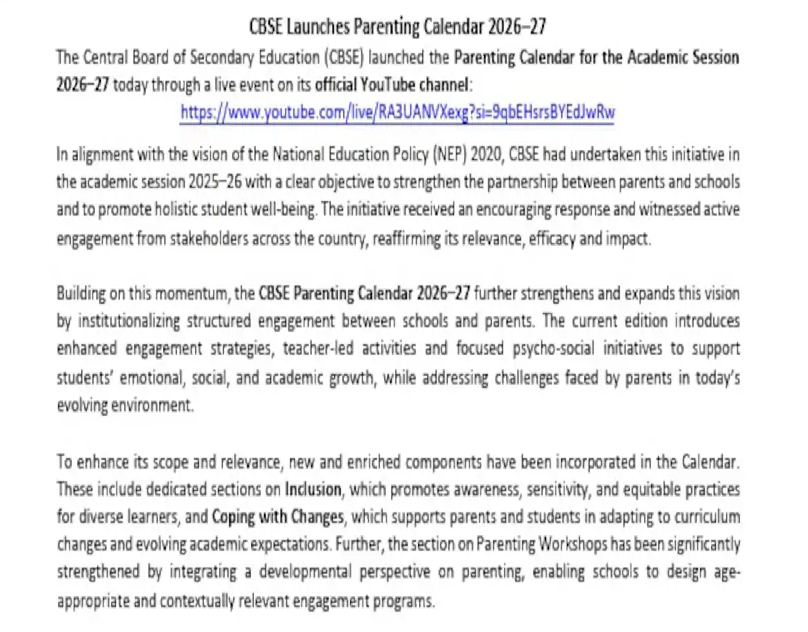
The Central Board of Secondary Education has introduced its Parenting Calendar for the academic session 2026-27, marking a progressive step towards redefining the role of parents in a child’s educational journey. At a time when the discourse around education is steadily shifting from rote learning to holistic development, this initiative underscores the importance of collaboration between schools and families. It is not merely a guideline but a structured framework designed to create a cohesive ecosystem where academic growth, emotional well-being and social development are nurtured in tandem. Aligned with the vision of the National Education Policy (NEP) 2020, the Parenting Calendar reflects a deeper understanding of the evolving needs of learners in contemporary society. By placing equal emphasis on parental engagement and institutional responsibility, the initiative aims to transform the traditional boundaries of schooling into a more inclusive and participatory experience.
A Structured Approach to Parent-School Engagement
The Parenting Calendar introduces a systematic and well-defined model for interaction between parents and schools. Unlike conventional parent-teacher meetings that are often sporadic and reactive, this framework promotes continuous engagement throughout the academic year. It offers structured activities, guided interactions and thematic discussions that encourage parents to play an active role in their child’s development.
This structured approach is particularly significant in the context of modern education, where the complexity of learning extends beyond textbooks and examinations. Children today navigate a wide spectrum of challenges, including academic pressures, digital distractions and evolving social dynamics. In such a scenario, a coordinated effort between parents and educators becomes indispensable.
The calendar seeks to address this need by providing a roadmap for sustained communication and collaboration. It ensures that parents are not passive observers but active participants in the educational process, thereby fostering a more integrated learning environment.
Focus on Holistic Development and Well-being
One of the defining features of the Parenting Calendar 2026–27 is its emphasis on holistic student development. Moving beyond the narrow confines of academic achievement, the initiative incorporates elements that support emotional, social and psychological well-being.
The framework includes teacher-led activities, psychosocial support mechanisms and engagement strategies that aim to nurture well-rounded individuals. These components are designed to address the diverse needs of students, recognising that learning is not a one-dimensional process but a multifaceted journey.
In addition, the calendar introduces new focus areas such as screen-time awareness and early sensitisation around substance use, reflecting a proactive approach to contemporary challenges faced by young learners. By incorporating such themes, CBSE acknowledges the broader social context in which education operates and seeks to equip students with the resilience and awareness required to navigate it.
Enhancing Parent-Child Interaction
At the heart of the Parenting Calendar lies the objective of strengthening the bond between parents and children. The initiative encourages meaningful interactions that go beyond routine academic discussions, promoting activities that foster emotional connection and mutual understanding.
By guiding parents on how to engage with their children in constructive ways, the calendar helps create a supportive home environment that complements school-based learning. This alignment between home and school is crucial for reinforcing values, habits and behavioural patterns that contribute to a child’s overall development.
The emphasis on parent-child interaction also reflects a shift in educational philosophy. It recognises that learning is not confined to the classroom but extends into everyday experiences, conversations and relationships. In this sense, parents become co-educators, playing a vital role in shaping the child’s outlook and aspirations.
Addressing Contemporary Educational Challenges
The Parenting Calendar is particularly relevant in the context of the rapidly changing educational landscape. With the increasing integration of technology in learning, students are exposed to both opportunities and challenges that require careful navigation. Issues such as excessive screen time, digital dependency and mental health concerns have become central to discussions around education.
By incorporating targeted interventions and awareness initiatives, the calendar seeks to address these challenges in a structured manner. It provides parents with the knowledge and tools needed to guide their children effectively, ensuring that technological advancements are harnessed positively rather than becoming sources of distraction or stress.
Furthermore, the inclusion of psychosocial support highlights the growing recognition of mental health as a critical component of education. By fostering open communication and early intervention, the initiative aims to create a safe and supportive environment for students.
Building a Collaborative Educational Ecosystem
The introduction of the Parenting Calendar represents a broader shift towards collaborative education. It challenges the traditional notion of schools as isolated institutions and instead promotes a model where multiple stakeholders work together to achieve common goals.
In this ecosystem, parents, teachers and school leaders function as partners, each contributing to the child’s development in distinct yet interconnected ways. The calendar serves as a unifying framework that aligns their efforts, ensuring consistency and coherence in the learning process.
Such collaboration is particularly important in the Indian context, where diverse socio-economic backgrounds and educational experiences can create disparities in student outcomes. By standardising engagement practices across schools, CBSE aims to create a more equitable and inclusive system.
Implementation and Role of Schools
While the Parenting Calendar provides a comprehensive framework, its success ultimately depends on effective implementation at the school level. CBSE has urged affiliated institutions to adopt and integrate the calendar into their academic planning, ensuring that its principles are translated into practice.
Schools play a pivotal role in facilitating parent engagement, organising activities and creating platforms for interaction. This may include workshops, orientation sessions, group discussions and community-building initiatives that encourage active participation.
Moreover, schools are expected to tailor the calendar to their specific contexts, adapting activities to suit the needs of their students and communities. This flexibility ensures that the framework remains relevant and effective across diverse educational settings.
A Continuation of Progressive Educational Reforms
The Parenting Calendar 2026–27 builds upon earlier efforts by CBSE to promote holistic and competency-based education. It complements other reforms aligned with the National Curriculum Framework and NEP 2020, which emphasise experiential learning, critical thinking and life skills.
By integrating parental involvement into this broader framework, CBSE reinforces the idea that education is a shared responsibility. It acknowledges that meaningful learning outcomes cannot be achieved in isolation but require collective effort and sustained engagement.
This initiative also reflects a growing awareness of the need to prepare students for an uncertain and rapidly evolving future. By fostering resilience, adaptability and emotional intelligence, the Parenting Calendar contributes to the development of skills that extend beyond academic success.
The Way Forward
As the Parenting Calendar is rolled out across CBSE-affiliated schools, its impact will depend on the extent to which stakeholders embrace its principles. For parents, it offers an opportunity to become more actively involved in their child’s education, gaining insights into their development and contributing to their growth.
For educators, it provides a structured framework for engaging with families, enhancing communication and building trust. For students, it creates a supportive environment where learning is reinforced both at school and at home.
In the long term, such initiatives have the potential to redefine the educational experience in India. By fostering a culture of collaboration, empathy and shared responsibility, the Parenting Calendar sets the stage for a more inclusive and holistic approach to education.
Key Takeaways
The launch of the CBSE Parenting Calendar for the academic session 2026-27 represents a significant step towards bridging the gap between home and school. It reflects a progressive vision of education that prioritises not only academic excellence but also emotional well-being, social awareness and personal growth. By empowering parents and strengthening their partnership with schools, the initiative creates a robust support system for students. As education continues to evolve in response to changing societal needs, such collaborative frameworks will play a crucial role in shaping the future of learning in India.