CUET UG 2026 City Intimation Slip Released by NTA
CUET UG 2026 City Intimation Slip Released: Key Details, Candidate Guidance and What Lies Ahead
The release of the Common University Entrance Test (CUET UG) 2026 city intimation slip marks an important juncture in India’s contemporary higher education admission landscape. Issued by the National Testing Agency (NTA), this document serves as a preliminary notification that informs candidates of the city in which their examination centre will be located. While it does not constitute the final admission document, it plays a vital role in enabling candidates to plan effectively for the forthcoming examination period. At a time when national-level entrance examinations are becoming increasingly streamlined and centralised, such measures reflect a broader commitment to transparency, efficiency and candidate convenience.
With lakhs of aspirants expected to appear for CUET UG 2026, the timely release of the city intimation slip offers a much-needed sense of direction. It bridges the gap between application submission and the final issuance of admit cards, ensuring that candidates are not left grappling with last-minute logistical uncertainties. In a country as geographically diverse as India, where candidates often travel across cities or states to appear for examinations, early information regarding the exam city can make a substantial difference in preparedness.
Understanding the Purpose of the City Intimation Slip
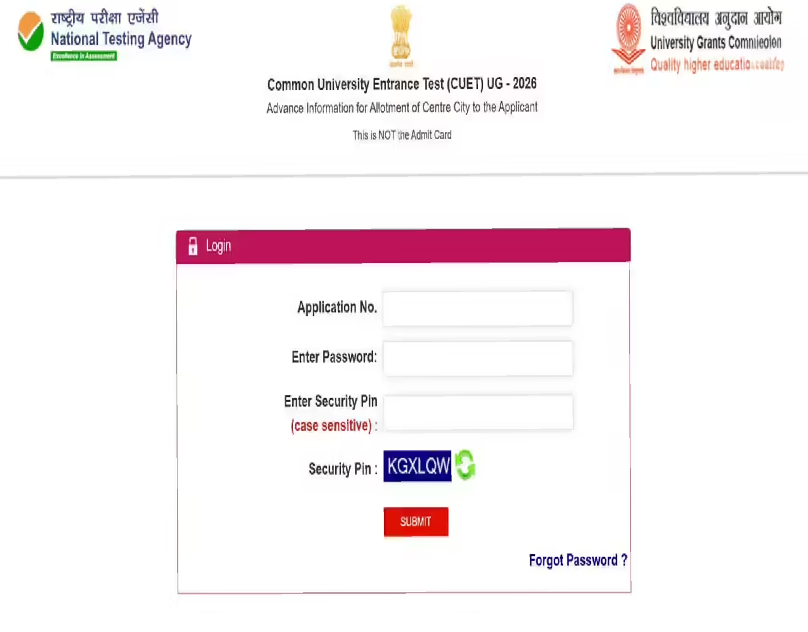
The city intimation slip is designed to provide advance information regarding the location of a candidate’s examination centre at the city level. Candidates who have successfully registered for CUET UG 2026 can access this slip through the official portal by logging in with their credentials. The document typically includes details such as the candidate’s name, application number and the allotted examination city.
It is important to note that this slip does not specify the exact examination centre or venue. Instead, it serves as a preparatory tool, allowing candidates to familiarise themselves with the city in which they will be appearing for the examination. This distinction is crucial, as many candidates mistakenly assume that the city slip is equivalent to the admit card. In reality, it is only a precursor to the final document.
The introduction of this system underscores the NTA’s emphasis on reducing ambiguity in the examination process. By providing candidates with early access to key logistical information, the agency helps them avoid the stress that often accompanies last-minute travel arrangements. This is particularly beneficial for candidates who may be appearing for CUET UG in cities far from their place of residence.
City Intimation Slip vs Admit Card: A Crucial Distinction
One of the most important aspects candidates must understand is the difference between the city intimation slip and the admit card. While the former provides only the name of the examination city, the latter is a comprehensive document that contains all essential details required for entry into the examination hall.
The admit card, which is expected to be released shortly after the city slip, will include the exact address of the examination centre, reporting time, examination shift and detailed instructions that candidates must follow. It is the only document that grants permission to enter the examination venue and candidates will be required to present it along with a valid photo identification on the day of the test.
Failure to carry the admit card can result in denial of entry, regardless of whether the candidate has the city intimation slip. Therefore, while the slip is important for planning purposes, it should not be confused with the final examination document.
CUET UG 2026: Exam Schedule and Structure
The CUET UG 2026 examination is scheduled to be conducted between May 11 and May 31, 2026, in a computer-based format. This extended examination window reflects the scale and complexity of the test, which accommodates a wide range of subjects and candidate combinations.
Unlike traditional entrance examinations that are held on a single day, CUET follows a staggered schedule. This approach enables the NTA to manage resources more efficiently while ensuring that candidates are provided with a smooth and organised testing experience. It also allows for better distribution of candidates across multiple centres, reducing overcrowding and logistical challenges.
The computer-based mode of examination further aligns with global standards, offering a standardised and secure testing environment. It ensures uniformity in question delivery and evaluation, thereby enhancing the credibility of the examination process.
The Significance of Early Information
The release of the city intimation slip is not merely an administrative formality; it is a strategic step that enhances candidate preparedness. By informing candidates of their examination city in advance, the NTA enables them to plan their travel, arrange accommodation if necessary and familiarise themselves with the local environment.
For candidates travelling long distances, this early notification can significantly reduce stress and uncertainty. It allows them to explore transportation options, estimate travel time, and make arrangements that align with their examination schedule. In many cases, it also provides an opportunity to visit the city beforehand, which can be particularly helpful for those who are unfamiliar with the location.
Furthermore, the availability of this information well in advance contributes to a more equitable examination process. Candidates from rural or remote areas, who may face additional challenges in accessing transportation and accommodation, benefit greatly from the additional time provided by the city slip.
What Candidates Should Do After Downloading the Slip
Once candidates have downloaded their city intimation slip, there are several steps they should take to ensure a smooth examination experience. First and foremost, they must carefully verify all the details mentioned in the document. This includes checking their name, application number and the allotted examination city. Any discrepancies should be reported immediately to the NTA through the official helpline or support channels.
Next, candidates should begin planning their travel arrangements. If the examination city is different from their place of residence, it is advisable to book tickets and accommodation well in advance. This not only ensures availability but also helps in avoiding last-minute price surges.
Candidates should also use this time to continue their academic preparation. While logistical planning is important, it should not overshadow the need for focused revision and practice. A balanced approach that addresses both academic and logistical aspects will be key to success.
CUET and the Transformation of Higher Education Admissions
The CUET framework represents a significant shift in the way undergraduate admissions are conducted in India. By introducing a single, standardised entrance test for multiple universities, it has simplified the admission process and reduced the burden on students.
Previously, candidates were required to appear for multiple entrance examinations, each with its own format and syllabus. This not only increased stress but also created disparities in evaluation standards. CUET addresses these challenges by providing a common platform for assessment, ensuring fairness and consistency across institutions.
In this context, initiatives such as the release of the city intimation slip are part of a broader effort to enhance the overall examination experience. They reflect a move towards a more organised, transparent and student-centric system that prioritises the needs of candidates.
Conclusion
As CUET UG 2026 approaches, the release of the city intimation slip marks the beginning of the final phase of preparation. It signals a transition from application to execution, where careful planning and attention to detail become increasingly important. While the slip itself does not grant entry to the examination hall, its significance lies in the clarity and direction it provides. It empowers candidates to take control of their preparation, both academically and logistically, ensuring that they are well-equipped to face the examination. In the coming weeks, the release of admit cards will provide the final piece of the puzzle. Until then, candidates are advised to remain vigilant, regularly check official updates and utilise this time effectively. With the right approach and adequate preparation, they can navigate this crucial stage with confidence and composure.