Delhi University Colleges Set For Smart Upgrade With Digitised Libraries, New Academic Centres
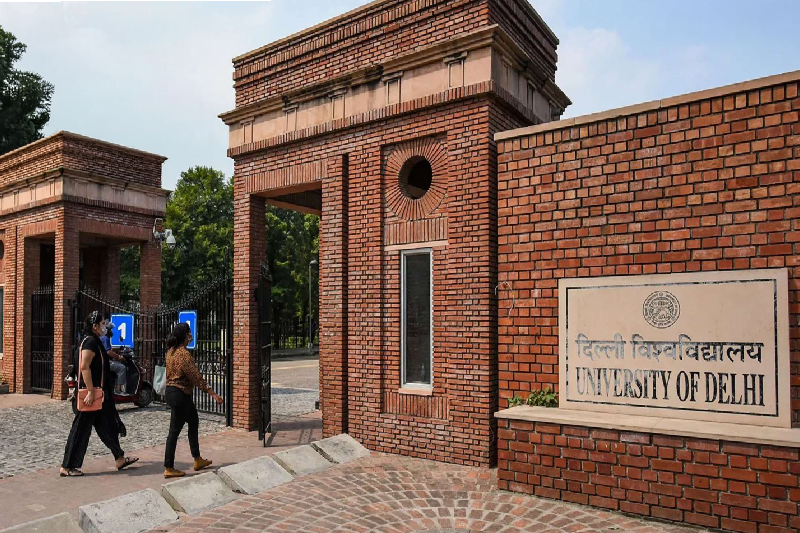
In a significant move poised to reshape the academic environment of the capital’s higher education landscape, colleges funded by the Delhi government under the University of Delhi are set to undergo a comprehensive technological and infrastructural transformation. Announced by Education Minister Ashish Sood at Maharaja Agrasen College, the initiative signals not merely a cosmetic upgrade, but a deliberate attempt to align public higher education with contemporary pedagogical and research standards.
For years, several of these institutions have navigated financial uncertainty and administrative delays, often to the detriment of staff morale and student experience. The newly unveiled plan therefore arrives not only as a modernisation effort but as a reassurance of stability. The promise of upgraded classrooms, digitised libraries and renewed fiscal clarity suggests a recalibration of priorities, one that seeks to foreground academic excellence, operational efficiency and institutional dignity.
Smart Technology and Academic Infrastructure
Central to the reform package is the establishment of Smart Classrooms across campuses. Designed to facilitate digital and interactive modes of teaching, these spaces will integrate audio-visual technology, projection systems and enhanced connectivity, enabling faculty members to diversify instructional methods. In an era where hybrid learning, multimedia content and real-time digital collaboration are increasingly embedded in higher education, such infrastructure is no longer aspirational; it is foundational.
Complementing this pedagogical shift is the introduction of an RFID-enabled Library Management System. By automating book tracking, circulation and inventory processes, the system is expected to streamline administrative workflows and improve access to academic resources. For students and researchers alike, quicker issue-and-return procedures and more accurate catalogue management translate into a smoother scholarly experience. Libraries remain the intellectual heart of any university, and digitising their core functions signals a recognition that academic rigour depends as much on efficient systems as on inspired teaching.
Further additions include a new Student Facility Centre and a Multimedia Seminar Hall. The former is envisaged as a consolidated hub for student services, potentially reducing bureaucratic fragmentation and improving access to academic and administrative support. The latter promises to expand opportunities for conferences, guest lectures, cultural engagements and interdisciplinary dialogues, activities that enrich campus life beyond formal curricula.
Perhaps most symbolically resonant is the laying of the foundation stone for an Indian Knowledge Tradition Centre. While details of its eventual scope remain forthcoming, the very nomenclature gestures towards a renewed emphasis on indigenous intellectual heritage within the contemporary university framework. Whether through research, archival work or curricular development, such a centre may seek to position traditional knowledge systems within global academic discourse, thereby contributing to a more pluralistic understanding of scholarship.
Addressing Funding Uncertainty
The presence of principals from twelve Delhi government-funded colleges at the announcement underscored an issue that has hovered persistently over these institutions: financial disruption. In recent years, delayed grants have reportedly affected salary disbursements, stalled promotions and impeded infrastructure projects. For academic communities, such uncertainty erodes not only operational efficiency but also professional confidence.
In response, the minister offered categorical assurance: no institution would face a shortage of funds, and no teacher’s dignity would be compromised. The language was deliberate. By foregrounding dignity alongside financial continuity, the statement acknowledged that academic institutions are sustained by human capital as much as by physical infrastructure. Faculty morale, research continuity and long-term planning all depend on predictable funding streams.
Whether these assurances will translate into sustained administrative reform remains to be seen. However, the public commitment marks an important rhetorical shift from reactive crisis management to proactive institutional strengthening. Stability, after all, is a prerequisite for innovation.
A Broader Educational Vision
The announcement did not confine itself to higher education. Beyond university campuses, the minister outlined plans to convert 7,000 classrooms for Classes 9 to 12 in Delhi government schools into Smart Classrooms in the next phase of reforms. This wider technology-led push suggests a continuum of educational modernisation—from secondary schooling to postgraduate study.
Such alignment is strategically significant. The digital competencies cultivated at school level will inevitably shape expectations at university. By embedding technological infrastructure across educational tiers, the government appears to be seeking systemic coherence rather than isolated upgrades.
Moreover, the articulation of a long-term ambition to position Delhi as a “Knowledge Capital” by 2047, situates these measures within a generational framework. The year marks the centenary of India’s independence, a milestone frequently invoked in national policy discourse. To aspire towards knowledge production rather than mere degree distribution is to reimagine the capital’s universities as research-intensive, innovation-driven institutions capable of contributing meaningfully to global scholarship.
The distinction is not trivial. A degree-distribution centre implies scale without depth; a knowledge-production centre demands inquiry, experimentation and intellectual risk-taking. For the University of Delhi’s government-funded colleges, historically known for their strong teaching traditions but variable research outputs, this shift may necessitate cultural as well as infrastructural change.
The Question of Implementation
Ambitious announcements, however, are only the beginning. For students and faculty, the tangible impact will depend on the pace and quality of implementation. Smart Classrooms require not only hardware installation but also faculty training and curricular integration. RFID systems demand maintenance, technical oversight and data management protocols. New facilities must be staffed, regulated and incorporated into everyday institutional rhythms.
Furthermore, financial assurances must be underpinned by timely disbursal mechanisms and transparent oversight. Without these, technological enhancements risk becoming isolated interventions rather than components of a coherent reform agenda.
There is also the matter of equitable distribution. Government-funded colleges under the University of Delhi vary widely in size, legacy and resource base. Ensuring that smaller or historically underfunded institutions receive proportionate attention will be essential if the reform is to avoid reinforcing existing disparities.
Reimagining the Campus Experience
If implemented effectively, the cumulative effect of these measures could be transformative. A student entering a digitally equipped classroom, accessing a seamlessly managed library, engaging in seminars within a multimedia hall and navigating administrative processes through a centralized facility centre would experience a campus environment markedly different from that of a decade ago.
For faculty, reliable funding combined with upgraded infrastructure may encourage more ambitious research projects, interdisciplinary collaborations and external partnerships. The integration of technology into daily academic practice can, when thoughtfully deployed, enhance rather than dilute scholarly engagement.
At a broader level, such reforms may recalibrate public perception of government-funded higher education. In a landscape where private institutions often market themselves on the strength of modern facilities, public colleges have sometimes struggled to compete on infrastructure. By investing in technological and academic spaces, the government signals an intention to sustain competitiveness without relinquishing accessibility.
A Turning Point or a Transitional Phase?
The announcement at Maharaja Agrasen College thus represents more than a list of infrastructural additions. It reflects an evolving understanding of what contemporary higher education requires: technological fluency, administrative reliability, intellectual ambition and long-term strategic vision.
Whether this moment proves to be a turning point will depend on execution, accountability and sustained political will. Yet even as questions of implementation remain, the articulation of a coherent upgrade plan offers a measure of optimism.
For the University of Delhi’s government-funded colleges, institutions that have long served diverse student populations with limited resources, the promise of smart technology, digitised libraries and assured funding suggests the possibility of renewed confidence. As Delhi aspires to reconstitute itself as a knowledge capital by 2047, the everyday realities of classrooms and libraries may well determine whether that ambition is realised in substance rather than in slogan.