JEE Main Exam 2026 Session 2: Correction Window Opens: What Candidates Can Modify and Why It Matters
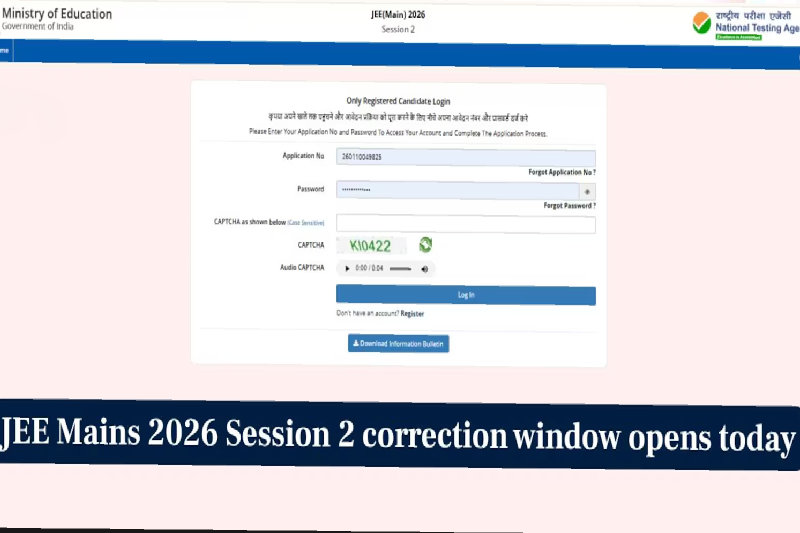
The National Testing Agency (NTA) has opened the correction window for JEE Main 2026 Session 2, offering candidates a brief yet crucial opportunity to rectify errors in their application forms. The facility is available from 27 February and will close on 28 February 2026, underscoring the importance of prompt and careful action.
For lakhs of aspirants preparing for one of India’s most competitive engineering entrance examinations, even a minor discrepancy in application details can lead to avoidable complications. The correction window therefore serves not merely as an administrative provision but as a safeguard against technical disqualification and procedural setbacks.
A One-Time Opportunity
The NTA has clarified that this is a one-time facility extended to candidates in order to prevent hardship. No further opportunity for corrections will be provided once the window closes. Both categories of applicants are eligible to utilise the facility:
- Candidates who applied afresh for JEE (Main) 2026 Session 2
- Candidates who had previously applied for Session 1 and have also registered for Session 2
Given the high stakes associated with the Joint Entrance Examination (JEE) Main, accuracy in documentation is paramount. An incorrect state code, category declaration, or examination city preference may not only complicate the candidature but also influence eligibility for reservations, seat allocation, and logistical arrangements.
To effect any modification, candidates must log in via the official JEE Main portal at jeemain.nta.nic.in and remit any additional fee, where applicable, through credit card, debit card, net banking, or UPI. The fee requirement reflects adjustments in category, paper selection, or other parameters that may alter the originally calculated application charge.
What Existing Candidates Can Modify
Candidates who had previously registered and are seeking changes in their Session 2 details may edit the following fields:
- Course (Paper)
- Medium of Question Paper
- State Code of Eligibility
- Examination Cities (subject to availability)
- Educational Qualification Details (Class 10 and 12)
- Gender
- Category
- Fee Payment
Each of these categories carries procedural and academic implications. For instance, the selection of paper determines whether a candidate appears for B.E./B.Tech., B.Arch., or B.Planning streams. Similarly, the medium of the question paper available in multiple Indian languages must be selected judiciously, as it shapes the candidate’s examination experience.
The state code of eligibility is particularly significant in the context of domicile-based reservations and state quota considerations during counselling. An error in this field can affect seat allocation outcomes at a later stage.
Educational qualification details must correspond precisely with official records, including year of passing and board information. Discrepancies may result in verification challenges during counselling or admission.
What New Candidates Can Modify
For those who registered specifically for Session 2, the range of editable fields is broader. They may modify:
- Educational Qualification Details (Class 10 and 12)
- State Code of Eligibility
- Date of Birth
- Gender
- Category
- Sub-category/PwD Status
- Signature
- Paper Selection
- Examination City Preference
- Medium of Examination
The inclusion of date of birth among editable fields highlights the NTA’s recognition of clerical mistakes that occasionally arise during hurried form submissions. Similarly, candidates belonging to Persons with Disabilities (PwD) categories or specific sub-categories must ensure accurate representation, as these declarations affect both examination arrangements and reservation benefits.
The correction of uploaded signatures is another critical element. In past examination cycles, improperly uploaded or unclear signatures have led to procedural queries. Candidates are therefore advised to verify the clarity, format and compliance of their digital uploads before final submission.
The Importance of Precision
The JEE Main examination process is multi-layered. From application to result declaration, counselling and seat allocation, data accuracy forms the backbone of every stage. The correction window is, in effect, the final checkpoint before the examination process moves forward irreversibly.
Candidates are strongly advised to review their forms meticulously. This entails cross-checking spellings, numerical entries, category codes, and examination city preferences. Even a seemingly minor typographical error in name or qualification year can lead to discrepancies between application data and official identity documents.
Moreover, as this facility is explicitly described as a one-time measure, candidates must resist the temptation to defer corrections. Administrative timelines are rigid, and post-deadline appeals are rarely entertained.
Examination Schedule and Structure
JEE Main 2026 Session 2 is scheduled to be conducted from 2 April to 9 April 2026. The examination will be held in two shifts daily:
- Morning Shift: 9.00 am to 12.00 noon
- Afternoon Shift: 3.00 pm to 6.00 pm
The staggered scheduling accommodates the vast number of candidates appearing across the country and internationally. It also necessitates precise logistical planning, including city allocation, centre distribution and invigilation arrangements.
Candidates must note that examination city preferences, though editable during the correction window, remain subject to availability. The NTA allocates centres based on capacity constraints and administrative feasibility. Hence, timely corrections increase the likelihood of securing a preferred location.
Why the Correction Window Matters Strategically
Beyond administrative rectification, the correction window offers candidates an opportunity for strategic reassessment. Between Session 1 and Session 2, many aspirants refine their preparation plans, reconsider paper combinations, or re-evaluate medium preferences.
For instance, a candidate who appeared for Paper 1 (B.E./B.Tech.) in Session 1 may decide to add or modify their selection for Session 2 based on career aspirations. Others may adjust their examination city preference to align with travel considerations or personal circumstances.
However, such strategic decisions must be informed and measured. Frequent alterations without clear rationale may create unnecessary confusion. Candidates should consult official guidelines, review their academic plans and, where necessary, seek advice from mentors before finalising changes.
Financial Considerations
Any modification that affects the application fee will require payment of the differential amount. The NTA’s digital payment infrastructure supports credit cards, debit cards, net banking and UPI transactions. Candidates must ensure successful payment confirmation, as incomplete transactions may invalidate the correction process.
It is prudent to retain transaction receipts and confirmation messages for record-keeping. Technical glitches, though infrequent, can occur during peak traffic periods, especially close to the deadline.
Maintaining Composure Amid Competitive Pressure
The correction window often coincides with an intense phase of preparation. With the examination barely weeks away, aspirants are balancing revision schedules, mock tests and performance analysis. Administrative formalities can appear secondary, yet they are no less critical.
A composed and systematic approach is advisable. Candidates should allocate a dedicated interval to review and amend their application forms, rather than attempting hurried corrections between study sessions. Precision today prevents procedural distress tomorrow.
Looking Ahead to Session 2
Session 2 holds particular significance for candidates aiming to improve upon their Session 1 scores. JEE Main permits multiple attempts within an academic year, with the best score typically considered for ranking. The April session therefore offers a renewed opportunity for academic advancement.
However, performance outcomes rest not only on preparation but also on compliance with procedural norms. Ensuring the correctness of personal and academic data is a foundational step in this journey.
Final Advisory
As the correction window remains open only until 28 February 2026, candidates are urged to act without delay. Careful scrutiny, accurate modification and secure fee payment will ensure that administrative oversights do not undermine months or years of preparation.
The path to competitive engineering institutions is demanding. Yet attention to detail, whether in problem-solving or paperwork, is often what distinguishes a seamless examination experience from an unnecessarily complicated one.
With Session 2 approaching in early April, this brief correction period represents the final administrative checkpoint. Candidates would do well to treat it with the seriousness it deserves.