IIT Bombay Inaugurates PARAM Rudra: A Major Boost to India’s Indigenous Supercomputing Mission
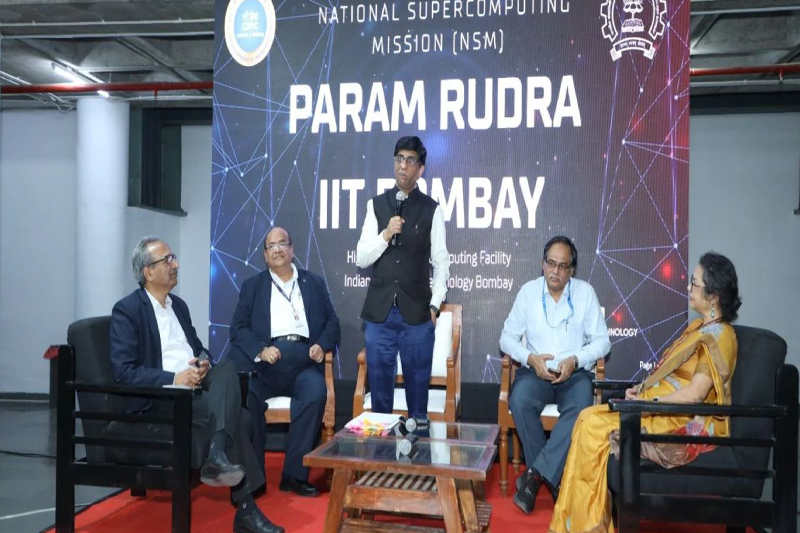
The Indian Institute of Technology (IIT) Bombay has taken a significant step forward in high-performance computing with the inauguration of a new supercomputing facility named PARAM Rudra. The facility was inaugurated on Thursday by Professor Abhay Karandikar, Secretary of the Department of Science and Technology (DST), marking another milestone in India’s journey towards self-reliance in advanced computing technologies.
Developed by the Centre for Development of Advanced Computing (C-DAC), PARAM Rudra is designed to support cutting-edge research and innovation across multiple scientific and engineering disciplines. The new facility strengthens not only IIT Bombay’s research ecosystem but also contributes to the broader national goal of building a robust indigenous supercomputing infrastructure.
A High-Performance System Built Under the National Supercomputing Mission
PARAM Rudra is a three Peta FLOPS high-performance computing (HPC) system developed and deployed under the Build Approach of the National Supercomputing Mission (NSM). The mission aims to create a comprehensive supercomputing ecosystem within India, reducing dependence on imported technologies and fostering domestic capabilities.
What sets PARAM Rudra apart is its strong focus on indigenisation. The system is built on Rudra servers, which have been designed by C-DAC and manufactured entirely in India. In addition, the supercomputer runs on C-DAC’s indigenous software stack, reinforcing India’s push towards self-reliant digital and scientific infrastructure.
The facility also incorporates Direct Contact Liquid Cooling (DCLC) technology, an advanced cooling solution that enhances energy efficiency and system performance. This technology allows the supercomputer to manage heat more effectively, reducing power consumption and making large-scale computing more sustainable.
Strengthening Research at IIT Bombay and Beyond
During the inauguration, Professor Abhay Karandikar emphasised the wide-ranging impact the new facility will have on academic and research activities. According to him, PARAM Rudra will significantly strengthen computational research capabilities at IIT Bombay, directly benefiting over 200 faculty members and nearly 1,200 students.
Beyond the campus, the facility is expected to support researchers from institutions across the country. High-performance computing resources like PARAM Rudra enable complex simulations, data-intensive analysis and advanced modelling that would otherwise be difficult or impossible using conventional computing systems.
Professor Karandikar highlighted that access to such computational power is critical for modern research, where progress increasingly depends on the ability to process large datasets and run sophisticated algorithms at scale.
Enabling Innovation in Key Growth Areas
One of the key objectives of PARAM Rudra is to accelerate innovation in strategically important fields. The facility will support advanced research in areas such as Artificial Intelligence (AI), Biotechnology, and Advanced Manufacturing. These domains are central to India’s long-term economic and technological growth, and high-performance computing plays a vital role in driving breakthroughs within them.
In artificial intelligence, supercomputers enable faster training of complex models, large-scale data analysis and experimentation with advanced algorithms. In biotechnology, researchers can use HPC systems for genomic analysis, drug discovery and molecular simulations. Advanced manufacturing also benefits from simulations related to materials, design optimisation and process efficiency.
Professor Karandikar also noted that PARAM Rudra would help support startups and industry-driven research, creating stronger links between academia and industry. By providing access to advanced computing resources, IIT Bombay can act as a hub for innovation, collaboration and technology development.
A Milestone in India’s Indigenous Supercomputing Journey
Sunita Verma, Group Coordinator at the Ministry of Electronics and Information Technology (MeitY), described the Rudra-based supercomputing cluster as a major milestone in India’s indigenous supercomputing journey. She underlined the importance of continued and sustained investment in key areas such as HPC systems, software platforms, microprocessors and high-speed networking.
According to her, these investments are essential for India to progress towards exascale computing, the next frontier in supercomputing where systems can perform at least one exaFLOP, or a billion billion calculations per second. PARAM Rudra represents an important building block in this long-term vision.
Expanding the National Supercomputing Network
Dr Hemant Darbari, Mission Director of the National Supercomputing Mission, provided a broader national context for the inauguration. With the commissioning of PARAM Rudra at IIT Bombay, India now has 38 supercomputers with a cumulative capacity of 44 Peta FLOPS deployed across the country under the NSM.
He noted that the new facility will not only enhance IIT Bombay’s research capabilities but also augment research prospects for institutions in and around Mumbai. By enabling collaboration and shared access, PARAM Rudra is expected to improve scientific outcomes and foster stronger inter-institutional partnerships.
Dr Darbari highlighted that such facilities are critical for building a culture of computational research and for training the next generation of scientists and engineers in high-performance computing.
The Vision Behind the National Supercomputing Mission
The National Supercomputing Mission is jointly steered by MeitY and DST, with C-DAC and the Indian Institute of Science (IISc) Bengaluru serving as the implementing agencies. The mission is structured around four key pillars:
- Supercomputing Infrastructure – creating a nationwide network of powerful computing systems
- Applications Development – enabling the use of HPC across scientific, industrial and societal domains
- Research and Development – advancing indigenous technologies and system design
- Human Resource Development – building skilled manpower in HPC and computational sciences
PARAM Rudra aligns closely with all four pillars, making it a flagship example of what the mission aims to achieve.
A Strategic Step Forward
The inauguration of PARAM Rudra at IIT Bombay reflects India’s growing confidence and capability in building world-class supercomputing systems using indigenous technology. As research challenges become more complex and data-driven, access to powerful, efficient and locally developed HPC infrastructure will be essential.
With PARAM Rudra, IIT Bombay and the National Supercomputing Mission have taken a decisive step toward strengthening India’s position in global scientific research, innovation and advanced computing.