JEE Main 2026 Session 2 Result Date: Key Timeline Explained
JEE Main 2026 Session 2 Result Timeline: What Candidates Should Know About Key Dates and Next Steps
The announcement of the result timeline for the Joint Entrance Examination Main 2026 Session 2 by the National Testing Agency marks a crucial phase in India’s engineering entrance landscape. For lakhs of aspirants who appeared in the April session, this timeline does not merely outline administrative milestones; it provides a structured pathway from examination to admission. At a glance, the process may appear procedural. Yet, beneath the surface lies a carefully designed evaluation system that determines not only individual performance but also eligibility for some of the country’s most prestigious engineering institutions. The clarity offered by the timeline enables candidates to prepare mentally and strategically for what follows next.
Understanding the Significance of Session 2
JEE Main is conducted in multiple sessions to provide candidates with multiple opportunities to demonstrate their capabilities. Session 2, held in April 2026, is particularly important because it contributes to the final ranking of candidates.
The National Testing Agency administers the examination in a computer-based format across multiple days and shifts, ensuring accessibility and fairness. For the 2026 cycle, the Session 2 examinations were conducted between April 2 and April 9, 2026, accommodating a vast number of candidates across the country.
This multi-day format necessitates a robust normalisation process to ensure that variations in difficulty levels across shifts do not disadvantage any candidate. It is within this framework that the result timeline becomes especially relevant.
Release of Question Papers: The First Step Towards Transparency
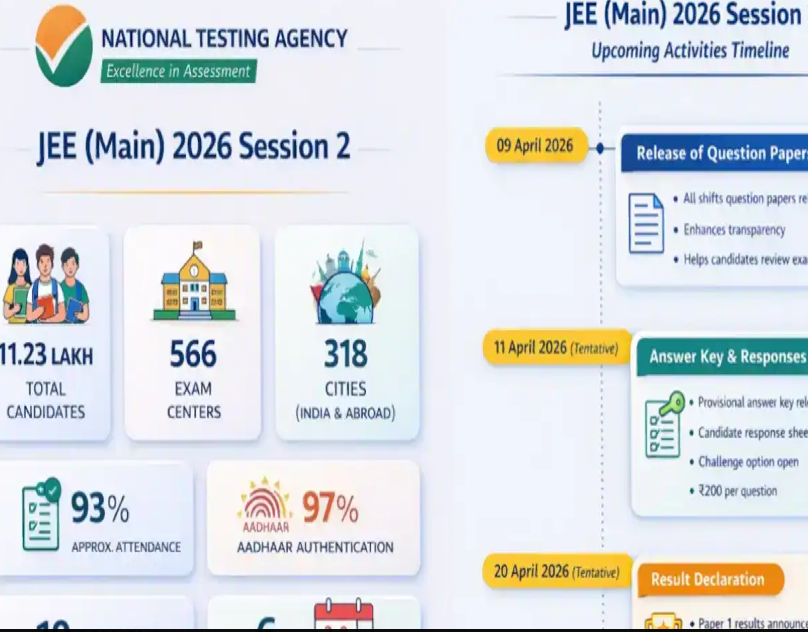
The first major milestone in the timeline is the release of question papers. According to official updates, the National Testing Agency has made the Session 2 question papers available shortly after the examination, allowing candidates to revisit the questions attempted during their respective shifts.
This step serves multiple purposes. It reinforces transparency, enables candidates to evaluate their performance, and prepares them for the next stage: the release of the provisional answer key.
For aspirants, this phase often becomes a period of introspection. It allows them to gauge their likely scores and identify areas of strength and weakness.
Provisional Answer Key and the Challenge Window
Following the release of question papers, the next significant development is the publication of the provisional answer key. This is expected around April 11, 2026, providing candidates with an official reference for evaluating their responses.
The provisional answer key is not final. It is accompanied by a challenge window, during which candidates can raise objections if they believe a particular answer is incorrect. This participatory mechanism reflects the agency’s commitment to fairness and accuracy.
The challenge process is not merely symbolic. It plays a substantive role in refining the final answer key. Each objection is reviewed by subject experts and valid challenges lead to necessary corrections.
This stage underscores an important principle: large-scale examinations must remain open to scrutiny to maintain credibility.
Final Answer Key: Establishing the Benchmark
Once all objections have been reviewed, the National Testing Agency releases the final answer key. This document serves as the definitive benchmark for evaluating candidate responses.
The significance of the final answer key extends beyond individual scores. It forms the basis for calculating percentile scores and, ultimately, the All India Rank.
By resolving discrepancies and incorporating valid challenges, the final answer key ensures that the evaluation process is both accurate and equitable.
Declaration of Results: The Defining Moment
The culmination of the timeline is the declaration of results, expected on or before April 20, 2026.
This date holds immense significance for candidates. The result is not merely a scorecard; it is a comprehensive reflection of performance, including percentile scores and rankings.
For those who have appeared in both sessions of JEE Main 2026, the National Testing Agency adopts a “best of two attempts” policy. The higher percentile score from either session is considered for the final ranking.
This approach offers a measure of flexibility and fairness, allowing candidates to improve upon their earlier performance. It also reduces the pressure associated with a single high-stakes examination.
The Role of Normalisation in Fair Evaluation
One of the defining features of JEE Main is its normalisation process. Given that the examination is conducted in multiple shifts, the difficulty level may vary slightly across sessions.
To address this, the National Testing Agency employs a statistical method that converts raw scores into percentile scores. This ensures that candidates are evaluated on a relative scale, accounting for variations in question paper difficulty.
The normalisation process is integral to maintaining the integrity of the examination. It ensures that no candidate is unfairly advantaged or disadvantaged due to external factors.
Beyond Results: Admission Pathways
The declaration of results marks the beginning of the next phase in the admission process. Based on their scores, candidates become eligible for admission to a wide range of institutions, including the National Institutes of Technology, the Indian Institutes of Information Technology, and other centrally funded technical institutions.
In addition, the top-performing candidates, typically those within the top 2.5 lakh ranks, qualify to appear for JEE Advanced, the gateway to the Indian Institutes of Technology.
Thus, the JEE Main result serves a dual purpose. It is both an endpoint and a beginning, determining immediate admissions while also opening doors to further opportunities.
The Importance of Official Platforms
The National Testing Agency has consistently emphasised that results will be available exclusively on official websites. Candidates are required to log in using either their application number and password or their date of birth to access their scorecards. This centralised approach ensures authenticity and minimises the risk of misinformation. In an era where unofficial sources can often create confusion, adherence to official platforms becomes essential.
Strategic Preparation in the Interim
While the timeline provides clarity, it also introduces a waiting period that can be both anticipatory and stressful. Candidates are advised to use this time constructively.
For those confident of qualifying, preparation for counselling and further examinations such as JEE Advanced, becomes imperative. This includes revising core concepts, practising advanced-level questions and staying informed about counselling procedures.
For others, the interim period offers an opportunity for reflection and planning. Analysing performance, identifying areas for improvement and considering alternative pathways can help make informed decisions.
Psychological Dimensions of Result Waiting
The period between examination and result declaration is often characterised by uncertainty. Managing this phase effectively is as important as preparing for the examination itself. Candidates are encouraged to maintain a balanced routine, engage in productive activities, and avoid excessive speculation. The clarity provided by the timeline can serve as a stabilising factor, offering a sense of direction amidst uncertainty.
Broader Implications for India’s Education System
The structured timeline of JEE Main reflects the evolving sophistication of India’s examination systems. By incorporating transparency, flexibility and technological efficiency, the National Testing Agency has set a benchmark for large-scale assessments.
The emphasis on multiple sessions, normalisation and candidate participation through challenge mechanisms highlights a shift towards more inclusive and equitable evaluation practices.
Such developments are particularly significant in a country where competitive examinations play a central role in shaping educational and professional trajectories.
Looking Ahead: From Examination to Opportunity
As the result date approaches, candidates stand at a threshold. The outcome will determine not only their immediate academic future but also their long-term career pathways. For many, success in JEE Main represents the fulfilment of years of dedication and effort. For others, it may signal the need to explore alternative routes. In either case, the experience contributes to personal growth and resilience.
Conclusion
The JEE Main 2026 Session 2 result timeline offers more than a sequence of dates. It provides a structured framework that guides candidates from examination to evaluation and beyond. From the release of question papers to the final declaration of results, each stage is designed to ensure transparency, accuracy and fairness. The anticipated result date of April 20, 2026, stands as a focal point, bringing clarity to the aspirations of countless students. In the broader context, the process exemplifies the evolving standards of India’s educational assessments. For candidates, it represents both a culmination and a commencement, a moment that bridges preparation with possibility.