UPSC ESE Mains 2026 Timetable Released: Exam on June 21
UPSC ESE Mains 2026 Timetable Released: A Defining Moment for Engineering Aspirants
The release of the Engineering Services Examination (ESE) Mains 2026 timetable by the Union Public Service Commission (UPSC) marks a pivotal juncture in the journey of thousands of engineering aspirants across India. As one of the most prestigious and technically demanding examinations in the country, the ESE is not merely a test of academic proficiency but a gateway to influential roles within the nation’s administrative and infrastructural framework. With the official schedule now available, candidates who have successfully cleared the preliminary stage must shift their focus to the next, and arguably most rigorous, phase of the selection process.
A Clear Timeline: Structure and Schedule
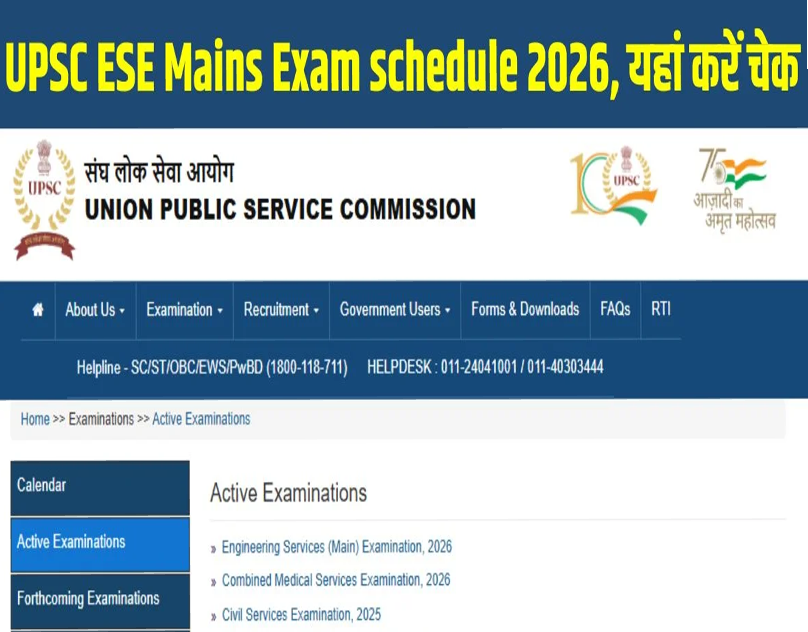
According to the official notification, the UPSC ESE Mains 2026 examination will be conducted on June 21, 2026. The examination is scheduled to be held in two shifts on the same day. The first session will take place from 9:00 am to 12:00 noon, followed by the second session from 2:30 pm to 5:30 pm. This dual-shift format underscores the intensity of the examination. Candidates are required to demonstrate sustained concentration and technical precision across two extensive papers within a single day, a challenge that tests both intellectual stamina and composure under pressure.
Eligibility: Who Can Appear?
Only those candidates who have successfully cleared the preliminary stage of the Engineering Services Examination are eligible to appear for the Mains. The prelims results for the 2026 cycle were declared on February 27, 2026, marking the transition point for shortlisted candidates. This progression reflects the multi-stage nature of the examination, in which each level serves as a filter to identify candidates with the requisite technical competence and analytical depth.
The Nature of the Mains Examination
The ESE Mains examination is fundamentally different from its preliminary counterpart. While the prelims are objective in nature and designed to assess the breadth of knowledge, the Mains examination adopts a conventional (descriptive) format.
As per the official details, the Mains will consist of two discipline-specific papers, each carrying 300 marks, culminating in a total of 600 marks.
Each paper spans three hours, requiring candidates to present detailed, structured answers that reflect not only theoretical understanding but also practical application. The emphasis here is on clarity, precision and depth, qualities that distinguish successful candidates at this stage.
A Shift from Recognition to Articulation
One of the defining features of the Mains examination is its demand for articulation. Unlike objective questions, where recognition and elimination techniques may suffice, descriptive papers require candidates to construct coherent arguments, solve complex numerical problems and present solutions with methodological clarity.
This shift necessitates a corresponding transformation in preparation strategy. Aspirants must move beyond rote learning and develop the ability to:
- Explain technical concepts in a structured manner
- Solve problems step-by-step with clarity
- Manage time effectively across lengthy questions
- Maintain accuracy under exam conditions
In essence, the Mains examination evaluates not just what candidates know, but how effectively they can communicate that knowledge.
The Examination Cycle: A Structured Progression
The Engineering Services Examination follows a three-stage selection process:
- Preliminary Examination
- Mains Examination
- Personality Test (Interview)
Candidates who secure the minimum qualifying marks in both the preliminary and mains stages, as determined by the Commission, are subsequently shortlisted for the Personality Test. This structured progression ensures that only those candidates who demonstrate consistent excellence across multiple dimensions - objective knowledge, descriptive analysis and interpersonal competence are selected.
Why the Timetable Matters
The release of the timetable is more than a procedural announcement; it serves as a strategic anchor for aspirants. With a definitive date in place, candidates can now calibrate their preparation with precision.
A fixed schedule allows aspirants to:
- Design a structured revision plan
- Allocate time to high-weightage topics
- Practise mock tests under timed conditions
- Fine-tune answer-writing techniques
In competitive examinations, uncertainty often breeds anxiety. By providing clarity, the timetable enables candidates to channel their efforts more effectively.
Preparation Strategy: The Final Phase
With the Mains examination scheduled for June, the intervening period becomes a crucial window for consolidation and refinement. At this stage, preparation must be both strategic and disciplined.
Focused Revision
Candidates should prioritise revisiting core subjects and strengthening conceptual clarity. Attempting to cover entirely new topics at this stage may prove counterproductive.
Answer Writing Practice
Regular practice of descriptive questions is indispensable. Candidates must develop the ability to present answers in a logical, concise and structured format.
Time Management
Given the length and complexity of the papers, effective time allocation is critical. Practising full-length mock tests under exam conditions can significantly enhance performance.
Error Analysis
Reviewing mistakes and identifying weak areas is as important as practising questions. Continuous refinement is key to achieving precision.
The Psychological Dimension
Beyond academic preparation, the announcement of the timetable introduces a psychological shift. The examination is no longer an abstract objective but an imminent reality.
This phase often demands a balance between confidence and composure. Candidates must guard against both complacency and anxiety, maintaining a steady focus on their preparation.
Discipline, consistency and mental resilience become as important as technical knowledge. The ability to remain calm under pressure can often be the differentiating factor in high-stakes examinations.
The Broader Significance of ESE
The Engineering Services Examination occupies a unique position within India’s competitive landscape. It is not merely a career pathway but a platform for engineers to contribute to nation-building.
Successful candidates are appointed to prestigious Group A and Group B services, where they play a crucial role in planning, executing and managing large-scale infrastructure projects. Their work spans sectors such as transportation, telecommunications, water resources and defence.
In this context, the Mains examination assumes greater significance. It is designed to identify individuals capable of handling complex technical responsibilities with precision and accountability.
Administrative Efficiency and Transparency
The timely release of the Mains timetable reflects the UPSC’s commitment to maintaining a structured and transparent examination process. Over the years, the Commission has established a reputation for adhering to schedules and ensuring procedural clarity. Such consistency is particularly important in examinations involving candidates from diverse geographical and socio-economic backgrounds. It fosters trust in the system and enables aspirants to plan their preparation with confidence.
Looking Ahead: Beyond the Mains
While the Mains examination is a critical milestone, it is not the final step. Candidates who perform well will advance to the Personality Test, where their suitability for administrative roles will be assessed. However, the foundation for success in the interview stage is often laid during the Mains. A strong performance not only enhances one’s position in the merit list but also builds the confidence required for the final stage.
Conclusion
The release of the UPSC ESE Mains 2026 timetable marks a decisive moment in the examination journey. With the examination scheduled for June 21, 2026, aspirants now have a clear timeline within which to refine their preparation and sharpen their focus. At this stage, success will depend not merely on knowledge but on execution, on the ability to translate preparation into performance under demanding conditions. In the final analysis, the Mains examination is a test of both intellect and endurance. For those who navigate it successfully, it opens the door to a career defined by responsibility, impact and the opportunity to contribute meaningfully to the nation’s development.