RBI Assistant Result 2026 Declared, Mains Exam on June 7
RBI Assistant Result 2026: A Defining Moment in India’s Competitive Recruitment Landscape
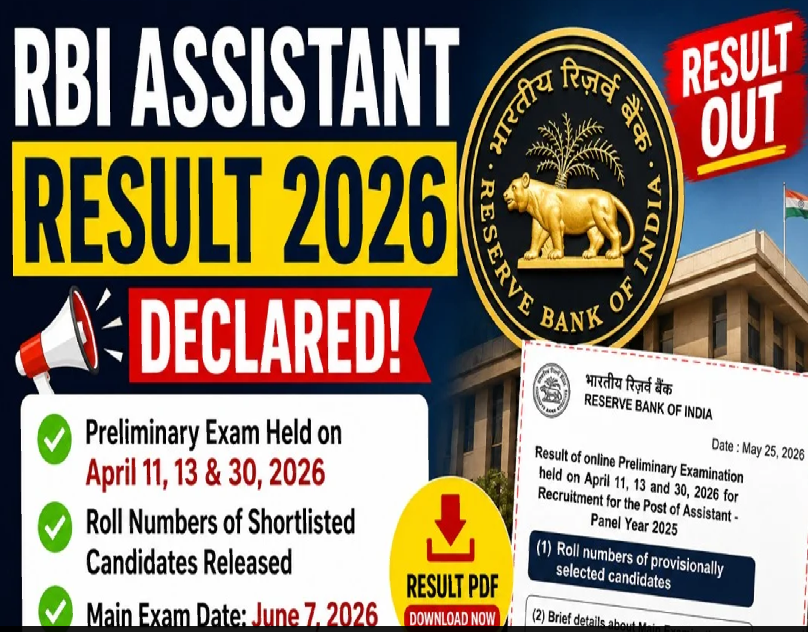
The declaration of the Assistant Preliminary Examination Result 2026 by the Reserve Bank of India (RBI) marks a significant juncture in one of the country’s most sought-after recruitment processes. Released on the official portal, the result not only signals the culmination of the first stage but also ushers shortlisted candidates into the more demanding phase of the selection process, the Mains examination, scheduled for June 7, 2026.
For thousands of aspirants across India, this announcement is far more than a routine update. It represents months, often years, of disciplined preparation, sustained focus, and calculated perseverance. The transition from prelims to mains is not merely procedural; it is transformative, demanding a recalibration of strategy, depth of understanding and psychological readiness.
The result, published in a downloadable PDF format, enables candidates to verify their roll numbers with relative ease. Yet, behind this seemingly simple mechanism lies a moment of considerable emotional weight, one that separates those who advance from those who must reassess and prepare anew.
The Enduring Appeal of RBI Recruitment
Recruitment to the Reserve Bank of India has long occupied a distinguished place within the broader ecosystem of public sector employment. Unlike many other examinations, RBI recruitment carries with it a distinct aura, an intersection of financial authority, institutional prestige, and intellectual rigour.
The role of an Assistant within the RBI, though often perceived as an entry-level position, offers exposure to the inner workings of India’s central banking system. From currency management to regulatory oversight, the institution operates at the heart of the nation’s economic framework. For candidates, therefore, selection is not merely a matter of employment but an entry into a system that shapes macroeconomic stability and policy direction.
This intrinsic appeal contributes to the intensity of competition. Each recruitment cycle witnesses a vast pool of applicants, drawn from diverse academic and professional backgrounds. The preliminary examination, designed as a screening test, serves to filter this large cohort, identifying candidates with the aptitude and foundational knowledge required for the subsequent stages.
Understanding the Preliminary Phase
The preliminary examination is structured to assess core competencies: reasoning ability, numerical aptitude and English language proficiency. While the syllabus may appear conventional, the level of competition elevates the standard considerably. Success in this stage demands not only conceptual clarity but also speed, accuracy and effective time management.
For many candidates, the prelims represent a critical threshold. It is here that preparation strategies are first tested against the realities of the examination environment. The declaration of results, therefore, functions as both validation and feedback, affirming effective approaches while exposing areas that require refinement.
The release of the results in a consolidated PDF format reflects a broader trend towards transparency and efficiency in recruitment processes. Candidates can access the document, search for their roll numbers and quickly ascertain their status. This streamlined approach minimises ambiguity, ensuring that information is both accessible and verifiable.
The Mains Examination: Depth Over Breadth
With the prelims now concluded, attention shifts decisively to the Mains examination, scheduled for June 7. Unlike the preliminary stage, which prioritises breadth and speed, the mains demand depth of understanding and analytical precision.
The syllabus expands to include areas such as general awareness, particularly with a focus on financial and economic developments, alongside more advanced sections in reasoning and quantitative aptitude. This shift necessitates a corresponding change in preparation strategy. Candidates must move beyond surface-level familiarity, engaging more deeply with concepts and their applications.
Equally important is the cultivation of awareness regarding current affairs, especially those related to banking, finance and the broader economic landscape. In an institution such as the RBI, where policy decisions are informed by complex economic indicators, such awareness is not merely desirable but essential.
The limited time between the declaration of prelims results and the mains examination adds layer of urgency. Candidates must optimise their preparation, focusing on high-impact areas while maintaining consistency and composure.
The Psychology of Progression
Beyond the academic demands, the transition to the mains stage introduces a distinct psychological dimension. Success in the prelims can instil confidence, yet it also brings heightened expectations, both internal and external. Managing this duality is crucial.
For those who have qualified, the challenge lies in sustaining momentum without succumbing to complacency. For those who have not, the experience offers an opportunity for reflection and recalibration. In both cases, the process underscores the importance of resilience, a quality that is as vital in competitive examinations as it is in professional life.
The RBI recruitment process, by design, tests not only knowledge but also temperament. The ability to perform under pressure, to adapt to evolving demands and to maintain clarity of thought are attributes that the institution values highly.
Administrative Transparency and Candidate Responsibility
The RBI has consistently emphasised transparency in its recruitment procedures, and the current cycle is no exception. The publication of results, updates regarding examination schedules and subsequent notifications are all made available through the official website, ensuring that candidates have access to reliable and timely information.
However, this transparency is complemented by an expectation of responsibility on the part of candidates. It is incumbent upon them to regularly monitor official communications, download relevant documents and adhere to prescribed guidelines. In an era of digital administration, where information is readily available, oversight often stems not from scarcity but from inattention.
Candidates are also advised to secure copies of their result PDFs and maintain records of all relevant communications. Such practices, though seemingly routine, can prove invaluable in navigating later stages of the recruitment process.
A Broader Reflection on Competitive Examinations
The RBI Assistant examination is emblematic of a wider culture of competitive testing in India. It reflects both the aspirations of a young, ambitious population and the structural realities of a labour market where demand often outstrips opportunity.
In this context, each stage of the examination assumes heightened significance. Success is not merely a personal achievement but a testament to discipline, strategy and perseverance. At the same time, the process invites reflection on the nature of merit, the role of standardised testing and the broader objectives of recruitment systems.
For policymakers and institutions, the challenge lies in designing examinations that are both rigorous and equitable, capable of identifying talent while accommodating the diversity of candidate backgrounds. For aspirants, the task is to engage with the process thoughtfully, recognising both its opportunities and its limitations.
What Lies Ahead
As the June 7 Mains examination approaches, the focus for shortlisted candidates must be both strategic and measured. Preparation should be guided by clarity, an understanding of the examination’s demands, one’s own strengths and weaknesses and the most effective allocation of time and effort.
Equally important is the cultivation of balance. While rigorous study is indispensable, it must be complemented by adequate rest, mental composure and a sustainable routine. The ability to perform at one’s best on the day of the examination often depends as much on well-being as on preparation.
For those who do not progress to the next stage, the journey does not end here. Each attempt contributes to a deeper understanding of the examination, refining strategies and strengthening resolve for future opportunities.
In conclusion, the release of the RBI Assistant Preliminary Result 2026 is more than a procedural milestone. It is a moment of transition, one that encapsulates the challenges and possibilities inherent in competitive recruitment. As candidates move forward, whether to the mains examination or to renewed preparation, what remains constant is the enduring value of perseverance, clarity and purposeful effort.