SECR Apprentice Recruitment 2026 Opens for 1,644 Vacancies
SECR Apprentice Recruitment 2026 Opens New Opportunities for Technical Aspirants Across India
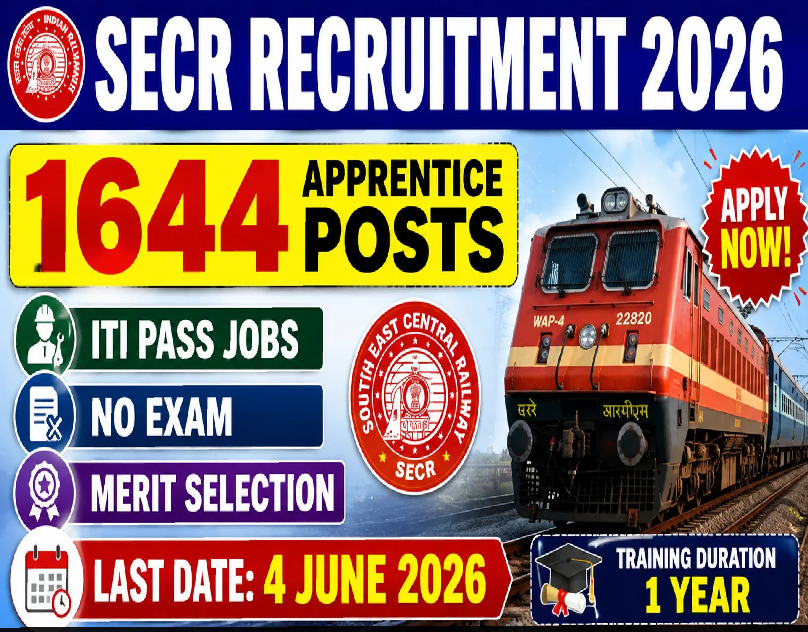
The South East Central Railway (SECR) has commenced its Apprentice Recruitment 2026 drive, announcing 1,644 vacancies across multiple technical trades and divisions, thereby creating one of the most substantial apprenticeship opportunities currently available within the Indian Railways network. The application process officially began on May 5 and will remain open until June 4, 2026, through the Apprenticeship India portal. For thousands of ITI-qualified candidates and Class 10 graduates across the country, the recruitment drive represents more than a training opportunity. It offers a potential gateway into India’s vast railway ecosystem, an institution long regarded as one of the nation’s most stable and prestigious public sector employers.
The scale of this year’s recruitment reflects not only the continuing expansion of technical workforce requirements within Indian Railways but also the growing importance of skill-based vocational pathways in India’s evolving employment landscape.
One of the Largest Railway Apprentice Drives of the Year
According to official notifications, SECR has announced a total of 1,644 apprentice vacancies under the Apprentices Act, 1961. Of these, 1,363 posts are available under the DRM Office, Raipur Division, while the remaining 281 vacancies are allocated to the Wagon Repair Shop, Raipur.
The recruitment spans a wide range of technical trades, including:
- Fitter
- Electrician
- Welder
- COPA
- Turner
- Machinist
- Mechanic Diesel
- Carpenter
- Stenographer
- Electronics Mechanic
- Painter
- Pipe Line Fitter
Among these, fitter, electrician and welder trades account for the largest share of vacancies, reflecting the operational and maintenance requirements of railway infrastructure and rolling stock systems.
The breadth of trades included within the recruitment process ensures that candidates from varied vocational backgrounds can participate, thereby broadening the reach of technical employment opportunities.
Eligibility Criteria and Educational Requirements
The recruitment notification specifies that applicants must have passed Class 10 under the 10+2 system or its equivalent with a minimum of 50 per cent aggregate marks. In addition, candidates must possess an ITI certificate in the relevant trade from a recognised institution.
The prescribed age limit is between 15 and 24 years as of May 5, 2026, although age relaxation provisions remain applicable for reserved categories in accordance with government regulations.
Importantly, the recruitment process does not involve a written examination. Instead, selection will be based on merit, calculated through the average percentage obtained in both matriculation and ITI examinations, with equal weightage assigned to each.
This merit-based structure is particularly significant because it reduces examination pressure while simultaneously rewarding consistent academic and vocational performance.
Why Railway Apprenticeships Continue to Hold Strong Appeal
Apprenticeship programmes under Indian Railways have historically attracted immense interest among young technical aspirants. Several factors contribute to this sustained popularity.
Firstly, railway apprenticeships offer practical industrial exposure within one of the largest operational networks in the world. Unlike purely classroom-based vocational education, apprenticeships allow candidates to gain hands-on experience in real technical environments.
Secondly, the railway sector continues to enjoy considerable social and economic prestige in India. Employment opportunities associated with Indian Railways are widely perceived as stable, structured and professionally respectable.
For many candidates, apprenticeship programmes also serve as stepping stones towards future employment opportunities, both within the public and private sectors. Technical experience acquired during apprenticeship training often strengthens employability in manufacturing, transport, engineering and infrastructure industries.
The SECR recruitment drive, therefore, arrives at a time when vocational skill development is becoming increasingly important within India’s employment ecosystem.
India’s Growing Emphasis on Skill-Based Education
The significance of apprenticeship recruitment extends beyond the railway sector alone. It reflects a broader national shift towards vocational education, technical training and industry-oriented skill development.
Over the past decade, India has increasingly recognised the need to strengthen employability through practical learning frameworks. Traditional academic degrees, while important, are no longer viewed as sufficient in isolation within a rapidly evolving labour market.
Government initiatives such as Skill India, apprenticeship promotion schemes and industrial training reforms have sought to bridge the gap between formal education and workforce readiness. Railway apprenticeship programmes form an important component within this wider strategy.
In this context, SECR’s recruitment initiative aligns closely with national objectives surrounding technical workforce expansion and industrial productivity.
Digital Recruitment and Simplified Accessibility
One of the notable aspects of the 2026 recruitment process is the continued reliance on fully online application systems. Interested candidates must submit applications through the official Apprenticeship India portal before the June 4 deadline.
The digitalisation of recruitment procedures has significantly improved accessibility for applicants from diverse geographical backgrounds. Candidates can now complete registrations, upload documents and monitor application status without needing to visit physical offices.
This shift towards digital recruitment has also enhanced transparency and administrative efficiency within public sector hiring processes.
However, experts continue to note that digital accessibility remains uneven across certain rural and economically disadvantaged regions. Reliable internet connectivity and digital literacy still influence participation rates in online recruitment systems.
Consequently, educational institutions, cyber centres and local training institutes continue to play an important role in assisting candidates throughout the application procedures.
The Importance of Apprenticeship in Modern Workforce Development
The renewed focus on apprenticeship training reflects changing realities within global employment markets. Employers increasingly seek candidates who possess not only theoretical knowledge but also operational competence and technical adaptability.
Apprenticeships bridge this gap by integrating structured learning with practical workplace experience. Candidates are exposed to industrial processes, equipment handling, maintenance systems and professional discipline within real operational environments.
In sectors such as railways, where safety, precision and technical coordination are essential, apprenticeship training becomes particularly valuable.
Moreover, apprenticeship models help reduce the disconnect that sometimes exists between academic curricula and industry requirements. By engaging directly with infrastructure systems and technical operations, apprentices gain experience that conventional classroom instruction may struggle to replicate fully.
The SECR recruitment drive, therefore, carries significance not merely as an employment notification but as part of a wider conversation surrounding workforce preparedness in India.
Railways and India’s Infrastructure Expansion
The importance of technical recruitment within Indian Railways has grown substantially in recent years due to ongoing infrastructure modernisation initiatives. Across the country, railway networks are undergoing extensive transformation through electrification projects, track modernisation, high-speed corridors, freight optimisation and digital operational systems.
These developments require a skilled technical workforce capable of maintaining and supporting increasingly sophisticated infrastructure.
Apprenticeship programmes contribute directly to this ecosystem by creating pipelines of technically trained personnel familiar with railway operations and maintenance frameworks.
South East Central Railway itself occupies strategic importance within India’s railway network, particularly in freight movement and industrial connectivity across central India. Recruitment within such divisions, therefore, supports broader logistical and infrastructural objectives at the national level.
Competition and Aspirational Employment
The considerable interest surrounding railway apprenticeship programmes also reflects the intense competition currently shaping India’s employment environment.
For many young people, particularly those from middle-income and lower-income backgrounds, public sector opportunities continue to represent pathways towards financial stability and social mobility. Even apprenticeship positions attract large numbers of applicants due to their association with reputed government institutions.
At the same time, the growing demand for technical and vocational opportunities indicates a gradual shift in societal perceptions regarding career pathways. Skill-based professions are increasingly gaining recognition as viable and respectable alternatives to conventional degree-oriented careers.
This evolution may prove crucial for India’s demographic and economic future. With millions of young people entering the workforce annually, vocational training and technical education are becoming indispensable components of sustainable employment generation.
Preparing for the Recruitment Process
Candidates applying for the SECR apprenticeship programme are advised to carefully review the official eligibility criteria and documentation requirements before completing the application process.
Typically required documents include:
- Class 10 marksheet
- ITI certificate
- Aadhaar card
- Passport-size photograph
- Signature
- Category certificate, where applicable
Since selection is merit-based, accuracy in application details becomes especially important. Discrepancies in academic records or uploaded documents may lead to rejection during verification stages.
Applicants shortlisted through the merit process may also be required to produce medical fitness certificates during document verification, in accordance with apprenticeship regulations.
Beyond Recruitment: Building a Skilled Future
The SECR Apprentice Recruitment 2026 drive ultimately represents more than a routine employment notification. It reflects the growing intersection between education, vocational training and infrastructure development in modern India.
As industries evolve and technological systems become increasingly complex, the demand for technically trained personnel will continue expanding across sectors. Apprenticeship programmes provide a practical mechanism through which young individuals can transition from education into industry with greater confidence and preparedness.
For thousands of aspiring candidates, the coming weeks will represent an important opportunity to secure entry into one of India’s most influential public institutions.
Yet beyond the immediate recruitment cycle lies a larger reality: the future of India’s workforce will depend not only on academic qualifications, but also on the country’s ability to nurture practical skills, technical competence and adaptable learning pathways for the generations ahead.