SSC MTS Answer Key 2026 Released: A Crucial Milestone in a Competitive Recruitment Process
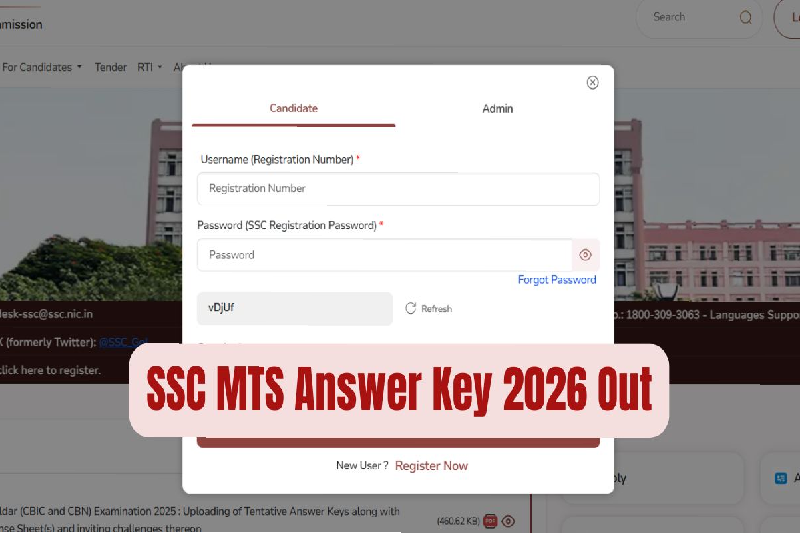
In a development of considerable significance for aspirants of government service, the Staff Selection Commission (SSC) has released the provisional answer key for the Multi-Tasking Staff (Non-Technical) and Havaldar Examination 2025-26 commonly referred to as SSC MTS 2026 on 3 March 2026. This publication, accessible via the Commission’s official website at ssc.gov.in, represents an essential step in the transparency and legitimacy of the recruitment process. Candidates who sat the examination now have the means to evaluate their performance, calculate tentative scores and, if necessary, lodge objections against any perceived inaccuracies before the final key and results are formalised. For thousands of applicants who completed the computer-based test (CBT) earlier this year, the release of the answer key is both a moment of relief and renewed focus, a chance to understand where they stand and what lies ahead in this highly competitive recruitment cascade.
Context: What Is the SSC MTS Examination?
The SSC MTS examination is a nationwide competitive test conducted to recruit personnel for Multi-Tasking (Non-Technical) Staff positions across various ministries, departments and offices of the Government of India. In addition to the MTS posts, the examination also caters to Havaldar vacancies under the Central Board of Indirect Taxes and Customs (CBIC) and the Central Board of Narcotics (CBN). Because these posts are among the most sought-after opportunities in government employment offering job security, stable remuneration and scopes for advancement, the examination draws a substantial pool of candidates from across India. The SSC’s commitment to procedural transparency, therefore, is vital to ensuring faith in the recruitment process and in the meritocratic principles on which it rests.
The Significance of Releasing the Answer Key
An answer key might seem like a technical artefact of exam administration, but its release performs several key functions in the lifecycle of a competitive examination:
- Performance Estimation: Candidates can match their recorded responses against official solutions to estimate their likely marks before the result announcement.
- Transparency: Making the key public reinforces the fairness of the selection process by allowing scrutiny of official answers.
- Opportunity for Redress: If candidates identify discrepancies, they can challenge specific answers during the objection window, a critical mechanism for justice and accuracy.
These aspects make the answer key release a milestone event that bridges the immediate aftermath of the examination with the forthcoming declaration of results.
How to Access the SSC MTS 2026 Answer Key
The provisional answer key, along with individual response sheets, is available on the official SSC portal. Candidates must log in using their registration number or roll number and password to download both documents.
To ensure ease of access, SSC typically hosts a direct login link on the homepage, which leads to a consolidated page containing:
- The Answer Key PDF showing correct answers to all Computer-Based Test questions.
- Candidate Response Sheets detailing the answers submitted by individual candidates during the examination.
A careful review of both these documents enables candidates to measure their performance with precision and to make informed decisions about raising objections, if necessary.
The Objection Window: An Avenue for Accuracy
One of the defining features of modern recruitment examinations is the ability for candidates to challenge the provisional answer key. In this instance, SSC has opened the objection window from 3 March to 6 March 2026. Candidates who find potential errors in the provisional key may submit challenges online, albeit with a fee of ₹50 per question challenged using the same SSC login portal.
This window for representation underscores the Commission’s effort to balance procedural rigor with openness. It recognises that errors however inadvertent can occur in complex examinations of this scale, and it compensates by offering candidates a structured process to contest them. However, it also instills responsibility in candidates: objections must be substantiated, clear and timely, else the opportunity to rectify genuine errors might slip away.
After the objection period concludes, SSC will review all representations and, where justified, revise the answer key before releasing the final version. Subsequent score calculation and result preparation will be based on that definitive key.
Estimating Scores: A Practical Guide
For aspirants keen to estimate their performance, understanding the marking scheme is crucial. Typically, the SSC MTS examination follows a structure wherein:
- Each correct answer earns assigned marks according to the paper pattern,
- Incorrect answers may attract a penalty, often modest, such as one mark deduction in certain sections.
By comparing their responses with the provisional key and applying the official marking rules, candidates can derive a tentative score. This score does not guarantee final selection but serves as a useful benchmark to gauge potential standing prior to the official declaration of results.
The Process Ahead: Final Key and Results
Once the objection phase is complete and the final answer key has been released, SSC will proceed to compile the results for the MTS and Havaldar examination. These will include:
- Final scores for all candidates, based on verified answers
- Cut-off marks delineating merit thresholds across categories
- Merit lists that inform future stages, such as document verification and appointment formalities
Given the typical timeline of SSC examinations, candidates can expect results to follow several weeks after the conclusion of the objection period, although specific dates are usually announced on the official website.
Arbitration and Assurance in Competitive Examinations
The very idea of a publicly accessible answer key embodies a broader principle of accountability in public examinations. It places the onus not only on the recruiting agency to uphold standards but also on candidates to exercise their rights responsibly. This interplay fosters a recruitment environment where procedural safeguards coexist with aspirant agencies. In a landscape where anxiety levels run high among examinees - eager for clarity, anxious about fairness and keenly awaiting outcomes such mechanisms affirm that the process is robust, equitable and systematically audited.
Reflections on the Larger Examination Ecosystem
The release of the MTS answer key, while a routine event in administrative terms, offers a broader lens through which to view competitive examinations in India. With millions of candidates vying each year for government posts across numerous agencies, transparency at every stage is vital to sustaining confidence in public recruitment.
SSC’s annual examination cycles from registration and admit card issuance to answer key publication and final results, embody a complex choreography of logistics, data management and policy execution. The answer key release is one of the most eagerly anticipated junctures because it transitions candidates from passive participation (taking the test) to active evaluation (analysing their performance).
This shift is both psychological and pragmatic: it empowers candidates to reflect on their efforts, to confront uncertainties with data, and to make strategic choices about future stages.
Conclusion: A Moment of Evaluation and Anticipation
The announcement of the SSC MTS Answer Key 2026 marks a pivotal moment in the recruitment journey for thousands of aspirants across India. As candidates download their response sheets, compare answers and prepare to raise objections, they participate in a process that blends personal aspiration with institutional accountability.
The roadmap ahead from objection review to result publication, will unfold over the coming weeks. For now, candidates have in their hands the tools to assess their performance and to understand, with greater clarity, the outcomes of months of preparation. In a competitive examination landscape defined as much by preparation as by patience, the answer key release is both culmination and commencement, a point of reflection and a turning point towards the final chapter of selection.