XLRI to Launch 61.7-Acre Amravati Campus, Intake to Rise by 1,000+
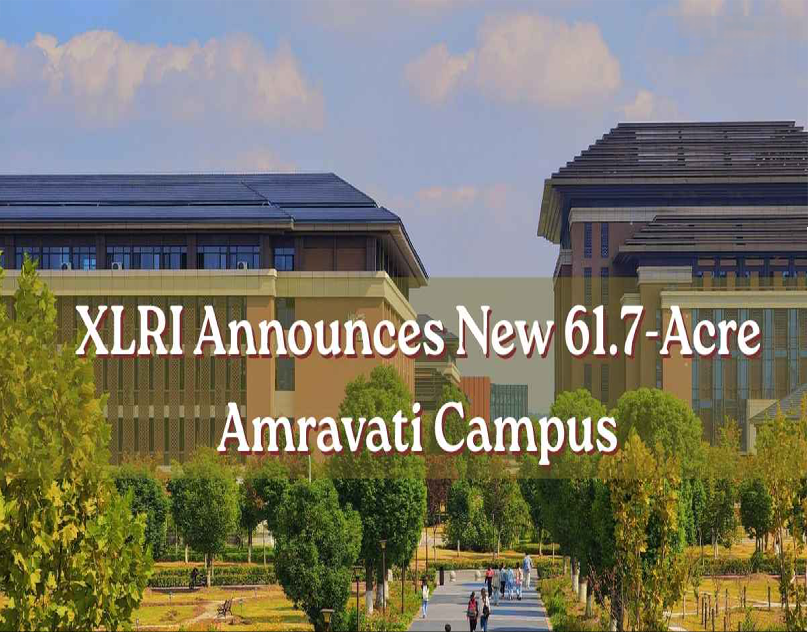
XLRI Announces New 61.7-Acre Amravati Campus, is set to expand its student intake by over 1,000
In a significant development for management education in India, XLRI – Xavier School of Management has unveiled plans to establish a new campus in Amravati, Andhra Pradesh. Spread across an expansive 61.7 acres, the proposed campus marks a strategic step in the institution’s long-term vision to expand its academic footprint and respond to the growing demand for high-quality management education.
This announcement comes at a time when India’s higher education ecosystem is undergoing rapid transformation, with increasing emphasis on accessibility, capacity expansion, and global competitiveness. XLRI’s move reflects both an institutional ambition and a broader national trend of strengthening educational infrastructure in emerging academic hubs.
Expanding Capacity to Meet Rising Demand
One of the most noteworthy aspects of this development is the planned increase of over 1,000 student seats. This expansion is not merely numerical; it represents a meaningful attempt to accommodate a larger and more diverse cohort of aspiring management professionals.
In recent years, premier business schools across India have witnessed a surge in applications, driven by the growing relevance of management education in a globalised economy. From entrepreneurship and consulting to technology and public policy, management graduates are playing pivotal roles across sectors. Against this backdrop, the expansion of XLRI’s intake capacity is both timely and necessary.
By creating additional seats, the institution is effectively widening access to its rigorous academic programmes, thereby enabling more students to benefit from its legacy of excellence. This move also aligns with the broader objective of democratising access to top-tier education without compromising on quality.
Strategic Location: The Rise of Amravati
The choice of Amravati, Andhra Pradesh, as the site for the new campus is particularly significant. Envisioned as a modern urban centre with robust infrastructure, Amravati has been steadily positioning itself as an emerging hub for education, governance, and innovation.
By establishing a presence in this region, XLRI is contributing to the development of a new academic ecosystem outside traditional metropolitan centres. This decentralisation of premier educational institutions is a crucial step towards balanced regional development.
Furthermore, the location offers strategic advantages in terms of connectivity, availability of land, and the opportunity to build a campus from the ground up with contemporary design principles. It also enhances the institute’s ability to attract talent from southern and central India, thereby fostering greater diversity within its student body.
A Vision for Modern Academic Infrastructure
The proposed campus is expected to feature state-of-the-art academic infrastructure, designed to support both teaching and research. While specific architectural details are yet to be fully disclosed, the emphasis is clearly on creating a modern, technology-enabled learning environment.
Such infrastructure typically includes advanced classrooms, digital learning platforms, research centres, and collaborative spaces that encourage innovation and interdisciplinary engagement. In an era where education is increasingly blended with technology, the design of physical and virtual learning environments plays a crucial role in shaping academic outcomes.
Additionally, the campus is likely to incorporate residential facilities, recreational amenities, and spaces for extracurricular engagement - elements that are integral to holistic development. This comprehensive approach reflects XLRI’s long-standing commitment to nurturing not just academically proficient graduates, but well-rounded individuals equipped with leadership qualities.
Strengthening Academic Offerings
The expansion is also expected to support a wider range of programmes, including full-time and executive education courses. This diversification is essential in addressing the evolving needs of learners at different stages of their careers.
For instance, early-career professionals may seek full-time postgraduate programmes that provide foundational knowledge and industry exposure. Meanwhile, mid-career executives often look for flexible learning options that enable them to upskill without interrupting their professional trajectories.
By catering to these varied needs, XLRI is positioning itself as a comprehensive centre for management education. The new campus will likely serve as a platform for introducing innovative curricula, interdisciplinary programmes, and industry-aligned courses that reflect current and future trends.
Bridging Academia and Industry
A defining feature of contemporary management education is its strong linkage with industry. Institutions are increasingly expected to produce graduates who are not only theoretically sound but also practically adept.
The Amravati campus is expected to play a vital role in strengthening these connections. With dedicated spaces for industry interaction, internships, live projects, and research collaborations, the campus can serve as a bridge between academic learning and real-world application.
Such integration is particularly important in a rapidly evolving business landscape characterised by technological disruption, global interdependence, and shifting consumer behaviours. By fostering closer ties with industry, XLRI can ensure that its graduates remain relevant, adaptable, and future-ready.
Contributing to India’s Educational Landscape
The establishment of a new campus by a leading institution like XLRI carries implications beyond the confines of the organisation itself. It contributes to the broader goal of enhancing India’s capacity in higher education, particularly in specialised fields such as management.
Government initiatives and policy frameworks have consistently emphasised the need to increase Gross Enrolment Ratio (GER) in higher education. Expansions such as this directly support that objective by creating additional opportunities for students.
Moreover, the presence of a reputed institution in Amravati can catalyse the development of ancillary educational and research institutions in the region. This, in turn, can lead to the creation of a vibrant academic cluster, fostering innovation, knowledge exchange, and economic growth.
Upholding a Legacy of Excellence
Founded in 1949, XLRI has long been regarded as one of India’s premier business schools, known for its rigorous academic standards, ethical orientation, and emphasis on social responsibility. Over the decades, it has built a reputation for producing leaders who excel not only in corporate settings but also in public service and social sectors.
The decision to expand into Amravati is consistent with this legacy. It reflects a forward-looking approach that seeks to balance tradition with innovation, and scale with quality. As the institution grows, maintaining its core values will be essential in ensuring that its impact remains meaningful and enduring.
Looking Ahead
The announcement of the Amravati campus signals a new chapter in XLRI’s journey. While the road ahead will involve careful planning, execution, and resource allocation, the potential benefits are considerable.
For students, it means increased access to a world-class management education. For the region, it brings opportunities for economic and intellectual growth. And for the institution, it represents a chance to extend its influence and reaffirm its position as a leader in the field.
In a broader sense, this development underscores the dynamic nature of India’s higher education sector, one that is continually evolving to meet the needs of a changing world. As institutions like XLRI expand their horizons, they not only shape the future of education but also contribute to the nation’s progress.
The Amravati campus, with its promise of scale, innovation, and excellence, stands as a testament to this transformative vision.