Maharashtra Signs South Korean Skill Development MoUs to Boost Vocational Training and Employability
Maharashtra’s Skill Development Push Gains Global Momentum Through South Korean Partnerships
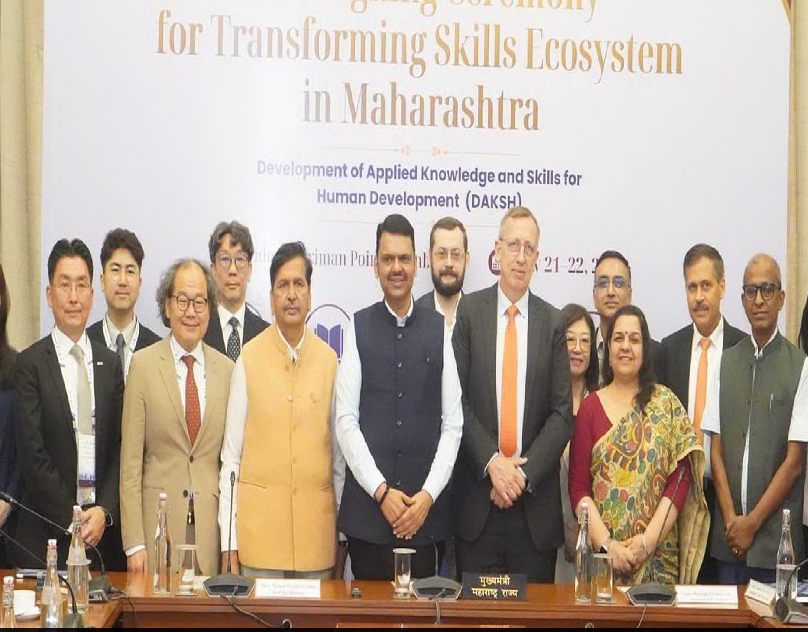
In an increasingly competitive global economy, the strength of a nation’s workforce is often measured not merely by educational attainment, but by the adaptability, technical competence, and industry-readiness of its young population. Against this backdrop, Maharashtra’s recent decision to sign three Memorandums of Understanding (MoUs) with South Korean institutions represents far more than a routine administrative exercise. It signals a strategic recalibration of the state’s skill development ecosystem, one that seeks to align vocational education with international standards and emerging industrial realities. The collaboration, announced through agreements between the Maharashtra government and prominent South Korean partners, is designed to strengthen vocational training, modernise skill development frameworks and improve employability among youth. At a time when industries are rapidly evolving under the influence of automation, artificial intelligence, advanced manufacturing and digital infrastructure, the move reflects a growing recognition that traditional training models are no longer sufficient.
Why Skill Development Has Become a Strategic Priority
India’s demographic advantage has long been described as one of its greatest strengths. With a large and youthful population entering the workforce each year, the country possesses enormous economic potential. Yet demographic strength alone does not guarantee economic success. Without relevant training and industry-oriented education, even a large workforce can struggle to meet contemporary labour market demands.
Maharashtra, as one of India’s most industrially advanced states, occupies a particularly important position in this conversation. Home to major manufacturing hubs, financial institutions, technology firms and start-up ecosystems, the state requires a workforce capable of navigating increasingly sophisticated industries. This is where targeted skill development initiatives assume critical importance.
The newly signed MoUs are intended to bridge the gap between academic instruction and industrial expectations by introducing globally informed training practices. The partnerships are expected to focus on sectors such as electronics, advanced manufacturing, technical services and emerging technologies, areas in which South Korea possesses considerable expertise.
South Korea’s Influence in Technical Education
South Korea’s rise as a technological and industrial powerhouse has often been attributed to its sustained investment in education, vocational training, and research-oriented growth. Over the decades, the country has cultivated an ecosystem where technical institutions work closely with industry, ensuring that training remains aligned with market needs.
For Maharashtra, collaboration with South Korean institutions offers access not only to technical expertise but also to institutional methodologies that have proven effective in creating highly skilled workforces. This includes curriculum modernisation, practical training models, faculty exchange programmes and exposure to cutting-edge industrial systems.
The emphasis on industry-linked learning is particularly significant. Traditional education systems frequently struggle to keep pace with technological transformation, leaving graduates academically qualified but practically underprepared. By integrating international practices into local training frameworks, Maharashtra aims to address this disconnect.
Beyond Employment: Building Economic Competitiveness
While the immediate objective of skill development initiatives is often framed in terms of employment generation, the broader implications extend much further. A highly skilled workforce enhances a region’s attractiveness to investors, strengthens industrial productivity and contributes to long-term economic resilience.
For Maharashtra, these partnerships are closely linked to the state’s ambition of positioning itself as a globally competitive industrial destination. International collaborations send a strong signal to investors that the state is committed to developing human capital capable of supporting advanced industries.
This is particularly relevant in sectors such as electronics manufacturing, semiconductor ecosystems, automation technologies and smart infrastructure, where specialised technical skills are increasingly indispensable. As global supply chains diversify and countries seek reliable industrial partners, workforce quality becomes a decisive factor in investment decisions.
The Importance of Industry-Oriented Curriculum
One of the recurring criticisms of conventional vocational education has been its limited alignment with real-world industry requirements. Courses often remain overly theoretical, outdated, or disconnected from technological developments.
The Maharashtra-South Korea collaboration seeks to address this challenge by introducing industry-oriented curricula and practical training methodologies. The emphasis appears to be not merely on certification but on employability, ensuring that trainees possess skills that are directly applicable within modern workplaces.
This distinction matters enormously. In today’s labour market, employers increasingly prioritise practical competence, adaptability, and technical familiarity over purely academic qualifications. Vocational systems that fail to evolve risk producing graduates who struggle to transition into meaningful employment.
Knowledge Exchange and Institutional Learning
An equally significant aspect of the agreements lies in the potential for institutional collaboration. Faculty exchange programmes, knowledge-sharing initiatives, and exposure visits can create long-term improvements within educational ecosystems.
Skill development is not solely about students; it also depends on the quality of trainers, infrastructure, and institutional governance. By engaging with internationally experienced partners, Maharashtra’s training institutions may gain access to improved pedagogical models, advanced technical systems, and contemporary teaching approaches.
Such exchanges can gradually elevate the overall quality of vocational education within the state, creating benefits that extend well beyond the duration of any single agreement.
Addressing the Employability Challenge
India’s employability challenge has been widely discussed across policy circles. Despite rising educational participation, many graduates continue to face difficulties securing employment that matches their qualifications. Employers, meanwhile, frequently report shortages of industry-ready talent.
This paradox highlights the importance of targeted skilling initiatives. The Maharashtra government’s collaboration with South Korean institutions appears to recognise that employability is shaped not only by formal education, but by the relevance and quality of training.
By integrating technical expertise with practical exposure, the initiative aims to create a workforce that is both competent and adaptable. This becomes especially important in industries undergoing rapid technological disruption, where continuous learning is increasingly essential.
Global Partnerships and the Future of Education
The agreements also reflect a broader trend within education and workforce development: the growing importance of international collaboration. As economies become more interconnected, educational systems are increasingly looking beyond national boundaries for expertise, innovation and institutional partnerships.
International collaborations allow states and institutions to benchmark themselves against global standards while adapting successful practices to local contexts. In the case of Maharashtra, the partnership with South Korean institutions represents an effort to combine local workforce potential with international technical proficiency.
This approach aligns with wider developments across India, where governments and educational bodies are actively pursuing global partnerships in areas such as artificial intelligence, manufacturing, entrepreneurship and vocational training.
Challenges That Will Determine Success
While the signing of MoUs generates optimism, the effectiveness of such initiatives ultimately depends on implementation. Agreements alone do not guarantee transformation. The real challenge lies in translating policy intent into measurable outcomes.
This includes ensuring adequate infrastructure, maintaining curriculum relevance, training faculty effectively, and creating pathways that genuinely connect trainees with employment opportunities. Monitoring mechanisms and industry engagement will be essential to ensure that the partnerships deliver sustained impact rather than symbolic value.
There is also the question of accessibility. Skill development initiatives must remain inclusive, reaching students from diverse socio-economic backgrounds and geographic regions. If implemented thoughtfully, the collaboration has the potential to create opportunities not only in metropolitan centres but also in emerging industrial regions across Maharashtra.
A Significant Step Towards Workforce Modernisation
The Maharashtra government’s decision to sign three MoUs with South Korean institutions represents a meaningful step in the evolution of the state’s vocational and technical education landscape. More importantly, it reflects an understanding that workforce development can no longer operate in isolation from global industrial realities.
In an age defined by technological acceleration and economic competition, the ability to cultivate skilled, adaptable, and industry-ready talent will increasingly determine regional success. Maharashtra’s latest initiative appears to recognise this reality with notable clarity.
Whether the partnerships ultimately reshape the state’s skill ecosystem will depend on sustained commitment, institutional coordination and effective execution. Yet the direction itself is significant. It suggests a move away from conventional training models towards a more globally integrated and future-oriented vision of education and employability.