A Prestigious Call to Serve: Indian Army AFMS MO 2026 Recruitment Opens for 100 MBBS SSC Posts
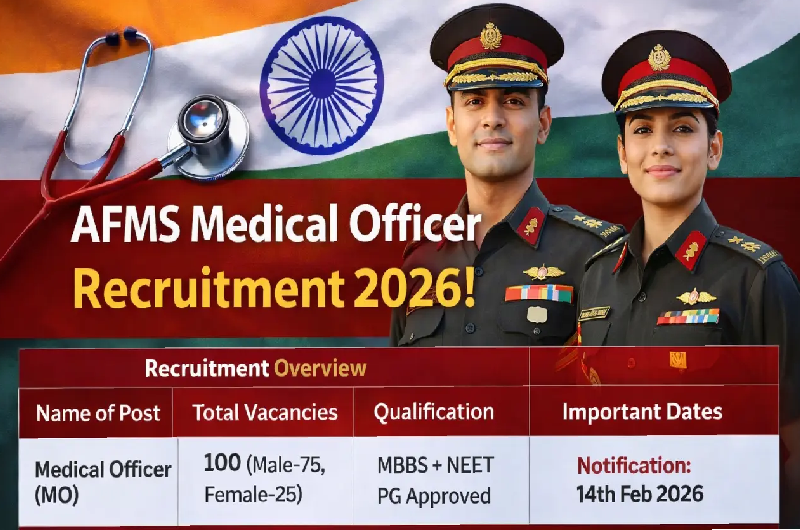
In a move that underscores both the strategic importance of medical excellence within the nation’s defence services and the enduring appeal of a career that blends professional rigour with patriotic service, the Indian Army has formally released the 2026 recruitment notification for Armed Forces Medical Services (AFMS) Medical Officers. This latest announcement invites eligible candidates to apply for 100 Short Service Commission (SSC) posts exclusively reserved for qualified MBBS graduates, a selective opportunity that promises both responsibility and distinction for those accepted into its ranks.
For aspirants of medical and defence careers alike, the AFMS MO recruitment represents one of the most sought after gateways into service, blending clinical capability with the unique ethos of military healthcare. In an era where the intersection of healthcare and national security has never been more pronounced, this recruitment drive deserves careful attention from prospective candidates, career counsellors and academic communities.
An Overview: What the Notification Entails
The AFMS MO 2026 notification, published on 14 February 2026, outlines a comprehensive recruitment process for 100 Short Service Commission posts for Medical Officers under the Armed Forces Medical Services. These positions are open to both male and female candidates holding an MBBS qualification and fulfilling stipulated eligibility criteria.
Online applications are scheduled to be accepted from 21 February to 4 March 2026, and all submissions must be made through the official portal designated by the Armed Forces Medical Services. This window, albeit brief, is sufficient for diligent applicants to prepare and submit their applications, provided they adhere strictly to the instructions detailed in the official notification.
One notable aspect of the AFMS MO notification is its emphasis on equality of opportunity. Among the 100 posts, 75 are earmarked for male candidates and 25 for female candidates, reflecting an inclusive approach that acknowledges the vital contribution of women medical professionals to military healthcare.
Eligibility: A Standard of Excellence
Prospective applicants must first and foremost possess an MBBS degree from an institution recognised under the National Medical Commission (NMC) regulations, a baseline credential that ensures professional competence. Additionally, candidates are expected to meet age requirements, with eligibility generally prescribed for those aged between 18 and 30 years as of 31 December 2026. Age relaxations are applicable as per prevailing government norms.
Candidates who have also appeared in the NEET PG exam are considered eligible to apply, and the selection process tenders a balance between academic qualifications and performance in subsequent assessments, though the precise weighting remains defined in the official notification.
In addition, an online application fee applies to all categories; however, this is modest in comparison to the career prospects that accrue from service within the AFMS. Applicants are urged to initiate the online submission promptly, as technical issues or last‑minute delays can create unnecessary hurdles in meeting the closing deadline.
The Selection Process: Merit, Interviews and Medical Assessment
The AFMS Medical Officer recruitment follows a multi‑tiered selection process. Initially, applications are scrutinised for eligibility and completeness, with a view to shortlisting candidates for the next stage, i.e - personal interviews. These interviews are conducted by the Armed Forces Medical Services and form a critical component of the final merit determination.
Successful interviewees are then required to undergo a medical examination, which assesses fitness and suitability for service under the exacting conditions often associated with military deployments. This step is not merely procedural: candidates must comply with specific medical standards to ensure they can perform duties reliably, both in garrison environments and, potentially, in austere field conditions.
The final list of selected candidates is published after completion of all requisite assessments. Those appointed as Medical Officers under the Short Service Commission will serve a defined tenure with the Armed Forces Medical Services, performing a range of duties that encompass clinical care, preventive medicine, field hospital support and collaboration with broader defence units.
The Strategic Importance of AFMS Medical Officers
Medical Officers in the Indian Army occupy a role of singular importance. Unlike civilian medical practice, service within the Armed Forces Medical Services demands adaptability to diverse contexts ranging from advanced clinical environments in cantonments to emergency response in conflict‑affected or remote locations. This blend of clinical acumen and operational readiness underscores the strategic role that AFMS doctors fulfil.
In addition to treating service personnel and their dependants, AFMS Medical Officers contribute significantly to public health preparedness, disaster response and community health initiatives, especially in regions where military and civilian interfaces converge. The recruitment of 100 new officers for 2026 also aligns with the broader imperative of equipping India’s defence apparatus with a cadre of highly trained, mission‑oriented medical professionals.
Candidate Preparedness: Guidelines for Applicants
For applicants contemplating submission to the AFMS MO 2026 recruitment, careful planning and preparation are essential. Beyond the academic requirement of an MBBS qualification, prospective candidates should ensure that:
- All academic and professional documentation is correctly attested and readily available.
- Candidates understand the application portal’s technical requirements, including upload formats, document size limits and mandatory fields.
- They prepare thoroughly for the interview stage, which assesses not just medical knowledge but also communication skills, critical reasoning and professional demeanour.
- Medical fitness standards are reviewed in advance to anticipate and address potential concerns before the formal evaluation process.
Furthermore, candidates are advised to periodically check the official AFMS recruitment portal and related Ministry of Defence notifications for any updates or corrigenda that may emerge during the application window.
Broader Context: Military and Medical Career Intersections
The AFMS MO 2026 recruitment emerges at a time when interest in defence‑oriented medical careers is rising in India, with aspirants cognisant of the dual rewards of national service and professional growth. Such opportunities when structured with clear eligibility parameters and transparent selection criteria enhance the attractiveness of a career that is as intellectually demanding as it is socially significant.
This latest notification also forms part of a suite of defence recruitment exercises announced across 2026, including other Indian Army, Navy and Air Force entries for Short Service and permanent commissions in various domains. Collectively, they highlight a sustained institutional effort to attract diverse talent into the nation’s uniformed services.
Conclusion: A Call to Service and Sustained Excellence
The release of the Indian Army AFMS MO 2026 recruitment notification marks not merely an administrative announcement but a clarion call to a generation of medical professionals seeking to harmonise clinical expertise with service to the nation. For MBBS graduates poised at the threshold of professional decisions, this opportunity presents a compelling pathway, one that transcends conventional practice to embrace the rigours and rewards of military medicine.
As the application window unfolds and candidates step forward to engage with this esteemed process, the broader medical and defence communities will watch with keen interest. The outcome will not only shape individual careers but contribute to the resilience and readiness of the Armed Forces Medical Services itself, an institution whose bearing on national wellbeing has never been more critical.