Telangana State Engineering, Agriculture And Pharmacy Common Entrance Test 2026 Registration Begins
The registration process for the Telangana State Engineering, Agriculture and Pharmacy Common Entrance Test (TG EAPCET) 2026 has formally commenced, marking the beginning of a crucial admission cycle for thousands of aspirants across the state. The Telangana Council of Higher Education opened the online application window on 19 February 2026, inviting eligible candidates to apply through the official portal, eapcet.tgche.ac.in.
As one of the most significant state-level entrance examinations, TG EAPCET serves as the gateway to undergraduate programmes in engineering, agriculture and pharmacy offered by universities and affiliated colleges throughout Telangana. Each year, the examination draws substantial participation from students seeking admission to professional courses that form the backbone of the state’s higher education and technical ecosystem.
Examination Schedule and Format
The Council has announced a structured timetable for the conduct of TG EAPCET 2026. The Agriculture and Pharmacy streams will be examined on 4 and 5 May 2026, while the Engineering stream is scheduled from 9 to 11 May 2026. The examinations will be conducted in two shifts each day: the morning session from 9.00 am to 12.00 noon, followed by the afternoon session from 3.00 pm to 6.00 pm.
This staggered schedule is designed to ensure smooth logistical management while accommodating the large number of candidates expected to appear. The two-shift format also allows for efficient utilisation of examination centres and technological infrastructure, particularly given the scale and importance of the assessment.
TG EAPCET remains a computer-based examination that evaluates candidates’ proficiency in subjects aligned with their chosen stream. For engineering aspirants, the emphasis typically rests on mathematics, physics and chemistry, whereas agriculture and pharmacy candidates are assessed through subject combinations tailored to their respective disciplines. The examination’s rigour and competitive nature underscore its role as a merit-based selection mechanism for professional education.
Key Dates and Application Window
Candidates are advised to note the critical deadlines associated with the application process. The last date to submit the online application without incurring a late fee is 4 April 2026. Given the limited timeframe, aspirants are encouraged to complete their registrations well in advance to avoid last-minute technical disruptions.
Recognising the possibility of inadvertent errors during form submission, the Council has also provided a correction window from 6 April to 8 April 2026. During this period, applicants may amend specific details in their submitted forms, subject to prescribed guidelines. This facility serves as an important safeguard, allowing candidates to rectify discrepancies that could otherwise affect their candidature.
Timely compliance with these dates is essential. Applications submitted beyond the stipulated deadline without adherence to late fee provisions may not be entertained, potentially jeopardising a candidate’s opportunity to participate in the 2026 examination cycle.
Examination Fee Structure
The application fee for TG EAPCET 2026 has been structured to reflect both stream selection and candidate category. For those applying to a single course, candidates belonging to the General category and other non-reserved categories are required to pay ₹900. Candidates from Scheduled Caste (SC), Scheduled Tribe (ST) and Physically Handicapped (PH) categories are required to pay ₹500 for one course.
For candidates opting to apply for both streams typically Engineering alongside Agriculture or Pharmacy the fee is ₹1,800 for General category applicants and ₹1,000 for SC, ST and PH candidates. All payments must be made through the prescribed online mode, ensuring transparency and efficiency in the transaction process.
The fee structure underscores the Council’s attempt to balance administrative requirements with equitable access. By offering concessional rates for reserved categories, the system reflects broader policy commitments towards inclusivity in higher education.
Step-by-Step Registration Process
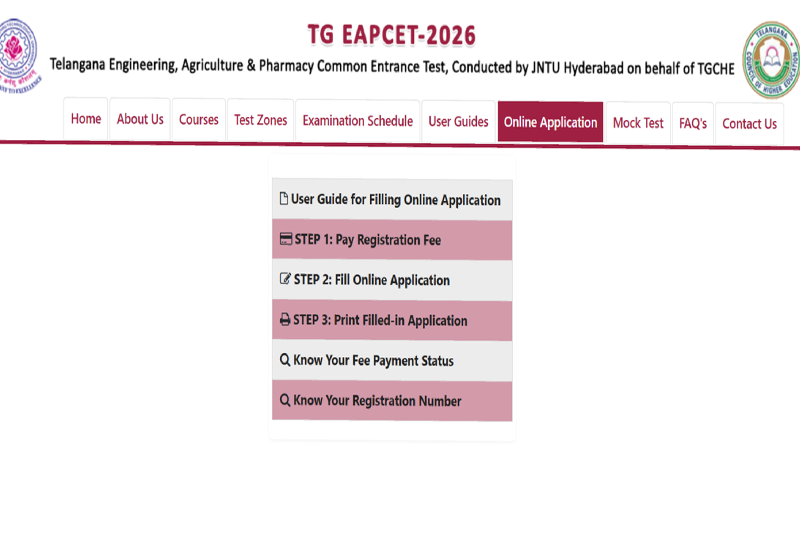
To facilitate a seamless application experience, the Council has outlined a straightforward online registration procedure. Candidates must first visit the official TG EAPCET website at eapcet.tgche.ac.in. Upon accessing the homepage, applicants should locate and click on the TS EAMCET 2026 registration link.
A new page will then open, prompting candidates to enter preliminary registration details. Upon successful registration, applicants will receive login credentials enabling them to access their personalised dashboard. Using these credentials, candidates must complete the application form by entering academic qualifications, personal information and other required particulars with precision.
Following the completion of form details, applicants are required to proceed with payment of the application fee through the available online payment gateways. Once the payment is confirmed, candidates should submit the form and download the confirmation page for future reference. It is advisable to retain both a digital and printed copy of the confirmation document until the conclusion of the admission process.
Meticulous attention to detail during this process cannot be overstated. Errors in personal data, educational records or category selection may lead to complications at later stages, particularly during verification and counselling.
Significance of TG EAPCET in Telangana’s Academic Landscape
TG EAPCET occupies a central position in Telangana’s higher education framework. It acts as the principal entrance examination for admissions into professional courses that are instrumental in shaping the state’s technical workforce. Engineering, agriculture and pharmacy programmes collectively contribute to sectors vital for economic growth, innovation and public welfare.
Engineering graduates fuel the expansion of infrastructure, information technology and manufacturing industries. Agricultural education strengthens food security and sustainable farming practices, particularly relevant in a state where agriculture remains a significant economic activity. Pharmacy programmes, meanwhile, prepare professionals for the rapidly evolving healthcare and pharmaceutical sectors.
By centralising admissions through a standardised examination, the Telangana Council of Higher Education ensures uniformity, transparency and merit-based allocation of seats. This system mitigates disparities and fosters public confidence in the admissions process.
A Competitive Yet Aspirational Journey
For many students, TG EAPCET represents more than an entrance test; it is a defining milestone in their academic journey. Preparation often spans several months, demanding disciplined study, conceptual clarity and rigorous practice. Coaching institutes, online learning platforms and self-study regimens form integral components of candidates’ preparation strategies.
Given the competitive nature of the examination, aspirants are advised to approach preparation with a balanced methodology, combining revision of core concepts with regular mock tests to simulate examination conditions. Familiarity with the computer-based format and time management skills can significantly enhance performance.
Looking Ahead
With registrations now open, the focus shifts to meticulous preparation and timely application submission. Prospective candidates must remain attentive to official notifications issued by the Telangana Council of Higher Education to stay informed about any updates or procedural clarifications.
As Telangana continues to expand its educational infrastructure and strengthen its professional sectors, TG EAPCET remains a cornerstone of this developmental trajectory. The 2026 examination cycle is poised to once again attract a vast cohort of ambitious learners seeking to secure their place in the state’s premier institutions.
For aspirants, the immediate priority is clear: complete the registration process before 4 April 2026, utilise the correction window judiciously if required, and embark upon focused preparation. In doing so, they take the first decisive step towards realising their academic and professional aspirations in engineering, agriculture or pharmacy.