Delhi-NCR Schools Shift to Hybrid Learning as GRAP Stages 3 and 4 Come into Force
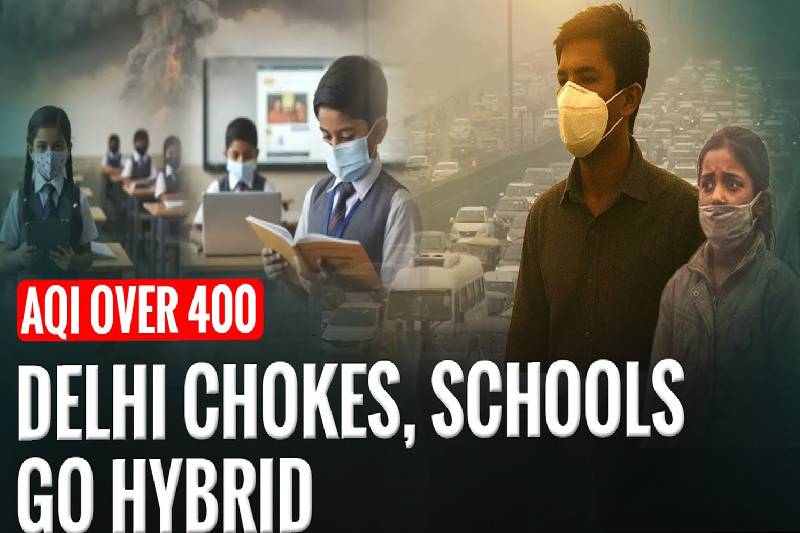
As air quality across the National Capital Region (NCR) deteriorates to alarming levels, schools in Delhi and surrounding districts have been directed to shift to a hybrid mode of learning. The decision comes under the implementation of Stages 3 and 4 of the Graded Response Action Plan (GRAP), a set of emergency measures enforced to combat severe air pollution. The move aims to reduce children’s exposure to toxic smog while ensuring that academic schedules continue with minimal disruption.
The Office of the District Inspector of Schools (DIOS), Gautam Budh Nagar, has issued clear instructions mandating hybrid education—combining physical classroom teaching with online learning—across Delhi-NCR. These directions apply to both government and private schools and are strictly enforceable in identified regions where pollution levels have entered the “severe” and “severe+” categories.
What the GRAP Directives Mean for Schools
GRAP is a structured, stage-wise response mechanism designed to tackle escalating air pollution levels in Delhi-NCR. Each stage is triggered based on Air Quality Index (AQI) readings, with higher stages imposing stricter controls on public activity, construction, transport, and now, schooling.
Under Stage 3 of GRAP, state governments in the NCR and the Government of the National Capital Territory of Delhi (GNCTD) are required to mandatorily implement hybrid classes for students from Nursery to Class 5. This means schools must offer simultaneous physical and online instruction, allowing younger children to study from home if parents prefer to avoid health risks linked to poor air quality.
As pollution worsened further, Stage 4 of GRAP was imposed, extending the hybrid learning mandate to older students. Under this stage, students in Classes 6 to 9 and Class 11 must also transition to the hybrid model within the same regions.
The mandatory hybrid learning order applies to the following jurisdictions:
- NCT of Delhi
- Gurugram
- Faridabad
- Ghaziabad
- Gautam Budh Nagar (Noida and Greater Noida)
Flexibility for Parents and Students
A key clarification from the Commission for Air Quality Management (CAQM) is that the choice to attend classes online rests entirely with students and their parents. Wherever online education facilities are available, schools cannot compel physical attendance if parents opt for remote learning due to health concerns. This provision is particularly significant for families with younger children or those with respiratory vulnerabilities.
To ensure transparency, the GRAP framework for schooling can be summarised as follows:
- Stage III: Nursery to Class 5 – Mandatory Hybrid (Physical + Online)
- Stage IV: Classes 6–9 and 11 – Mandatory Hybrid (Physical + Online)
Schools are expected to maintain parallel systems so that students choosing the online option do not face academic disadvantages.
School Timings in Gautam Budh Nagar
In addition to the hybrid learning mandate, authorities have revised school timings in parts of Uttar Pradesh affected by GRAP. Schools in Gautam Budh Nagar, including Noida, Greater Noida, Dadri, and nearby localities, will function from 10:00 am to 3:00 pm. This directive applies uniformly to all institutions—government and private—across educational boards such as CBSE, UP Board, IB, ICSE, and others.
The adjusted timings are intended to limit early morning exposure to peak pollution levels while still allowing schools to function.
What About Board Classes?
Recognising the importance of uninterrupted preparation for board examinations, Classes 10 and 12 are generally permitted to continue in physical mode. However, this arrangement remains subject to further notifications from education departments, depending on how pollution levels evolve. Schools have been advised to remain flexible and prepared for changes if conditions worsen.
Authorities have also urged schools to ensure that their digital infrastructure is fully operational, including live-streamed classes, learning management systems, and online assessments. The objective is to maintain academic continuity and prevent learning gaps for students attending remotely.
A Challenging Winter for Delhi-NCR Schools
The shift to hybrid learning follows a week of school closures across Delhi-NCR due to extreme cold conditions. Schools were expected to reopen around January 16, but the sudden spike in pollution levels and the imposition of GRAP Stage 4 have forced authorities to reassess the feasibility of full-scale physical classes—particularly for younger age groups.
This combination of harsh winter weather and hazardous air quality has made the 2026 academic calendar especially challenging for schools, parents, and students in the region.
How Other States Are Responding
While Delhi-NCR grapples with pollution-related disruptions, other northern states are also modifying school operations in response to seasonal challenges.
Punjab:
The Punjab government has revised school timings across the state due to prevailing winter conditions. According to an official notice, all government, aided, and private schools will follow reduced hours from January 16 to January 21, 2026.
- Primary schools will function from 10:00 am to 3:00 pm
- Upper primary, secondary, and senior secondary schools will operate from 10:00 am to 3:30 pm
School heads have been instructed to strictly adhere to the revised schedule and ensure that no student is required to report before the stipulated time.
Jammu and Kashmir:
In the winter zone of the Kashmir Valley, including Srinagar, and in parts of the Jammu region, authorities have announced extended winter vacations due to sub-zero temperatures.
- Schools up to Class 8 will reopen on March 1, 2026
- Higher classes will resume earlier, on February 22, 2026
The decision reflects the region’s severe winter conditions, with temperatures dropping several degrees below freezing.
Balancing Health and Education
The shift to hybrid learning across Delhi-NCR highlights the growing need for adaptable education systems in the face of environmental and climatic challenges. While physical classrooms remain vital for learning and social development, health considerations are increasingly shaping policy decisions.
For now, hybrid education offers a middle path—allowing students to continue learning while minimising exposure to hazardous conditions. As authorities continue to monitor air quality and weather patterns, further adjustments may follow, making flexibility and preparedness essential for schools and families alike.