FMGE June 2026 Registration Begins, Exam on June 28
FMGE June 2026: Registration Opens, Key Dates and What It Means for Foreign Medical Graduates
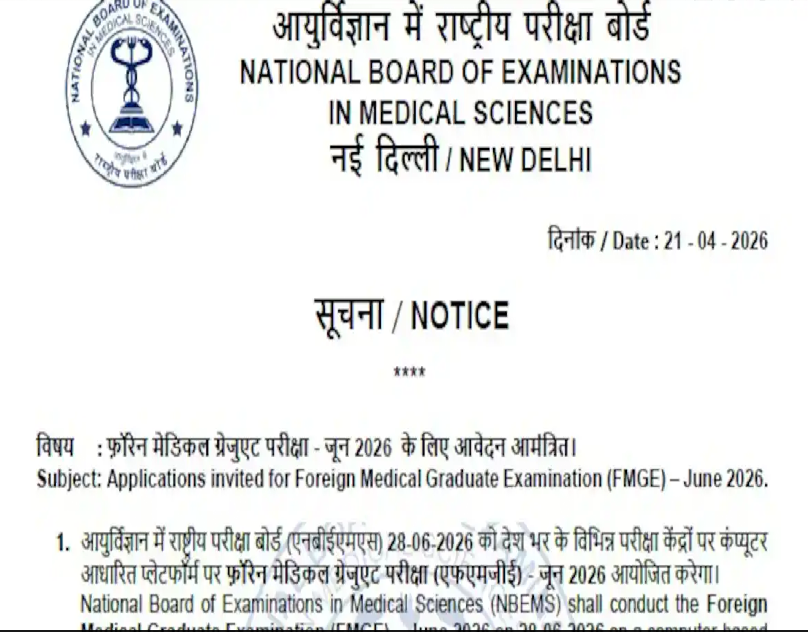
In a significant development for thousands of aspiring medical practitioners, the National Board of Examinations in Medical Sciences (NBEMS) has opened the registration window for the Foreign Medical Graduate Examination (FMGE) June 2026 session. This announcement marks a crucial phase for candidates who have completed their medical education abroad and now seek to practise in India, reaffirming the central role of the FMGE as a gateway to professional legitimacy within the country’s healthcare system. The commencement of registrations not only signals the beginning of an important examination cycle but also underscores the rigorous standards that govern medical practice in India. For candidates, it is both an opportunity and a challenge, one that demands careful preparation, procedural diligence and a clear understanding of the examination’s significance.
A Mandatory Gateway to Medical Practice
The FMGE, often referred to as the screening test for foreign medical graduates, is a mandatory requirement for Indian citizens and Overseas Citizens of India who have obtained their primary medical qualifications from institutions outside the country. Introduced under the Screening Test Regulations, 2002, the examination ensures that all practising doctors meet a uniform standard of competence.
Without qualifying for this examination, candidates are not eligible to obtain provisional or permanent registration with the National Medical Commission or state medical councils. In this sense, the FMGE serves as a critical regulatory mechanism, safeguarding the quality and credibility of medical practice in India.
Registration Window and Application Process
The registration process for the FMGE June 2026 session has now been opened online through the official NBEMS portal. Candidates are required to complete their applications within the stipulated timeframe, with reports indicating that the window is expected to remain open until mid-May 2026.
The application procedure is entirely digital, reflecting the broader shift towards streamlined and transparent examination systems. Applicants must provide detailed personal and academic information, upload scanned copies of required documents and complete the fee payment process online.
Accuracy in filling out the application form is paramount. Even minor discrepancies in documentation or personal details can lead to complications during verification or disqualification at later stages. As such, candidates are strongly advised to review their submissions carefully before finalising the application.
Examination Date and Schedule
According to the official schedule, the FMGE June 2026 examination is set to be conducted on June 28, 2026. This date aligns with the tentative calendar released earlier by NBEMS, providing candidates with a clear timeline for preparation.
The examination will be conducted in a computer-based format across designated centres nationwide. It is typically held in two sessions on the same day, covering a comprehensive range of medical subjects.
In addition to the examination date, NBEMS has also outlined key milestones in the examination process. The exam city intimation slip is expected to be released on June 17, followed by the issuance of admit cards on June 24. These steps are essential in ensuring that candidates are adequately informed and prepared ahead of the examination.
Understanding the Examination Pattern
The FMGE is designed as a rigorous assessment of a candidate’s medical knowledge and clinical understanding. The examination comprises 300 multiple-choice questions, divided into two parts, each covering a broad spectrum of subjects from pre-clinical, para-clinical and clinical disciplines.
Each correct answer carries one mark, and notably, there is no negative marking. This feature encourages candidates to attempt all questions, although accuracy remains critical in achieving a qualifying score.
To pass the examination, candidates must secure a minimum of 150 out of 300 marks, equivalent to 50 per cent. Unlike many competitive examinations, the FMGE operates on a pass-or-fail basis, with no ranking or merit list beyond qualification status.
Eligibility Criteria and Documentation
Eligibility for the FMGE is defined by specific regulatory requirements. Candidates must possess a primary medical qualification from a recognised institution outside India and this qualification must be verified by the relevant Indian embassy.
Additionally, candidates must ensure that the results of their final medical examination have been declared before the prescribed cut-off date. They are also required to hold essential documents, including degree certificates, provisional pass certificates and where applicable, an eligibility certificate issued by the National Medical Commission.
The verification process is stringent, reflecting the high stakes associated with medical licensure. Candidates who successfully qualify are issued a screening test pass certificate after in-person verification of biometric data and documentation.
The Significance of the Information Bulletin
Alongside the registration announcement, NBEMS has released a detailed information bulletin outlining the examination process. This document serves as a comprehensive guide, covering eligibility criteria, application procedures, examination guidelines and result declaration. For candidates, the bulletin is an indispensable resource. It provides clarity on procedural requirements and helps prevent common errors that could jeopardise candidature. Careful reading and adherence to its instructions are essential for a smooth application experience.
The Competitive Landscape
The FMGE is widely regarded as a challenging examination, with historically modest pass percentages. This reflects both the breadth of the syllabus and the level of proficiency required to meet Indian medical standards.
Candidates preparing for the examination must navigate a vast body of knowledge, often revisiting core medical concepts while aligning their preparation with the specific pattern and expectations of the FMGE. The absence of negative marking may appear advantageous, but it does not diminish the need for precision and conceptual clarity.
Structured preparation, regular revision, and consistent practice through mock tests are critical components of success. Given the limited time between registration and examination, early and focused preparation becomes even more important.
Digital Transformation and Accessibility
The FMGE process exemplifies the increasing digitisation of India’s examination systems. From application submission to admit card download and result declaration, every stage is conducted online. This digital framework enhances transparency, reduces administrative delays and ensures wider accessibility for candidates across the country. However, it also places a responsibility on candidates to be familiar with online processes and to maintain accurate digital records.
Opportunities Beyond Qualification
Qualifying for the FMGE is a pivotal achievement, opening the door to professional practice in India. Successful candidates become eligible to register with medical councils, enabling them to pursue clinical practice, postgraduate education and specialised training. For many, the FMGE represents the culmination of years of study abroad and the beginning of a new chapter in their medical careers. It is both a validation of their academic credentials and a gateway to contributing to India’s healthcare system.
Challenges and Considerations
Despite its importance, the FMGE is not without its challenges. Candidates often face the dual task of adapting to a new examination format while bridging gaps between international medical curricula and Indian standards.
Additionally, logistical considerations, such as documentation, verification and travel to examination centres, require careful planning. The high-stakes nature of the examination further adds to the pressure.
These challenges underscore the need for comprehensive preparation and informed decision-making at every stage of the process.
The Way Forward for Aspirants
As the FMGE June 2026 session approaches, candidates must adopt a disciplined and strategic approach. Key steps include:
- Completing the application process accurately and within deadlines
- Thoroughly reviewing the information bulletin
- Developing a structured study plan covering all major subjects
- Practising regularly through mock tests and previous question papers
- Staying updated through official NBEMS communications
Such an approach not only enhances preparedness but also instils confidence in navigating the examination process.
Conclusion
The opening of the FMGE June 2026 registration window marks a significant moment for foreign medical graduates aspiring to practise in India. It represents both an opportunity to achieve professional recognition and a challenge that demands dedication, precision and resilience. As candidates embark on this journey, the emphasis must remain on informed preparation and adherence to official guidelines. In a field as critical as medicine, where competence directly impacts lives, the standards set by examinations like the FMGE are not merely procedural; they are essential. For aspirants, success in the FMGE is not just about clearing an examination; it is about affirming their readiness to uphold the responsibilities of the medical profession with integrity and excellence.