Gujarat Police Recruitment 2026: Revised Physical Test Dates and What Aspirants Need to Know
In the ever‑evolving landscape of public service recruitment, few initiatives resonate as deeply with young aspirants as the opportunity to join the ranks of law enforcement. For thousands of candidates across Gujarat, the State’s ongoing police recruitment drive has been a source of both aspiration and intense preparation. Recently, the Gujarat Police Recruitment Board (GPRB) took a decisive step that has brought both relief and renewed focus to these aspirants: it revised the physical test schedule for the Gujarat Police Recruitment 2026.
This development, while procedural in its essence, offers a compelling lens through which to consider the broader dynamics of large‑scale public sector recruitment in India where logistical precision, candidate welfare and the expectations of fairness intersect. It serves as a moment to reflect on how aspirants navigate uncertainty, how institutions respond to the needs of stakeholders, and how robust processes contribute to the integrity of recruitment outcomes.
Background: A Mega Recruitment Drive Underway
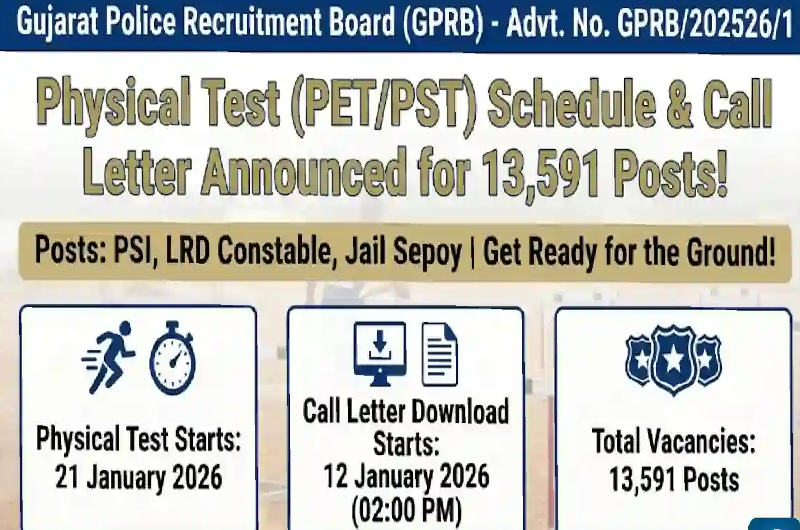
The Gujarat Police Recruitment 2025–26 exercise is one of the most expansive in recent memory, with the Board advertising 13,591 vacancies across several cadres, including Police Sub‑Inspectors (PSI), Lokrakshak Dal (LRD) constables, Jail Sepoys, and other supporting roles.
The scale of this drive is significant. Reports from earlier stages indicate that more than one million candidates competed for these positions, a testament to both the allure of a career in law enforcement and the broader aspirations of India’s youth for meaningful employment.
Selection for these posts typically encompasses multiple stages, beginning with online application and document scrutiny, followed by written examinations and culminating in physically demanding assessments. The purpose of this multi‑stage design is twofold: to identify candidates who demonstrate intellectual aptitude as well as those who possess the stamina, agility and resilience necessary for frontline service.
Revised Physical Test Dates: What Has Changed
Originally, many candidates had been preparing for physical tests scheduled in late January and February 2026. However, in a structured update released on the Board’s official portal, the physical test dates were formally revised for candidates whose applications were received between 9 and 13 February 2026. Those affected have been advised to consult the official GPRB website gprb.gujarat.gov.in for the latest scheduling details and any subsequent notifications.
While the revisions do not fundamentally alter the overall examination structure, they do reflect the Board’s responsiveness to logistical imperatives. Behind such adjustments often lie considerations that include venue availability, candidate volume, administrative coordination and broader public safety obligations. The Board’s decision to issue a revised schedule underscores the complexity inherent in coordinating tests involving tens of thousands of aspirants.
The Significance of the Physical Test
For aspirants across the state, the physical efficiency and standard tests represent more than a procedural step, they are a crucible that distinguishes those with the determination and conditioning required for the rigours of police service. These tests typically assess attributes such as endurance, speed and strength, often including timed runs, endurance walks and other measures of agility.
Physical tests in police recruitment serve dual functions: they accommodate the physical demands of routine police work, from foot patrols and crowd management to tactical response and they reaffirm the commitment of candidates to serve in demanding circumstances.
Indeed, in a state like Gujarat, where community engagement, public safety, and proactive policing intersect with the expectations of global competitiveness and civic trust, the selection of individuals fit both in mind and body is of paramount importance.
Challenges in Physical Test Administration
Logistical arrangements for such large‑scale physical assessments are inherently complex. The Board must ensure that testing grounds across the state adhere to uniform standards of measurement, safety protocols, and equality of opportunity. In practice, this entails synchronising multiple venues, trained evaluators, medical personnel, emergency facilities, and precise timing mechanisms, all under the watchful scrutiny of aspirants and their advocates.
Furthermore, the Board’s approach to transparency has been noteworthy. Leveraging technology for biometric identification, ground‑level monitoring and digitised result dissemination forms part of a broader commitment to integrity. Reports from earlier phases of the recruitment echoed this emphasis, highlighting the use of Radio‑Frequency Identification (RFID) chips, biometric scans and real‑time surveillance to ensure that merit and performance, and not chance or manipulation, determine outcomes.
Nevertheless, these systematic protocols also introduce additional layers of administrative planning and execution, which occasionally necessitate schedule refinements such as the recent revision. While such adjustments can be inconvenient in the short term, they often reflect a careful calibration that seeks to preserve fairness and logistical efficacy.
Aspirant Perspectives: Hope, Preparation and Adaptability
For those preparing to enter the recruitment terrain, the revision in dates is likely to have elicited mixed reactions. On one hand, any change in schedule can introduce uncertainty and disrupt training regimens that candidates have painstakingly developed. On the other hand, an official revision communicated in advance and with clarity, allows aspirants to recalibrate their preparation, accommodate travel arrangements and attend to other personal obligations.
The journey to the police force often begins months, and sometimes years, before a candidate formally applies. It encompasses physical conditioning, strategic study, mentorship, peer support and importantly a mindset oriented toward resilience. As aspirants confront these revised dates, their ability to adapt becomes as crucial a trait as their physical prowess.
Recruitment campaigns of this magnitude inevitably draw candidates from a broad cross‑section of society: rural youth, urban aspirants, first‑generation job‑seekers, career changers and those balancing familial responsibilities. Each brings unique motivations and challenges to the process and each relies on clear, reliable communication from recruiting authorities.
In this context, the GPRB’s announcement serves not simply as a procedural update but as a reaffirmation that the Board recognises the human element of recruitment. Clear directives, timely notifications and transparent scheduling are essential to uphold candidates’ trust and to maintain confidence in the process.
Wider Implications: Governance, Accountability and Public Service
The current recruitment cycle also invites broader reflection on governance in public service recruitment in India. Police forces play a definitive role in shaping the lived experience of citizens enforcing the rule of law, safeguarding public order, responding to emergencies and embodying the state’s commitment to justice.
By revising test schedules in a manner that is communicated officially and transparently, the GPRB upholds a standard of institutional accountability. In doing so, it balances the imperative of procedural efficiency with respect for candidates’ aspirations.
Moreover, recruitment campaigns of this scale have socio‑economic resonance. They offer stable employment, an avenue for skills development, and in many instances a life‑altering opportunity for young people seeking upward mobility. The rigorous selection process anchored in merit, capability and fitness reflects the seriousness with which this life choice is regarded.
Moving Forward: What Candidates Should Do Now
As candidates await the revised physical test dates, there are several practical steps they can take:
-
Monitor Official Communication: Regularly check the GPRB website for updates on schedules, call letters and other official notices.
-
Fine‑Tune Physical Preparation: Use the revised timeline to optimise training focusing on endurance, speed and recovery.
-
Stay Informed: Engage with official FAQs and recruitment resources to clarify queries about reporting times, health prerequisites and testing protocols.
-
Prepare Logistically: Confirm travel, accommodation and documentation ahead of the test to avoid last‑minute challenges.