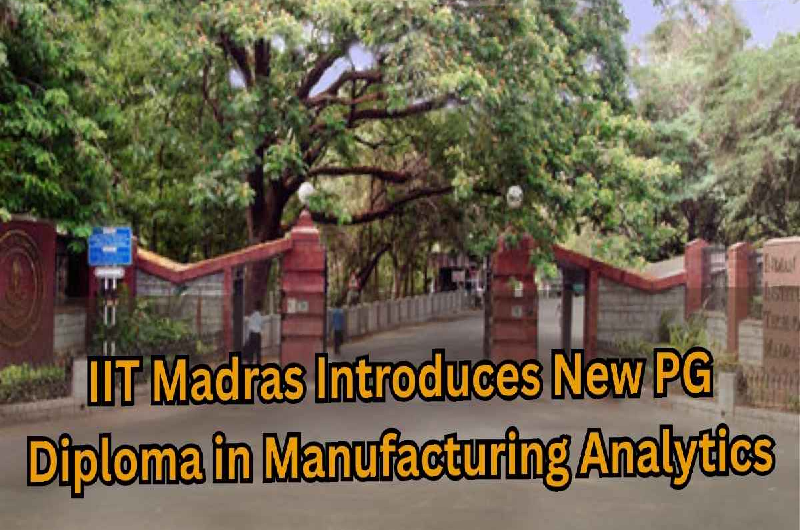
IIT Madras Sets a New Benchmark with One‑Year PG Diploma in Manufacturing Analytics
In an era defined by relentless technological advancement and the escalating complexity of industrial operations, academic institutions are under increasing pressure to equip professionals with skills that transcend traditional boundaries. Rising to this challenge, the Indian Institute of Technology Madras (IIT Madras), a premier engineering and research institution in India, has announced the launch of a trailblazing Postgraduate Diploma in Manufacturing Analytics. This innovative offering reflects both the institute’s deep commitment to academic excellence and its strategic alignment with the evolving needs of the global manufacturing sector.
This comprehensive one‑year programme, delivered in a fully web‑enabled format, is designed to empower industry professionals and graduates with an advanced skill set in data analytics, artificial intelligence (AI), and digital transformation - competencies increasingly essential in modern manufacturing environments.
Bridging Industry and Academia
Manufacturing analytics sits at the nexus of data science and operational strategy. As factories and supply chains digitise, the ability to interpret vast quantities of process data and convert it into actionable insight has become a strategic imperative. Recognising this shift, IIT Madras has crafted its diploma to serve as a conduit between rigorous academic instruction and real‑world industrial application.
Offered through the Department of Data Science and Artificial Intelligence, this diploma acknowledges that the future of manufacturing will be driven not just by machines and hardware but by intelligent systems capable of enhancing productivity, efficiency, and decision‑making across the board.
The programme’s stated goal is to address a palpable industry demand for professionals endowed with the expertise to deploy analytics and AI directly within manufacturing contexts from optimising production lines to informing strategic operational decisions.
Structure and Academic Rigour
The diploma spans three academic terms over the course of a year, running from September to August. With a total of 90 credits, the curriculum has been structured to balance foundational knowledge with specialised technical training, underscoring both mathematical depth and practical relevance.
Unlike many short‑form online certificates, this programme maintains a comprehensive, academically rigorous architecture that aligns with postgraduate standards. Its wide‑ranging modules include essential mathematical foundations, digital transformation strategies, and advanced machine learning disciplines such as deep learning and generative AI - all contextualised for manufacturing applications.
A distinguishing feature of the course is its strong emphasis on real‑world use cases and hands-on implementation. Learners engage with applied modules such as Manufacturing Analytics Implementation I and II, designed to move beyond theory and cultivate practical skills relevant to contemporary industrial challenges.
The programme culminates in a Holistic Assessment of AI in Manufacturing Analytics, a capstone evaluation that encourages participants to synthesise technological, organisational and operational perspectives, an apt finale for a curriculum rooted in both precision and pragmatism.
A Strategic Response to Industrial Evolution
Comments from academic leaders underscore the wider significance of this initiative. Professor V. Kamakoti, Director of IIT Madras, has highlighted that as India’s manufacturing sector accelerates its digital transformation, there is a pressing need for programmes that fuse academic depth with practical application. According to him, this postgraduate diploma not only responds to that need but also reinforces the institute’s role in cultivating professionals poised to lead technology‑driven transformations in manufacturing.
Such remarks reflect broader industry sentiments. Across the globe, manufacturers are increasingly pivoting towards data‑driven decision‑making, driven by the advent of technologies such as the Industrial Internet of Things (IIoT), robotics, predictive maintenance tools and advanced automation. In this landscape, analytics is no longer an auxiliary tool, it is a strategic asset. The diploma’s emphasis on integrating analytics into manufacturing workflows signals a forward‑looking approach to education that resonates with this reality.
Who Should Apply? Eligibility and Audience
The diploma aims to serve a broad, diverse audience. Eligibility extends to individuals holding three‑year or four‑year undergraduate degrees in relevant disciplines, including but not limited to computer science, computer applications, engineering and science fields. Applicants are vetted according to IIT Madras admission criteria, ensuring a baseline of academic preparedness among enrolled learners.
Primarily, the programme targets working professionals from medium and large manufacturing organisations who are looking to augment their analytical expertise and lead digital transformation initiatives within their enterprises. Yet, it is equally open to eligible graduates who seek to build advanced capabilities before embarking on or progressing within their careers.
The web‑enabled mode of delivery enhances accessibility for those balancing professional commitments, making it possible for participants across geographical and occupational contexts to undertake the diploma without compromising work responsibilities.
Application Details and Timeline
Prospective applicants should note key dates: the first batch is scheduled to commence on 7 September 2026, with the application deadline set for 31 May 2026. Prospective candidates are advised to complete their applications through the official IIT Madras portal within this timeframe.
The structured timeline beginning with application submissions, moving through academic engagement, and concluding with the final assessment over three terms, enables learners to pace their engagement effectively while gaining sustained exposure to advanced analytics concepts.
The Broader Educational and Economic Context
Introducing such a specialised diploma aligns with broader trends across higher education, where institutions increasingly tailor offerings to meet industry needs and equip learners with job‑relevant competencies. In many ways, this initiative by IIT Madras exemplifies the future of postgraduate education: interdisciplinary, technologically sophisticated and closely aligned with enterprise requirements.
The focus on AI and analytics within manufacturing echoes global technological shifts. Manufacturing ecosystems worldwide are generating unprecedented volumes of data. Whether it is sensor outputs from production equipment or workflow information from enterprise resource systems, the real value lies in the ability to convert data into strategic insight. This programme seeks to harness that imperative, preparing professionals to not simply interpret data but to embed analytics into operational frameworks that influence efficiency, sustainability and global competitiveness.
Furthermore, with manufacturing being a critical driver of economic growth, particularly in countries like India with robust industrial ambitions, the cultivation of analytics talent is both timely and consequential. By producing graduates capable of bridging theoretical knowledge with practical impact, IIT Madras contributes meaningfully to the talent pipeline required for a digitised industrial future.
Concluding Remarks: A Forward‑Looking Offering
In launching the Postgraduate Diploma in Manufacturing Analytics, IIT Madras has made a significant stride towards addressing the technological aspirations of industry professionals and the broader challenges facing modern manufacturing. This diploma stands as a testament to how academic institutions can harness their intellectual capital to shape education that is as much about tomorrow’s opportunities as today’s demands.
Aspiring learners and industry leaders alike will do well to consider the implications of this programme, not just as an academic credential, but as a catalyst for transformation in a sector that sits at the heart of economic and technological progress.
With applications now open and the first cohort set to begin later this year, this diploma represents an exciting nexus where data, intelligence and industrial acumen converge, offering participants the chance to become architects of change in the rapidly evolving landscape of global manufacturing.