SSC JE Result 2026: Triumph, Transition and the Road Ahead for Aspiring Engineers
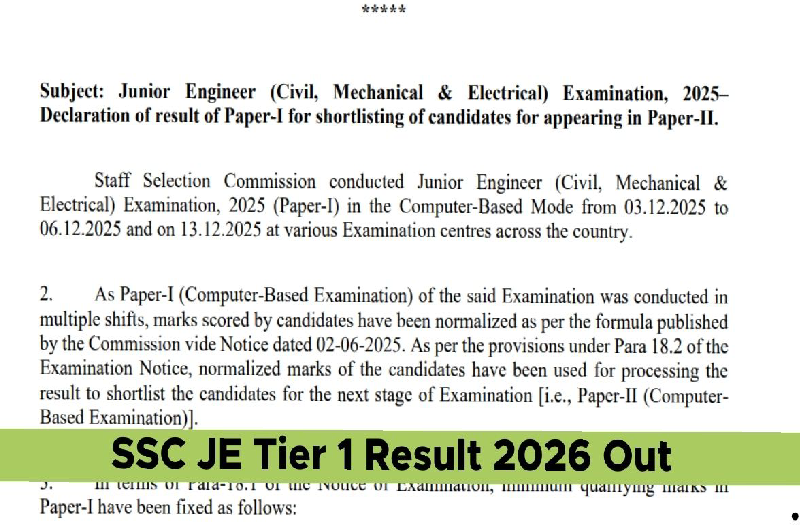
The anticipation among thousands of young engineers across India has now yielded a moment of vindication and relief. The Staff Selection Commission (SSC) has formally declared the result of Paper I of the Junior Engineer (JE) Examination 2025, marking a pivotal milestone in the careers of myriad aspirants seeking government engineering roles.
This examination, a crucial gateway to coveted positions across various ministries and departments, is a testament not only to academic proficiency but also to perseverance and meticulous preparation. In the high‑stakes world of competitive government recruitment, where tens of thousands of candidates vie for a limited number of positions, the announcement of results is far more than a mere administrative update: it symbolises years of study, personal sacrifices, and the collective aspirations of aspiring engineers nationwide.
In this comprehensive overview, we will delve into what the result means, how candidates can access it, the category‑wise performance landscape and the implications for future stages of the recruitment process.
The Examination Landscape: Paper I – A Crucible of Competence
The SSC Junior Engineer Examination is one of the most highly regarded competitive assessments in India for diploma and degree holders in engineering disciplines. Conducted in a computer‑based mode, the Paper I phase spanned multiple days and shifts, from 3 to 6 December 2025, with an additional day on 13 December 2025 to accommodate candidates and logistical contingencies.
Paper I serves as a broad filter, testing foundational technical knowledge in civil, mechanical and electrical engineering principles, as well as general intelligence and reasoning skills. The intent is to identify those candidates who possess not just theoretical understanding, but also the ability to apply concepts under time‑bound, pressured conditions.
Because of the examination’s nationwide scale and the considerable variation in question papers across shifts, the SSC employed a normalisation process to ensure that scores were equitable and comparable, irrespective of which session a candidate appeared in. This meticulous approach helps mitigate disparities that might otherwise arise from differences in exam difficulty across various sittings.
Step‑by‑Step: How to Check the Results
Now that the Paper I outcomes are available, candidates are naturally eager to confirm their status. The results have been published in PDF format on the official SSC portal (ssc.gov.in). This standard mode of result dissemination is designed to be easily accessible, searchable and downloadable for individual reference and verification.
To check the result:
- Visit the SSC official website at ssc.gov.in.
- Navigate to the “Results” section on the homepage.
- Locate the link for “Junior Engineer (Civil, Mechanical & Electrical) Examination, 2025 – Paper I Result”.
- Open the linked PDF, and use your roll number or name (via Ctrl+F on desktop) to locate your result.
- Download and save a copy of the PDF for future reference and documentation.
Though a seemingly simple process, accurately navigating the SSC portal and understanding the contextual information (such as roll number conventions and category annotations) can greatly smooth the experience for candidates.
Celebration and Cut‑Off: Who Has Progressed to Paper II
With the results declared, it has been revealed that a substantial cohort over 15,000 candidates, have successfully qualified for the next phase: Paper II. This second stage will further test technical depth and subject‑specific expertise in engineering disciplines, and only those who qualify in Paper II can advance toward final selection.
A detailed breakdown shows that:
- A significant majority of successful candidates come from the Civil Engineering stream, with more than 11,500 candidates meeting the criteria to progress.
- In the Mechanical and Electrical Engineering streams combined, over 4,000 candidates have been shortlisted.
The cut‑off marks - the minimum threshold required for qualification have been published on a category‑wise basis. This reflects the SSC’s longstanding commitment to affirmative action and ensures that candidates from various socioeconomic segments are assessed within a fair and structured framework.
For example, among unreserved candidates:
- The Civil Engineering cut‑off marks hovered around the higher end of the spectrum, reflecting both the intense competition and the comparatively large pool of candidates.
- In Mechanical and Electrical Engineering, the minimum marks required were also closely contested, and the spread of scores across categories underscores the multifaceted nature of competition.
Moreover, the SSC has taken care to include persons with disabilities, ensuring that cut‑off benchmarks offer equitable access to the next phase of selection across all recognised categories.
What Happens Next? The Road to Paper II
While the declaration of results is a climax of Paper I, it is equally a prologue to the next phase of this rigorous selection journey. The SSC has not yet released the schedule for Paper II, but has assured candidates that the dates will be announced soon on its portal.
Paper II, similarly conducted in a computer‑based format, will delve deeper into the candidate’s discipline‑specific knowledge, assessing not merely broad competency, but finer nuances in engineering aptitude. As such, candidates who have progressed from Paper I should now commence focussed preparation, reviewing subject matter with precision and reflecting on practical problem‑solving strategies.
The results also mark the release of the final answer keys for Paper I, alongside the question papers and candidate response sheets. This transparency enables aspirants to reconcile their own performances with official evaluations, thereby instilling confidence in the fairness and thoroughness of the assessment process.
The Broader Implications: Government Recruitment and Career Trajectories
In the wider canvas of public sector employment in India, the SSC JE exam carries significant weight. Government engineering posts span critical infrastructure, public works, energy distribution, urban development and defence sectors. Successful candidates will not only secure prestigious roles but also opportunities to contribute meaningfully to national development projects and public service initiatives.
For employers, these results represent a refreshed talent pipeline, a cohort possessing both technical rigour and the resilience necessary to thrive in structured, high‑accountability environments. The successful candidates will now prepare for Paper II with renewed focus, buoyed by the knowledge that their efforts have been recognised at a national level.
Reflecting on Aspirations and Achievement
The announcement of the SSC JE Result 2026 Paper I is more than a procedural milestone. It represents the culmination of aspirations nurtured across many months and for some, years of preparation. Each name on the shortlist embodies a personal story of dedication: early mornings spent poring over engineering texts, long evenings solving past papers, and the quiet persistence of those who refused to relinquish their goals despite daunting competition.
For those who have qualified, this is a moment to savour, but also to gear up for the challenges ahead. For those whose names do not appear on the list, this juncture, though difficult, can be a catalyst for further growth, deeper learning and renewed resolve.
In the realm of competitive examinations, success often results not merely from raw intellect, but from disciplined preparation, strategic understanding and emotional fortitude. As Paper II approaches, it is these very qualities that will define the next stage of achievement for India’s aspiring engineers.