Indian Air Force Revises Agniveer 2026 Eligibility: A Measured Expansion of Opportunity
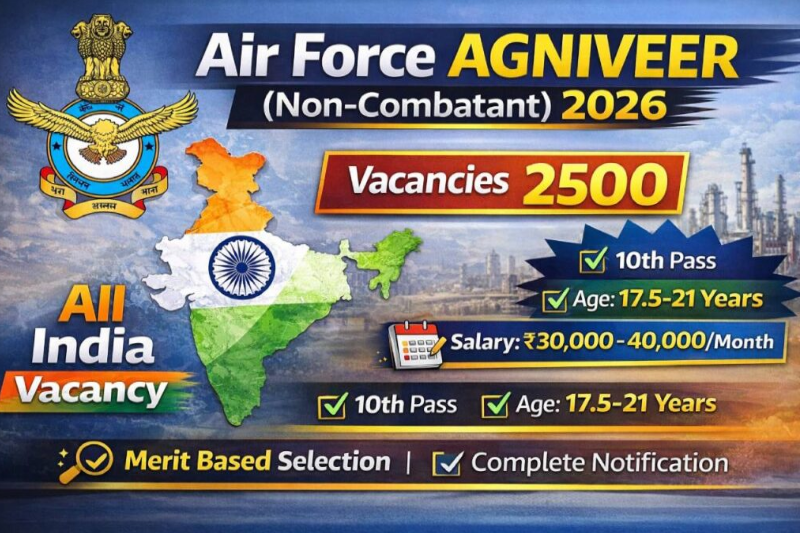
In a significant and carefully calibrated policy shift, the Indian Air Force (IAF) has revised the eligibility criteria for its Agniveer Vayu intake for 2026, most notably expanding the upper age limit for applicants. The amendment, while technical in phrasing, carries meaningful implications for thousands of aspirants across the country who had previously found themselves marginally outside the prescribed age bracket.
The decision forms part of the broader recruitment framework under the Government of India’s Agnipath scheme, introduced to reshape the structure of short-term military service. With the latest revision, the IAF signals both administrative responsiveness and a willingness to adapt its processes in line with ground realities.
A Thoughtful Adjustment to the Age Ceiling
At the heart of the announcement lies the upward revision of the maximum age limit for Agniveer Vayu candidates for the 2026 intake cycle. Previously, eligibility had been tightly defined within a narrow age window, often excluding otherwise qualified applicants by a matter of months. The revised criteria now extend that ceiling, offering renewed eligibility to a broader cohort of young men and women.
Such adjustments, while seemingly modest on paper, can prove transformative in practice. In a country where recruitment to the armed forces is viewed not merely as employment but as vocation and honour, even incremental expansions of eligibility can significantly alter opportunity landscapes.
The extension is widely interpreted as a pragmatic response to the realities faced by applicants in recent cycles including academic scheduling disruptions and pandemic-era delays that affected examination timelines and preparation pathways.
The Agnipath Context
The Agniveer Vayu recruitment falls under the Agnipath scheme, a reform initiative intended to inject youthful dynamism into India’s armed services while maintaining a lean and technologically adept force structure. Under this framework, selected candidates serve for a defined tenure, receiving military training, remuneration, and post-service benefits.
The Agnipath model has sparked debate since its inception. Supporters have emphasised its potential to modernise the forces and broaden participation, while critics have raised concerns about career continuity and long-term security for recruits. Against this backdrop, the IAF’s age-limit revision can be seen as a gesture of refinement rather than reversal, an administrative fine-tuning aimed at ensuring fairness and accessibility.
Academic Qualifications and Eligibility Parameters
While the age criterion has been expanded, the core academic and physical standards remain intact. Candidates applying under the Science stream are generally required to have completed higher secondary education with Physics and Mathematics, alongside minimum aggregate marks as stipulated in the official notification.
For non-science streams, eligibility continues to include completion of recognised intermediate qualifications or equivalent vocational courses, depending on the category applied for.
Physical fitness standards, a cornerstone of air force recruitment remain rigorous. Applicants must meet specified benchmarks in height, chest measurement (where applicable), and endurance tests, including timed runs and other physical tasks. Medical fitness examinations are conducted with exacting scrutiny, reflecting the operational demands of air service.
Inclusivity and National Reach
The expanded age window has particular resonance in semi-urban and rural regions, where aspirants often balance academic responsibilities with familial or financial obligations. For many such candidates, even a slight delay in examination or documentation can result in ageing out of eligibility. The IAF’s recalibration addresses this structural sensitivity.
Recruitment rallies and examinations are conducted across multiple centres nationwide, reinforcing the armed forces’ commitment to inclusivity and regional representation. The Agniveer Vayu programme continues to draw applicants from diverse socio-economic and educational backgrounds, underscoring its status as one of the most sought-after entry points into military service.
Financial and Post-Service Provisions
Under the Agnipath framework, Agniveers receive a structured compensation package during their four-year tenure. This includes a monthly salary, risk and hardship allowances where applicable, and a Seva Nidhi package upon completion of service. The latter is designed to provide financial support for reintegration into civilian life, whether through higher education, entrepreneurship, or other professional pursuits.
A portion of each intake is also eligible for permanent absorption into the regular cadre, subject to performance and organisational requirements. This pathway remains competitive and merit-based.
The revised age limit does not alter these foundational features but may indirectly expand the talent pool from which future permanent recruits are selected.
Operational Implications for the IAF
From an institutional standpoint, widening the eligibility net allows the IAF to tap into a slightly older and potentially more academically mature applicant pool. While the difference of a year may appear marginal, developmental studies suggest that even modest increments in age can correlate with improved cognitive maturity and emotional resilience.
For a technologically sophisticated branch such as the air force, where recruits must master complex systems and adhere to strict operational protocols, such attributes are valuable.
Moreover, by signalling flexibility, the IAF reinforces public confidence in its recruitment processes. Transparency and responsiveness remain essential in maintaining the legitimacy of large-scale national programmes.
Application Process and Timeline
Prospective candidates are expected to submit their applications through the official recruitment portal of the Indian Air Force within the stipulated dates. The process typically includes:
- Online registration
- Payment of examination fees (where applicable)
- Written examination
- Physical fitness testing
- Adaptability and medical assessments
Applicants are advised to review the detailed notification carefully, as category-specific requirements may vary. Given the competitive nature of the selection process, early preparation, particularly in mathematics, physics, reasoning, and general awareness remains critical.
Broader Social Significance
The Agniveer Vayu scheme occupies a unique position within India’s socio-economic framework. For many families, selection into the armed forces symbolises stability, prestige, and upward mobility. The revised age limit thus carries emotional as well as practical weight. In regions with limited formal employment opportunities, defence recruitment often represents one of the most structured and meritocratic avenues available. By extending eligibility, the IAF has effectively reopened doors that some had presumed permanently closed. The move may also mitigate a degree of public concern that accompanied earlier recruitment cycles. Incremental reforms of this nature suggest that the armed forces are attentive to stakeholder feedback while remaining steadfast in their operational objectives.
A Balanced Evolution
It would be premature to characterise the age-limit revision as transformative reform. Rather, it is best understood as a calibrated adjustment, one that balances inclusivity with institutional discipline.
The Agnipath scheme continues to evolve, shaped by administrative learning and public discourse. Within that evolving framework, the IAF’s decision stands as an example of adaptive governance: measured, deliberate, and responsive.
For aspirants who now find themselves newly eligible, the message is unequivocal. Preparation must begin in earnest. Expanded eligibility does not equate to relaxed standards. The competition remains intense, the assessments demanding, and the expectations exacting.
Conclusion
The Indian Air Force’s revision of the Agniveer Vayu 2026 eligibility criteria marks a thoughtful expansion of opportunity within a disciplined recruitment architecture. By raising the upper age limit, the IAF has broadened access without compromising standards, a delicate balance in any military institution. For the thousands who harbour aspirations of serving beneath the tricolour, this amendment offers renewed hope. For the institution itself, it reinforces a reputation for structured adaptability in a rapidly changing socio-demographic landscape. As applications open and preparation intensifies, the 2026 intake promises to draw from a more inclusive pool of candidates, each seeking not merely employment, but the privilege of service.