MMRDA Answer Key 2026 Released for Group A, B and C Exams
MMRDA Answer Key 2026 Released: Objection Window Opens for Group A, B and C Recruitment Exams
The Mumbai Metropolitan Region Development Authority (MMRDA) has officially released the provisional answer key for its 2026 recruitment examinations conducted for Group A, B and C posts, offering candidates an opportunity to review their responses and evaluate their probable performance before the declaration of final results. Alongside the release, the authority has also opened the objection window, enabling applicants to challenge discrepancies they may identify in the provisional responses.
For thousands of candidates who appeared for the examinations earlier this month, the publication of the answer key represents more than a routine procedural update. It marks the beginning of the post-examination evaluation phase, a period often characterised by equal parts anticipation, scrutiny, and anxiety. In competitive recruitment environments, particularly within government-linked infrastructure organisations such as MMRDA, answer keys have gradually evolved into important instruments of transparency and accountability.
The recruitment examinations conducted by MMRDA this year attracted considerable attention owing to the scale and diversity of vacancies involved. The authority, which plays a central role in planning and executing infrastructure projects across the Mumbai Metropolitan Region, has been steadily expanding its recruitment activity in response to the growing complexity of urban development, transport integration and metro rail operations within Maharashtra’s financial capital.
A Recruitment Process Under Public Attention
MMRDA occupies a uniquely influential position within India’s urban infrastructure landscape. Established to oversee planning and coordinated development across the Mumbai Metropolitan Region, the authority has become deeply associated with some of the city’s most visible transport and infrastructure projects, including metro corridors, urban mobility systems, flyovers and regional connectivity initiatives.
As the organisation’s operational footprint expands, so too does its demand for technical, administrative and support personnel across multiple cadres. Recruitment drives for Group A, B and C positions, therefore, attract applicants from a wide educational and professional spectrum, ranging from engineering graduates and diploma holders to administrative aspirants and technical specialists.
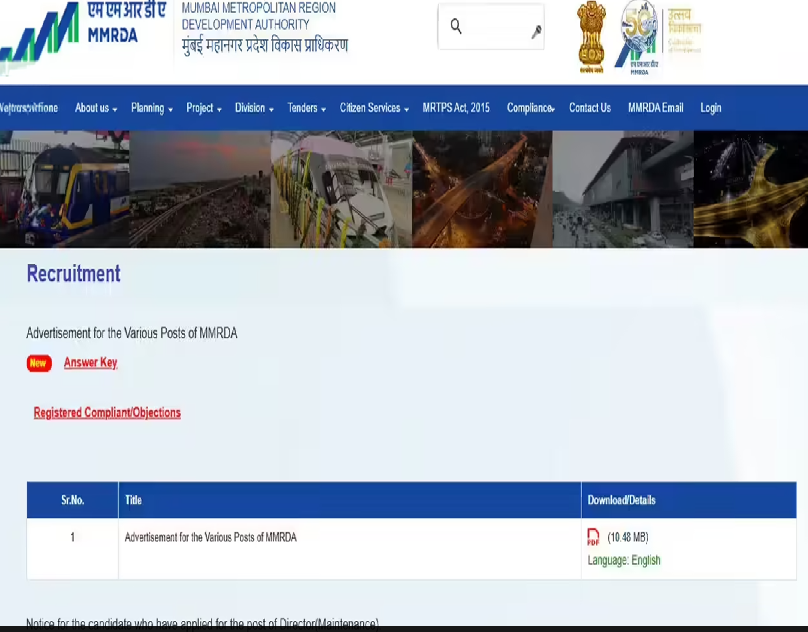
The recently conducted examinations formed part of this broader staffing exercise. According to official updates, the examinations were held for several posts distributed across different categories and departments. Following the completion of the examination process, the authority has now uploaded the provisional answer key through its official recruitment portal, allowing candidates to cross-check responses against the officially suggested answers.
While the release of an answer key may appear procedural, it performs an increasingly significant function within modern recruitment systems. It provides candidates with early insight into their likely scores while simultaneously establishing a mechanism through which inaccuracies can be identified and corrected before final evaluation.
Why the Objection Window Matters
One of the most important aspects of the MMRDA announcement is the activation of the objection or challenge window. Candidates who believe that any answer listed in the provisional key is incorrect may now submit objections within the stipulated timeframe by following the prescribed online procedure.
This mechanism reflects a broader shift within competitive examination frameworks towards greater procedural transparency. In earlier decades, recruitment examinations often operated through opaque evaluation systems where candidates had little visibility into how answers were assessed. The introduction of provisional answer keys and structured objection systems has altered that dynamic considerably.
Today, answer key challenges function as an important quality-control mechanism. They allow subject experts, educators, and candidates themselves to identify potential ambiguities, factual inaccuracies, or multiple-correct-answer situations before results are finalised.
For candidates, however, the objection process demands more than instinctive disagreement. Challenges typically require documentary or academic evidence supporting the objection being raised. Authorities generally examine such objections through expert review panels before issuing the final answer key.
This ensures that the process does not devolve into arbitrary disputes while still preserving candidates’ right to question potential errors.
The Psychological Phase Between Examination and Result
Competitive examinations are rarely confined to the hours spent inside examination halls. In many ways, the emotional intensity increases afterwards. The period between the examination and the final result often becomes one of uncertainty, speculation and constant score calculation. The release of answer keys intensifies this process further.
Candidates typically begin reconstructing probable cut-offs, comparing responses with peers, analysing difficult sections and estimating selection chances. In highly competitive recruitment environments, even a difference of one or two marks can dramatically alter ranking positions.
This is especially relevant in examinations linked to public-sector organisations such as MMRDA, where vacancy numbers, applicant volume and category-based competition create exceptionally narrow selection margins.
The answer key, therefore, becomes more than a technical document. It becomes an emotional reference point around which expectations begin to crystallise.
For some candidates, the provisional key brings reassurance. For others, it triggers renewed uncertainty, particularly where ambiguous or disputed questions emerge. This explains why objection windows often witness significant participation from candidates eager to protect every possible mark.
MMRDA and the Expanding Urban Infrastructure Workforce
The significance of the recruitment process also reflects the growing scale of urban infrastructure governance in India. Cities such as Mumbai are undergoing rapid transformation driven by metro expansion, regional transport integration, housing pressure, and evolving mobility requirements. Institutions like MMRDA stand at the centre of this transformation.
Over the past decade, infrastructure authorities across major metropolitan regions have increasingly required multidisciplinary workforces capable of managing engineering, planning, administration, digital systems, finance, operations and public coordination simultaneously. This expansion has generated sustained recruitment demand across technical and non-technical categories alike.
For aspirants, therefore, recruitment opportunities within MMRDA carry substantial appeal. Apart from the stability associated with government-linked institutions, such positions also offer involvement in projects that directly shape the future of urban development within one of the world’s most densely populated metropolitan regions.
That institutional prestige partly explains the competitive intensity surrounding these examinations.
Transparency and the Evolution of Recruitment Systems
The publication of answer keys has gradually become standard practice across many examination bodies in India, including national agencies, public-sector undertakings, railway boards and state recruitment authorities. Yet the importance of this evolution is sometimes underestimated.
Transparent evaluation systems strengthen institutional credibility. They reduce speculation regarding arbitrary marking and provide candidates with measurable visibility into the assessment process. More importantly, they establish procedural fairness at a time when public trust in competitive recruitment systems is frequently tested by delays, paper leaks, litigation and administrative controversies.
In this context, provisional answer keys serve both administrative and symbolic purposes. Administratively, they help correct evaluation inaccuracies before final result preparation. Symbolically, they signal that recruitment bodies recognise the importance of accountability in high-stakes examinations.
The MMRDA’s decision to provide candidates with an opportunity to challenge responses aligns with this broader institutional trend towards openness and review-based evaluation.
What Candidates Should Do Next
For candidates who appeared in the examinations, the immediate priority is careful verification rather than hurried assumption. Experts frequently advise aspirants to compare responses systematically using reliable references instead of depending entirely on unofficial discussions circulating across social media platforms.
Where genuine discrepancies exist, objections should ideally be supported by credible academic sources, standard textbooks, or officially recognised references. Frivolous objections submitted without evidence rarely influence final review outcomes and may unnecessarily complicate the process.
Candidates should also pay close attention to submission deadlines. Objection windows in competitive examinations are typically brief and delayed representations are usually not entertained once the portal closes.
Following the review of objections, the authority is expected to release the final answer key, after which the result declaration process will proceed. Recruitment examinations of this nature generally move through multiple stages, including merit preparation, document verification and further procedural formalities depending on the category of posts involved.
Beyond Results: The Real Impact of Competitive Examinations
The scale of public engagement surrounding answer keys also reveals something larger about contemporary India’s examination culture. Competitive recruitment processes now occupy a deeply significant social and economic position, particularly for younger populations navigating uncertain employment markets.
For many candidates, examinations conducted by organisations such as MMRDA represent not merely professional opportunities but long-term aspirations tied to stability, social mobility and institutional credibility.
That reality explains the extraordinary attention paid to every stage of the process, from application forms and admit cards to answer keys and final merit lists.
The release of the MMRDA Answer Key 2026 is therefore not simply an administrative notification. It is part of a much wider ecosystem in which examinations have become defining milestones within the career journeys of millions of aspirants across the country.
As candidates now move into the next phase of evaluation and objection review, the focus will inevitably shift towards final results and eventual selections. Until then, the provisional answer key remains both a technical resource and a symbol of the increasingly transparent mechanisms shaping India’s modern recruitment landscape.