MP PAT 2026 Preliminary Answer Key Released, Objection Window Open
MP PAT 2026 Preliminary Answer Key Released: What Candidates Need to Know About the Objection Window and Next Steps
The release of a preliminary answer key is often one of the most closely watched moments in any competitive entrance examination cycle. For thousands of aspirants who appeared for the Madhya Pradesh Pre-Agriculture Test (MP PAT) 2026, that moment has now arrived. The Madhya Pradesh Employees Selection Board (MPESB) has officially published the provisional answer key for MP PAT 2026, enabling candidates to review their responses and assess their likely performance before the declaration of results.
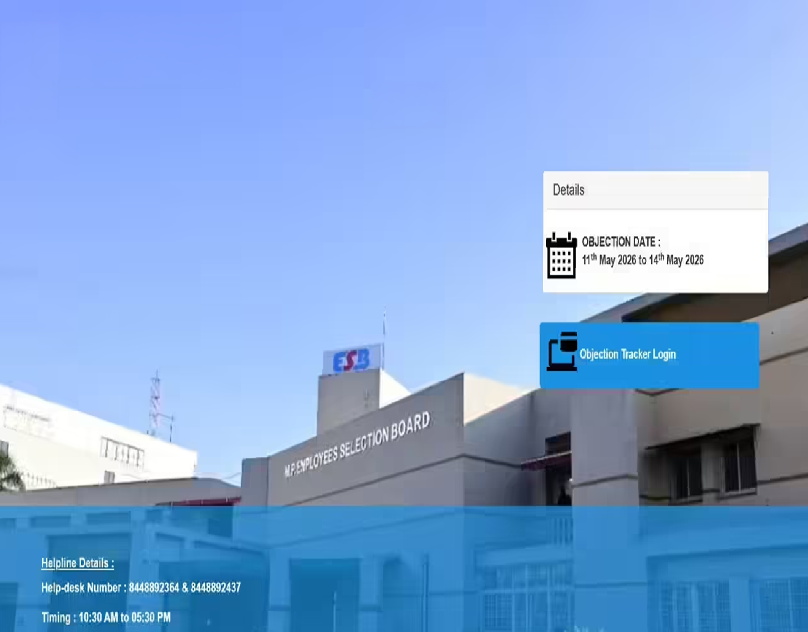
Alongside the answer key, the board has also activated the objection window, allowing candidates to challenge any responses they believe may be incorrect. The objection facility will remain open until May 14, 2026, after which the board will evaluate all submitted representations before issuing the final answer key.
The development marks an important milestone in the admission process for undergraduate agriculture and allied science programmes across Madhya Pradesh. Every year, MP PAT serves as a gateway for students aspiring to pursue higher education in agriculture, horticulture, forestry and agricultural engineering, fields that continue to gain relevance in India’s evolving rural and agrarian economy.
Importance of the MP PAT Examination
The MP Pre-Agriculture Test is one of the state’s major entrance examinations for candidates seeking admission into agriculture-related undergraduate courses. Conducted by MPESB, the examination opens pathways to programmes such as the Bachelor of Science in Agriculture, Horticulture and Forestry, along with engineering-based agricultural disciplines offered by participating institutions across Madhya Pradesh.
Over the years, agricultural education has undergone a substantial transformation. No longer restricted to conventional farming studies, modern agricultural curricula now encompass biotechnology, agri-business management, environmental sustainability, precision farming and food systems research. Consequently, examinations such as MP PAT have become increasingly significant for students aiming to build careers in agricultural innovation and rural development.
The 2026 edition of the examination was conducted on May 8 in computer-based mode across multiple centres in the state. The examination witnessed participation from a large number of students competing for limited seats in professional agricultural programmes.
Preliminary Answer Key: A Critical Transparency Measure
The publication of a provisional answer key serves several essential purposes within the examination process. Most importantly, it enhances transparency by allowing candidates to independently verify the correctness of official responses. Instead of waiting directly for results, students receive an opportunity to compare their attempted answers with those published by the examination authority.
This system has gradually become standard practice across major entrance examinations in India. By inviting objections before the finalisation of results, examination boards create a mechanism through which factual or technical inaccuracies can be corrected.
For MP PAT aspirants, the preliminary answer key acts as an early indicator of probable scores. Candidates can estimate their performance by matching their recorded responses against the officially released answers. Since MP PAT follows a structured marking scheme, students are able to derive a reasonably accurate projection of their expected results even before the merit list is announced.
At the same time, the provisional nature of the answer key means that corrections are still possible. This is precisely why the objection facility becomes significant.
Objection Window Open Till May 14
Candidates who identify discrepancies in the answer key may raise formal objections through the prescribed process before May 14, 2026. The board has instructed applicants to submit supporting documents or academic references while challenging any response.
Typically, objections without credible evidence are not entertained. Therefore, students are expected to provide standard textbook references, authoritative academic material or officially accepted scientific explanations to support their claims.
The objection process plays an important role in maintaining fairness in large-scale examinations. In technical subjects such as biology, chemistry, agriculture and physics, even a minor ambiguity in wording can occasionally lead to differing interpretations. By opening the challenge mechanism, MPESB ensures that students are not unfairly disadvantaged due to potential errors in evaluation.
In several competitive examinations across the country, objection windows have previously resulted in modifications to provisional answer keys. Examination authorities generally constitute expert panels to review every challenge submitted by candidates before arriving at a final decision.
Once all objections are examined, the board will release the final answer key, which will be treated as conclusive for result preparation.
How Candidates Can Access the Answer Key
Candidates can download the MP PAT 2026 preliminary answer key through the official MPESB portal. The answer key is generally available under the examination or objection section of the website, where candidates must log in using their application credentials.
After accessing the portal, students can review question-wise responses, compare them with their own attempted answers and identify any inconsistencies they may wish to challenge.
Students are also advised to preserve copies of their objection submissions and payment receipts, wherever applicable, until the admission process is completed.
Why the Final Answer Key Matters
While the preliminary answer key provides an estimated framework, the final answer key ultimately determines candidates’ scores and rankings. Once published, no further objections are entertained, and the results are prepared strictly based on the revised final responses.
This stage becomes particularly important because even marginal score differences can influence admission outcomes. Competitive entrance examinations often witness extremely close score variations among candidates. A single corrected response can therefore alter merit positions significantly.
Following the release of the final answer key, MPESB is expected to declare the examination results and merit list. Successful candidates will then proceed towards counselling and seat allocation processes conducted by participating institutions.
Rising Interest in Agricultural Education
The growing attention surrounding MP PAT also reflects the increasing attractiveness of agricultural education in India. Traditionally viewed as a sector limited to farming practices, agriculture has now emerged as a multidisciplinary domain closely connected with sustainability, food security and technological innovation.
Government initiatives promoting agri-tech entrepreneurship, climate-resilient farming and rural development have encouraged more students to consider agriculture as a viable professional pathway. Simultaneously, the rise of research opportunities in biotechnology, soil sciences, crop management and food processing has expanded the academic appeal of agricultural sciences.
Institutions offering agriculture-related programmes are increasingly integrating technology-driven learning models, including drone-assisted farming analysis, AI-based crop monitoring and data-led agricultural management systems. As a result, entrance examinations such as MP PAT have gained prominence among science students seeking specialised career opportunities beyond conventional engineering and medical streams.
Advisory for Candidates
As the objection deadline approaches, candidates are encouraged to review the answer key carefully rather than relying solely on unofficial discussions circulating online. Expert guidance, standard academic references and systematic evaluation of attempted questions can help students make informed decisions regarding objections.
Candidates should also ensure that objections are submitted within the prescribed timeline, as late representations are generally not considered by examination authorities.
Equally important is maintaining realistic expectations during score estimation. While provisional calculations may provide an approximate understanding of performance, actual rankings depend on several factors, including normalisation procedures, competition levels and the final answer key revisions.
For many aspirants, the coming weeks will determine the next phase of their academic journey. Until the final results are announced, the provisional answer key remains an essential tool for transparency, accountability and candidate confidence in the examination process.