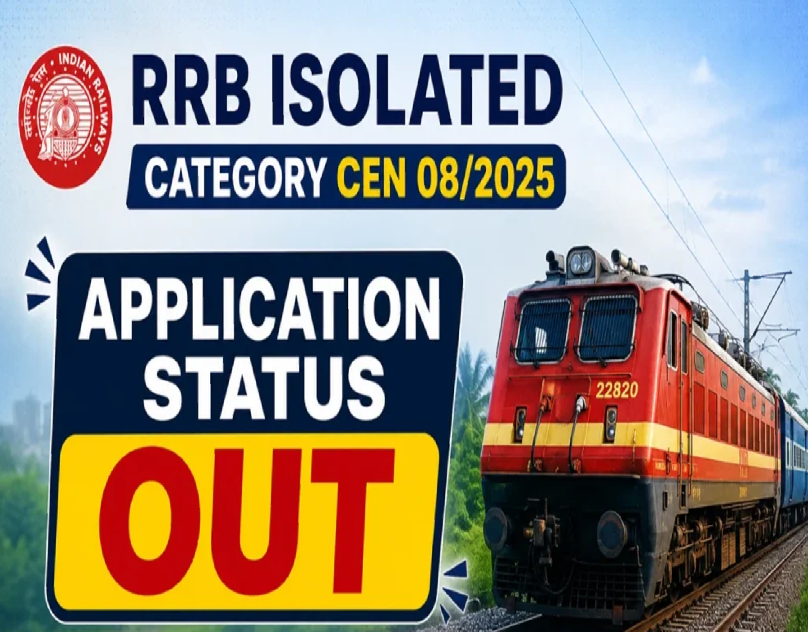
RRB Isolated Categories Recruitment 2026 Application Status Out
RRB Isolated Categories Recruitment 2026: Application Status Released as Recruitment Process Moves Ahead
The Railway Recruitment Board (RRB) has officially released the application status for the RRB Isolated Categories Recruitment 2026, marking an important development for thousands of candidates aspiring to secure specialised positions within Indian Railways. Applicants who registered for the recruitment drive can now verify whether their applications have been accepted or rejected by accessing the official regional RRB websites.
The release of the application status represents a significant milestone in the recruitment process and signals the transition towards the next phase of selection, which is expected to include a computer-based examination and further evaluation stages. Candidates are being advised to check their status promptly and remain attentive to subsequent notifications related to examination schedules, admit cards and recruitment procedures.
The RRB Isolated Categories recruitment remains one of the most specialised recruitment drives conducted by the Railway Recruitment Boards, offering opportunities across a wide range of ministerial, technical, educational and cultural posts within Indian Railways.
What Is the RRB Isolated Categories Recruitment?
The Isolated Categories recruitment conducted by RRB is designed to fill specialised and non-technical posts across various railway zones and production units. Unlike large-scale recruitment drives for technical or operational positions, the isolated categories segment focuses on posts requiring specific educational qualifications, professional expertise or specialised skills.
The recruitment typically includes vacancies for positions such as:
- Junior Translator and Hindi Translator
- Teachers and laboratory assistants
- Law assistants
- Publicity inspectors
- Staff and welfare inspectors
- Librarians
- Music and dance instructors
- Various ministerial and specialised administrative posts
These roles contribute significantly to the administrative, educational and cultural functioning of Indian Railways, one of the world’s largest public-sector employers.
The 2026 recruitment cycle reportedly involves hundreds of vacancies distributed across multiple categories and railway regions.
Application Status Released for Candidates
With the application process now complete, RRB has initiated the scrutiny stage by releasing the application status for registered candidates. Through this facility, applicants can verify whether their submitted forms have been provisionally accepted or rejected based on eligibility criteria and document verification conducted during the preliminary screening process.
The application status is available through official regional RRB portals as well as the central recruitment platform. Candidates are required to log in using their registration credentials, including registration number and date of birth, to access their application details.
For many applicants, this stage is crucial because only candidates with accepted applications will be permitted to appear for the next phase of the recruitment examination.
Why Applications Are Sometimes Rejected
In large-scale recruitment drives such as those conducted by RRB, application rejection is not uncommon. Applications may be rejected for several reasons, including:
- Incomplete submission of mandatory information
- Mismatch in uploaded documents or photographs
- Failure to meet prescribed eligibility criteria
- Incorrect category selection
- Non-payment of examination fees
- Invalid or unclear certificates
Candidates whose applications have been rejected are generally informed of the reason for rejection through the application portal itself. While the application status release may disappoint some aspirants, it also reinforces the importance of accuracy and procedural compliance in competitive recruitment processes.
Experts frequently advise candidates to review every detail carefully while completing recruitment applications, particularly in examinations involving large applicant pools and strict administrative scrutiny.
Recruitment Process Expected to Move Towards CBT Stage
Following the release of the application status, attention now shifts towards the next stage of recruitment, which is expected to involve a Computer-Based Test (CBT). Although the examination schedule has not yet been officially announced, reports indicate that the CBT dates are likely to be released shortly.
The CBT stage generally serves as the primary screening examination and evaluates candidates on subjects such as:
- General awareness
- Professional knowledge
- Reasoning and analytical ability
- Language proficiency
- Subject-specific expertise relevant to the applied post
Depending on the nature of the position, additional stages such as translation tests, teaching skill assessments, document verification or interviews may also be conducted later in the recruitment cycle.
Certain specialised posts within the isolated categories segment require domain-specific evaluations beyond conventional objective examinations. Consequently, candidates are advised to carefully review the official recruitment notification and syllabus applicable to their respective categories.
Importance of Railway Recruitment in India
Railway recruitment examinations continue to hold immense significance within India’s employment landscape. Indian Railways remains one of the country’s largest employers, offering stable government employment opportunities across technical, administrative, operational and specialised sectors.
For many aspirants, recruitment drives conducted by RRB represent opportunities for long-term career stability, professional growth and access to public-sector benefits. The popularity of railway examinations is particularly visible among graduates seeking government employment in administrative and specialised roles.
The isolated categories recruitment differs from broader railway recruitment drives such as NTPC, ALP or Group D examinations because it targets candidates possessing specialised educational backgrounds and professional expertise. As a result, competition within certain categories can be particularly intense due to the limited number of vacancies and highly specific eligibility requirements.
Digitalisation and Transparency in Recruitment
The release of online application status reflects the broader digital transformation that has reshaped public-sector recruitment processes across India in recent years. Railway recruitment procedures have increasingly adopted technology-driven systems for application submission, examination management, admit card issuance and result declaration.
Online application tracking allows candidates to access recruitment updates efficiently while reducing administrative delays and communication gaps. The introduction of centralised portals and digital verification systems has also improved transparency and accessibility for applicants across different regions.
RRB websites now regularly publish recruitment notifications, examination schedules, cut-off marks, scorecards and status updates through official digital platforms.
However, authorities continue to caution candidates against relying on unofficial social media messages or fraudulent recruitment claims. Several regional RRB portals prominently advise applicants to trust only verified information published through official railway recruitment websites.
What Candidates Should Do Next
Candidates whose applications have been accepted should now begin preparing seriously for the upcoming examination phase. Since isolated category posts often involve specialised syllabi, focused preparation becomes particularly important.
Applicants are advised to:
- Regularly monitor official RRB websites for examination notifications
- Review the syllabus and examination pattern carefully
- Practise previous years’ question papers where available
- Strengthen subject-specific knowledge related to the applied post
- Keep essential documents and identification proof ready for verification stages
Candidates should also ensure that their registered mobile numbers and email addresses remain active, as important recruitment communications may be issued through these channels.
Growing Competition for Government Recruitment
The sustained popularity of railway recruitment examinations reflects broader employment trends across India. Government-sector jobs continue to attract substantial interest due to perceived employment security, structured career progression and social prestige associated with public-sector service.
At the same time, competition for such positions has intensified considerably over the years. Recruitment drives involving even a few hundred vacancies frequently attract applications from lakhs of candidates nationwide.
This growing competition has elevated the importance of timely preparation, procedural accuracy and awareness of recruitment updates. For specialised posts under the isolated categories segment, candidates possessing strong academic qualifications and professional expertise often gain a significant advantage.
What Lies Ahead for Candidates
The release of the RRB Isolated Categories Recruitment 2026 application status marks the beginning of a more competitive and decisive phase within the selection process. For candidates whose applications have been accepted, the focus now shifts towards examination preparation and readiness for subsequent evaluation stages. As Indian Railways continues to modernise and expand its operational ecosystem, specialised administrative and professional roles are likely to remain integral to its functioning. Recruitment drives such as these, therefore, continue to attract aspirants seeking meaningful careers within one of India’s most significant public-sector institutions. Candidates are advised to remain vigilant regarding official announcements and avoid misinformation circulating through unofficial channels. With examination schedules expected to be announced soon, the coming weeks will prove crucial for aspirants hoping to progress further in the recruitment process.