NCERT Launches Free Online Physics Course For Class 12 On SWAYAM
In a noteworthy step towards strengthening accessible, high-quality education across India, the National Council of Educational Research and Training (NCERT), under the aegis of the Ministry of Education, has introduced a free online Physics course for Class 12 students on the SWAYAM platform. Designed to cover the entire senior secondary Physics syllabus over a structured 24-week period, this initiative reflects a growing commitment to digital learning, academic equity, and enhanced preparation for both board examinations and competitive assessments.
As education systems worldwide continue to integrate digital resources into mainstream pedagogy, initiatives such as this represent more than supplementary academic support. They signify a broader shift towards democratised learning, where quality educational content is accessible regardless of geographic, socio-economic, or institutional constraints.
Expanding Access to Quality Education
Physics, often regarded as one of the more demanding subjects in the science curriculum, requires conceptual clarity, analytical reasoning, and consistent practice. Students in many parts of the country, particularly in remote or under-resourced areas, may face challenges accessing specialised teaching or supplementary academic resources. By offering a comprehensive online course free of cost, NCERT is addressing these disparities while reinforcing the principle of educational inclusivity.
The SWAYAM platform, India’s national Massive Open Online Course (MOOC) initiative has increasingly become a central hub for accessible digital education. Hosting courses across disciplines and educational levels, it enables learners to access curated academic content from reputable institutions. The addition of a full-length Class 12 Physics course further strengthens its role as a national academic resource.
Course Structure and Academic Scope
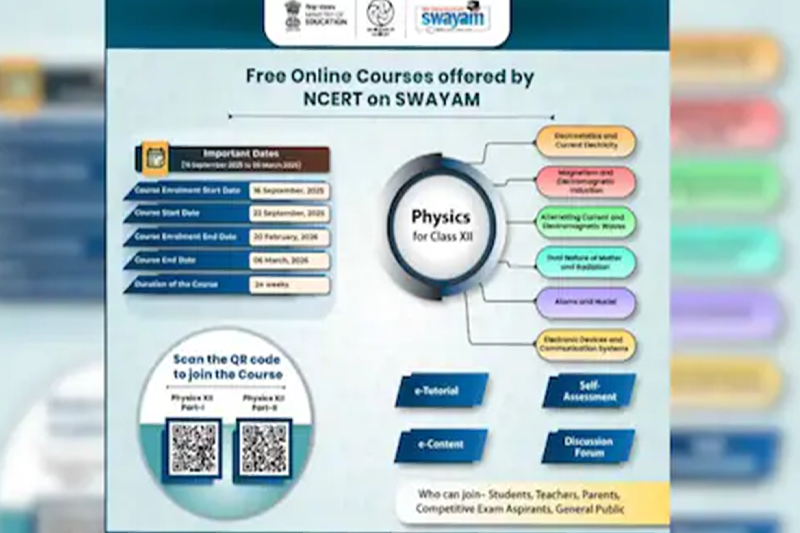
The newly launched course covers all major components of the Class XII Physics syllabus in alignment with NCERT textbooks and national curriculum standards. Core topics include Electrostatics and Current Electricity, Magnetism and Electromagnetic Induction, Alternating Current and Electromagnetic Waves, the Dual Nature of Matter and Radiation, Atoms and Nuclei, as well as Electronic Devices and Communication Systems.
This structured progression ensures that learners receive a comprehensive conceptual foundation while also gaining exposure to advanced topics essential for higher education in science and engineering fields. The alignment with official curriculum standards makes the course particularly valuable for students preparing for board examinations, national-level entrance tests, and other competitive assessments.
By maintaining curricular consistency, the programme ensures that learners can integrate online study seamlessly with their school coursework, thereby reinforcing classroom learning rather than replacing it.
Interactive Digital Learning Environment
A defining feature of the course is its emphasis on interactivity. Rather than relying solely on recorded lectures, the programme incorporates e-tutorials, digital study materials, self-assessment tools, and discussion forums. This multifaceted approach fosters active engagement, enabling students to test their understanding, clarify doubts, and interact with peers or instructors in a collaborative environment.
Self-assessment modules play a particularly important role in science education. Physics requires not only theoretical comprehension but also problem-solving proficiency. Regular quizzes, practice exercises, and diagnostic assessments allow learners to identify conceptual gaps and strengthen their analytical skills systematically.
Discussion forums further enhance the learning experience by creating a community of learners. Peer interaction can stimulate critical thinking, encourage knowledge sharing, and provide motivational support, especially for students studying independently.
Supporting Examination Preparedness
For many Class 12 students, Physics is not merely an academic subject but a gateway to future academic and professional opportunities. Strong performance in Physics often influences admission prospects in engineering, medical, and scientific programmes. Consequently, comprehensive exam preparation is essential.
The NCERT online course is structured to support both board examination readiness and preparation for competitive examinations. By closely adhering to the prescribed syllabus while providing deeper conceptual insights, the course bridges the gap between foundational learning and advanced application.
Moreover, the flexibility of online learning allows students to revisit complex topics, practise repeatedly, and pace their studies according to individual needs, advantages that traditional classroom settings may not always provide.
Lifelong Learning Beyond the Classroom
While the primary audience for the course is Class 12 students, NCERT has intentionally kept it open to a broader learner base. Teachers, parents, competitive examination aspirants, and members of the general public with an interest in Physics are also eligible to enrol.
This inclusive approach reflects the evolving philosophy of lifelong learning. Education today is no longer confined to specific age groups or formal institutional settings. Professionals seeking to refresh their knowledge, educators aiming to enhance teaching strategies, or enthusiasts pursuing intellectual curiosity can all benefit from such accessible academic resources.
For teachers in particular, exposure to structured digital courses can support professional development. They can gain insights into updated pedagogical approaches, digital teaching tools, and innovative content delivery methods.
Digital Education and National Policy Priorities
The launch of this course aligns with broader national educational priorities emphasising digital integration, accessibility, and quality enhancement. Educational policies increasingly advocate blended learning models that combine traditional classroom instruction with digital resources.
Digital platforms offer scalability that physical infrastructure alone cannot achieve. A single high-quality online course can reach thousands of learners simultaneously, ensuring uniform access to reliable academic content. This scalability is particularly valuable in a country with diverse educational contexts and varying resource availability.
Furthermore, digital initiatives support resilience in education systems. Experiences from recent global disruptions have underscored the importance of flexible learning mechanisms capable of sustaining educational continuity under challenging circumstances.
Challenges and Considerations
Despite the evident advantages, digital learning initiatives must address several challenges to maximise impact. Access to reliable internet connectivity, availability of suitable digital devices, and digital literacy levels remain uneven across regions. Addressing these infrastructural and socio-economic factors is essential to ensure that online education truly promotes equity.
Another consideration is learner motivation. Online courses demand a degree of self-discipline and time management that some students may find challenging. Structured guidance from teachers, parental support, and institutional encouragement can help sustain engagement.
Quality assurance also remains crucial. Continuous feedback, periodic updates, and rigorous academic oversight ensure that course content remains accurate, relevant, and pedagogically effective.
Implications for Future Science Education
The introduction of comprehensive digital courses in subjects such as Physics reflects a broader transformation in science education. Increasingly, digital simulations, virtual laboratories, and interactive content complement traditional teaching methods. These tools can visualise complex phenomena, facilitate experimentation, and enhance conceptual understanding.
As technological capabilities expand, future iterations of such courses may incorporate augmented reality, artificial intelligence-driven personalisation, and advanced data analytics to further enrich learning experiences.
A Step Towards Educational Inclusivity
Ultimately, NCERT’s free online Physics course represents an important stride towards educational inclusivity, academic excellence, and digital empowerment. By providing structured, curriculum-aligned content accessible to learners across the country, the initiative strengthens the foundation of science education while supporting national aspirations for technological advancement.
For students navigating the challenges of Class 12 academics, the course offers a valuable supplementary resource. For educators and lifelong learners, it presents opportunities for professional enrichment and intellectual exploration. And for the education system at large, it exemplifies how digital innovation can expand access, enhance quality, and support equitable learning outcomes.
As enrolment remains open until 20 February 2026, the initiative invites learners to engage with Physics not merely as an academic requirement but as a field of inquiry that fosters curiosity, analytical thinking, and scientific literacy. In doing so, it reinforces the broader educational mission of cultivating informed, capable, and intellectually confident citizens prepared for an increasingly knowledge-driven world.