RRB NTPC Graduate CEN 06/2025 CBT-I Exam Date Announced: What Aspirants Need to Know
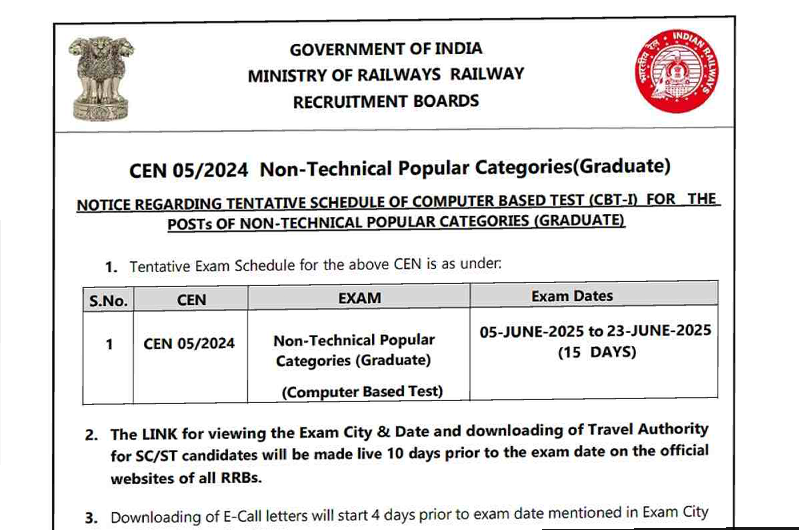
The announcement of examination schedules for major public sector recruitment exercises invariably attracts significant attention, particularly when the opportunities involve stable careers within India’s vast railway network. The recent notification issued by the Railway Recruitment Boards (RRBs), functioning under the Ministry of Railways, has confirmed the tentative schedule for the Computer Based Test (CBT-I) for Non-Technical Popular Categories (NTPC) Graduate posts under CEN 06/2025. The first stage examination is slated to be conducted from 16 March to 27 March 2026. For lakhs of candidates aspiring to secure positions within Indian Railways, this announcement marks a critical milestone, signalling the transition from application to assessment.
Significance of the NTPC Recruitment Drive
Railway recruitment examinations occupy a distinctive place in India’s employment landscape. The railway system remains one of the country’s largest public sector employers, offering diverse roles ranging from operational management to administrative support. NTPC graduate-level positions, in particular, are widely sought after because they combine professional responsibility with job stability, structured career progression, and attractive remuneration packages.
The CEN 06/2025 recruitment drive reportedly aims to fill approximately 5,810 vacancies across multiple posts. Such large-scale recruitment reflects both workforce requirements and the continued expansion and modernisation of railway services nationwide.
For many aspirants, these roles represent not merely employment but a long-term professional trajectory within a respected public institution.
Posts Covered Under the Recruitment
The recruitment exercise encompasses several graduate-level roles essential to the functioning of railway operations and administration. Among the prominent posts included are Chief Commercial cum Ticket Supervisor, Station Master, Goods Train Manager, Junior Accountant Assistant cum Typist, Senior Clerk cum Typist, and Traffic Assistant.
Each of these roles carries distinct responsibilities. Station Masters, for instance, oversee train operations at stations, ensuring safety, scheduling coordination, and passenger facilitation. Commercial supervisors manage ticketing operations and customer service aspects, while Goods Train Managers play a crucial role in freight logistics, an increasingly vital segment of railway revenue.
Administrative roles such as clerks and accounting assistants contribute to organisational efficiency, supporting documentation, financial processes, and operational coordination.
Salary levels for these posts generally range from Level 4 to Level 6 under the government pay matrix, offering competitive remuneration along with additional allowances and benefits.
Eligibility Criteria and Age Requirements
As with most government recruitment processes, eligibility criteria have been carefully defined to ensure fairness and clarity. Applicants must possess a recognised graduate degree to qualify for NTPC graduate-level posts.
Age requirements typically range from 18 to 33 years, with the cut-off date for age calculation specified as 1 January 2026. Age relaxation provisions apply to candidates belonging to reserved categories in accordance with established government norms.
These criteria ensure both inclusivity and consistency, enabling a broad demographic of educated young professionals to participate in the recruitment process.
Examination Timeline and Structure
The CBT-I examination will be conducted over multiple days between 16 and 27 March 2026. Multi-day scheduling is standard practice for large-scale examinations, enabling efficient management of candidate volumes while maintaining examination integrity.
The overall selection process extends beyond CBT-I and typically includes subsequent stages such as CBT-II, a Computer-Based Aptitude Test for specific posts, typing skill assessments where applicable, followed by document verification and medical examinations.
This multi-tiered approach ensures comprehensive evaluation of both academic competence and job-specific aptitude.
Exam City Intimation and E-Call Letters
Candidates eagerly awaiting logistical details will receive exam city information approximately ten days prior to their scheduled test date. This advance notification allows aspirants to make necessary travel arrangements and prepare accordingly.
E-call letters, which function as official admission documents, will be available for download roughly four days before the respective examination date. Candidates are advised to monitor official RRB websites regularly for updates, as reliance on unofficial sources may lead to misinformation.
Maintaining vigilance regarding official communication is crucial in high-stakes recruitment processes.
Aadhaar-Based Biometric Verification
An important procedural aspect of the upcoming examination involves biometric authentication linked to Aadhaar identification. This verification process, facilitated through the Unique Identification Authority of India (UIDAI) database, will be conducted at examination centres prior to entry into the examination hall.
Candidates must present either their original Aadhaar card or a verified electronic printout. Additionally, ensuring that Aadhaar data remains accessible, often referred to as keeping it “unlocked” is essential to prevent authentication delays.
Biometric verification serves multiple purposes: enhancing examination security, preventing impersonation, and ensuring transparency within the recruitment process.
Increasing Digitisation of Recruitment Examinations
The use of computer-based testing reflects a broader trend towards digitisation in public sector recruitment. Digital examinations offer advantages such as standardised question delivery, faster result processing, improved security protocols, and reduced logistical complexity compared with traditional paper-based tests.
For candidates, familiarity with digital interfaces has become increasingly important. Many aspirants now incorporate online mock tests into their preparation routines to build confidence and technical ease.
Digitisation also aligns recruitment practices with contemporary workplace realities, where digital literacy is an essential professional skill.
Preparation Strategies for Aspirants
Success in competitive recruitment examinations requires sustained preparation rather than last-minute revision. Aspirants typically benefit from a structured study plan encompassing quantitative aptitude, general awareness, reasoning ability, and language proficiency.
Regular mock testing helps candidates assess readiness while improving time management. Reviewing previous examination papers, staying updated with current affairs, and maintaining conceptual clarity are equally vital components of preparation.
Equally important is psychological readiness. Competitive examinations can be demanding, and maintaining balanced routines that include rest, physical activity, and stress management often enhances overall performance.
Career Prospects in Indian Railways
Employment within Indian Railways offers a combination of professional security, structured advancement pathways, and opportunities for skill development. Employees benefit from government service perks such as pension schemes, healthcare benefits, travel concessions, and housing support in certain cases.
Moreover, working within one of the world’s largest railway networks provides exposure to large-scale infrastructure management, technological innovation, and public service delivery.
For many candidates, railway employment represents both financial stability and social prestige.
Ensuring Authentic Information Sources
Given the scale of railway recruitment examinations, misinformation can sometimes circulate through unofficial channels. Candidates are therefore strongly encouraged to rely exclusively on official RRB notifications and government announcements.
Careful verification of information helps prevent unnecessary anxiety, logistical confusion, or missed deadlines.
Educational institutions and career counsellors also play an important role in guiding aspirants towards reliable sources.
Broader Implications for Public Sector Recruitment
Large recruitment drives such as CEN 06/2025 reflect ongoing efforts to strengthen public sector infrastructure and service delivery. As transportation networks expand and modernise, skilled personnel remain essential to operational efficiency.
Digitised recruitment systems, biometric authentication, and transparent evaluation mechanisms collectively enhance public confidence in government hiring processes.
These developments also indicate a broader commitment to administrative modernisation across public institutions.
Conclusion
The announcement of the CBT-I examination schedule for RRB NTPC Graduate posts under CEN 06/2025 represents a significant development for thousands of aspirants seeking careers in Indian Railways. Scheduled between 16 and 27 March 2026, the examination marks the next stage in a comprehensive recruitment process designed to identify capable professionals for diverse operational and administrative roles. With clear eligibility criteria, structured examination stages, digital testing protocols, and biometric verification measures, the recruitment process reflects both scale and sophistication. For candidates, the focus now shifts to diligent preparation, careful monitoring of official updates, and maintaining readiness for each subsequent stage of selection. With thoughtful preparation and informed engagement, aspirants can approach the examination confidently, viewing it not merely as a test but as a gateway to meaningful public service within one of India’s most vital institutions.