Tamil Nadu Class 12 Results 2026: Pass Percentage Reaches 95.20%
Tamil Nadu Class 12 Results 2026: Beyond Marks and Pass Percentages
The announcement of the Tamil Nadu Class 12 Higher Secondary Examination results for 2026 has once again brought the state’s education system into national focus. Declared by the Directorate of Government Examinations (DGE), the results recorded an impressive overall pass percentage of 95.20 per cent, continuing Tamil Nadu’s long-standing reputation for strong academic performance in senior secondary education.
For lakhs of students across the state, however, the result is far more than a statistical achievement. It represents the culmination of years of preparation, personal aspiration and intense academic discipline. The Class 12 examination remains one of the most decisive milestones in India’s educational structure, shaping higher education opportunities, competitive examination eligibility and future career trajectories.
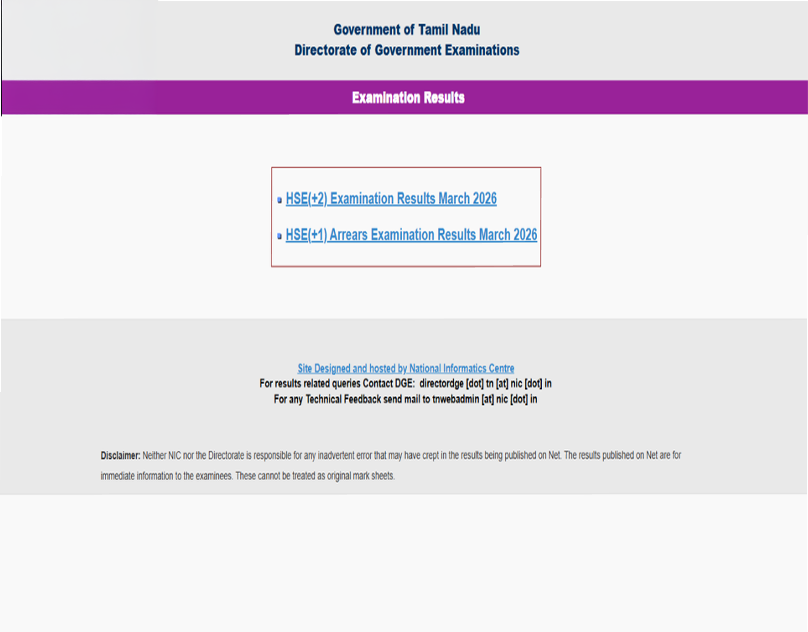
Students who appeared for the Higher Secondary Certificate examinations can now access their scores online through official portals, including tnresults.nic.in and dge.tn.gov.in, while alternative access through DigiLocker, WhatsApp and SMS services reflects the increasing digitisation of educational administration in India.
Tamil Nadu’s Consistent Academic Record
Tamil Nadu has historically maintained one of the strongest Class 12 pass percentages among Indian states. Over the past several years, the state’s Higher Secondary Examination results have reflected remarkable consistency, often recording pass rates above 94 per cent.
The 2026 results continued that trajectory with a pass percentage of 95.20 per cent, slightly improving upon previous years and reinforcing the state’s reputation for robust academic administration.
Reports indicate that girls once again outperformed boys, continuing a pattern that has become increasingly visible across board examinations in India. This recurring trend reflects broader developments in educational participation and academic achievement among female students, particularly in southern states where school retention and educational access indicators remain comparatively strong.
District-wise performance also drew attention, with Erode emerging as one of the state’s top-performing districts. Such regional distinctions frequently generate significant public interest in Tamil Nadu, where educational outcomes are closely observed by schools, local administrations and families alike.
The Significance of Class 12 in India’s Academic Structure
The Class 12 board examination occupies a uniquely influential position within India’s educational framework. Unlike lower secondary assessments, Higher Secondary examinations directly affect university admissions, scholarship eligibility and entrance examination preparation.
For students in Tamil Nadu, the Plus Two examination often determines access to engineering, medical, commerce, arts and professional degree programmes. Even in the era of national entrance examinations such as CUET and NEET, board examination scores continue to hold considerable significance.
The pressure associated with these examinations, therefore, remains immense. Students frequently spend two years preparing intensively while balancing coaching classes, school assessments and competitive entrance preparation simultaneously.
For many families, Class 12 results carry emotional and social significance extending beyond academics. High scores are often associated with prestige, opportunity and long-term professional security. Consequently, the result day becomes a deeply emotional event across households throughout the state.
Digital Access and the Modern Result System
One of the most striking features of the 2026 result declaration process was the wide range of digital access options provided to students. Beyond traditional websites, students could retrieve their provisional mark sheets through DigiLocker, WhatsApp and SMS services.
This reflects a broader transformation underway within India’s educational administration systems. Examination boards are increasingly adopting technology-driven methods to improve accessibility, reduce administrative delays and manage the enormous traffic generated during result announcements.
The availability of multiple access channels is particularly important in states like Tamil Nadu, where lakhs of candidates attempt to check results simultaneously. Heavy traffic often slows or crashes official portals during peak hours. Alternative systems such as DigiLocker and WhatsApp-based retrieval, therefore, provide practical solutions to logistical challenges.
Digital mark sheets have also reduced dependence on physical documentation during the immediate post-result period. Students can now use provisional online records for preliminary admission procedures while awaiting original certificates from schools.
This digitisation marks a significant departure from earlier decades when students gathered at schools or examination centres to manually access printed result sheets. The experience of the result day itself has been fundamentally reshaped by technology.
Girls Continue to Outperform Boys
One of the most consistently observed patterns in Tamil Nadu’s Higher Secondary results is the superior performance of female students. The 2026 examinations once again reflected this trend, with girls recording a higher pass percentage than boys.
This phenomenon is not unique to Tamil Nadu, but the gap has become particularly pronounced in several southern states. Educational researchers frequently attribute this pattern to factors such as improved school retention among girls, disciplined academic engagement and increasing family support for female education.
Tamil Nadu has historically invested heavily in educational welfare schemes, including free textbooks, transportation support and nutritional programmes. Such initiatives have contributed significantly to improving female participation in secondary and higher secondary education.
The sustained academic success of girls in board examinations also reflects changing social attitudes. Education is increasingly viewed as central to women’s professional and economic independence, particularly in urban and semi-urban regions.
However, educational experts also caution that academic success at school level must translate into broader workforce participation and leadership opportunities if genuine gender progress is to be achieved.
The Emotional Landscape of Board Results
While pass percentages and district rankings dominate headlines, the emotional realities surrounding board examinations are often more complex.
For students, the period surrounding result announcements can involve intense anxiety and anticipation. Months of preparation culminate in a single set of scores that may influence higher education admissions and plans.
Social expectations further intensify this pressure. Families, relatives and peer networks frequently attach considerable importance to marks and rankings, making board results highly emotional experiences for adolescents already navigating personal and academic uncertainty.
The culture of public comparison has expanded further through social media. Students now encounter immediate discussions regarding cut-offs, toppers and performance statistics across digital platforms.
Although Tamil Nadu’s consistently high pass percentages indicate strong overall academic outcomes, conversations regarding student well-being and examination stress continue to gain relevance nationwide. Educational achievement alone cannot remain the sole measure of academic success.
Revaluation and Supplementary Examinations
The Directorate of Government Examinations has also provided students with opportunities for revaluation and supplementary examinations following the declaration of results.
Revaluation systems remain crucial in maintaining student confidence within large examination frameworks. Given the scale of board evaluations involving lakhs of answer scripts, occasional discrepancies or tabulation errors cannot be entirely ruled out. The ability to apply for scrutiny and re-totalling provides students with an important institutional safeguard.
Similarly, supplementary examinations offer students another opportunity to qualify without losing an academic year. Such systems have become essential components of modern board administration, helping reduce the long-term consequences of single-examination setbacks.
Educational systems increasingly recognise that academic progression should not be entirely determined by one examination cycle alone.
Tamil Nadu’s Educational Model
Tamil Nadu’s consistent board examination performance frequently attracts attention from policymakers and education analysts across India. The state has historically prioritised public education infrastructure, teacher recruitment and welfare-based educational support systems.
Government schools in Tamil Nadu have also shown notable improvement over recent years, narrowing performance gaps with private institutions in several districts.
The state’s educational culture additionally places strong emphasis on examination preparedness and structured academic discipline. Coaching systems, parental involvement and institutional monitoring collectively contribute to high pass percentages.
However, educational experts increasingly argue that future reforms must move beyond examination success alone. Skills development, critical thinking, creativity and digital literacy are becoming equally important within contemporary higher education and employment environments.
As India’s economy evolves, the challenge for school systems will involve balancing examination performance with broader intellectual and professional readiness.
The Role of DigiLocker and Technology Integration
The increasing use of DigiLocker for academic documentation represents another important development in India’s educational ecosystem. Students can now securely access provisional mark sheets and certificates digitally without depending exclusively on physical records.
This integration reflects the government’s broader push towards digital governance and paperless administrative systems. For students applying to universities or competitive examinations, digital documentation significantly simplifies verification procedures.
Technology integration has therefore transformed not only the result declaration but the entire educational administration process. Admissions, scholarships, certificates and examination communication increasingly operate through digital platforms.
Nevertheless, concerns regarding digital access disparities remain relevant. Students in remote or economically weaker regions may still encounter connectivity challenges, highlighting the importance of maintaining inclusive systems alongside technological advancement.
Looking Ahead
The Tamil Nadu Class 12 Results 2026 represent much more than another successful examination cycle. They reflect the evolving intersection of academic ambition, technological modernisation and educational policy within one of India’s strongest school education systems.
For students, the results mark the beginning of new transitions, towards universities, professional courses and future careers. For families, they symbolise years of investment, expectation and aspiration. For the state itself, they reinforce Tamil Nadu’s longstanding reputation for educational consistency and administrative efficiency.
Yet the broader significance of the results lies in what they reveal about Indian education today. Academic achievement remains deeply valued, but conversations around student well-being, equitable access and skill-oriented learning are becoming increasingly important alongside examination success.
As board examinations continue to shape the futures of millions of students annually, educational systems will need to evolve beyond mere pass percentages and rankings. The real measure of success may ultimately lie not only in how many students pass, but in how effectively education prepares them for an increasingly complex and rapidly changing world.