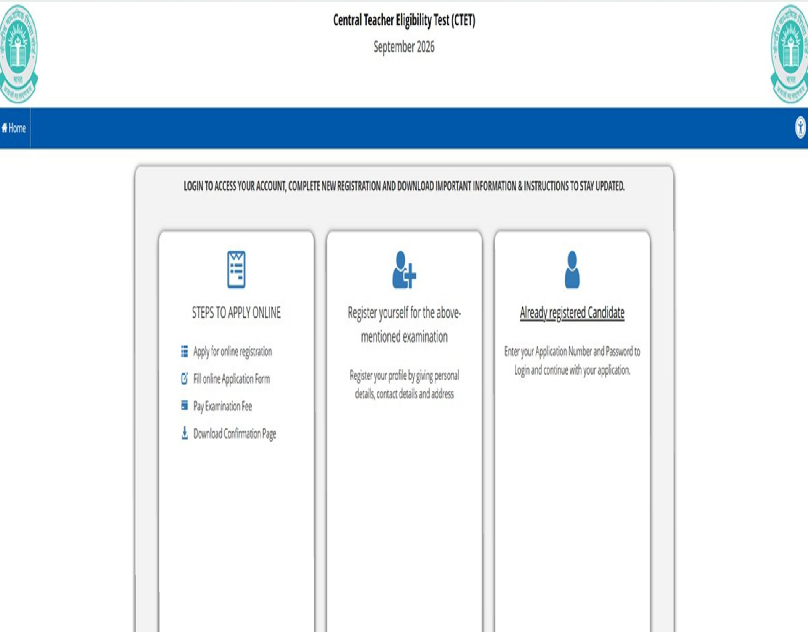
CTET September 2026 Registration Begins; CBSE Opens Application Window for Teacher Eligibility Exam
CTET September 2026 Registration Begins as CBSE Opens Application Window for Aspiring Teachers
The Central Board of Secondary Education (CBSE) has officially commenced the registration process for the Central Teacher Eligibility Test (CTET) September 2026 session, opening the gateway for thousands of aspiring educators seeking teaching opportunities in central government schools across India. Candidates interested in teaching Classes I to VIII can now submit their applications through the official CTET portal, marking the beginning of one of the country’s most significant teacher eligibility examinations.
According to the official notification issued by CBSE, the application process will remain open until June 10, 2026. The CTET September 2026 examination is scheduled to be conducted on September 6, although the board has indicated that an additional examination date may be introduced if the number of applicants increases substantially.
The commencement of the registration process represents a crucial moment for teaching aspirants nationwide, particularly as teacher eligibility examinations continue to play an increasingly important role in India’s educational recruitment framework.
Understanding the Importance of CTET
The Central Teacher Eligibility Test is one of India’s most prominent national-level examinations for teaching eligibility. Conducted by CBSE, CTET serves as a qualifying examination for candidates aspiring to teach in central government schools such as Kendriya Vidyalayas, Navodaya Vidyalayas and schools administered under the Union Territories.
Beyond central government institutions, several state governments and private schools also consider the CTET qualification while recruiting teachers, further enhancing the examination’s significance within the education sector.
The examination was introduced in accordance with the provisions laid down by the Right of Children to Free and Compulsory Education Act, which emphasised the importance of establishing professional teaching standards across the country. Over time, CTET has evolved into a nationally recognised benchmark for teacher eligibility and pedagogical competence.
For many aspiring educators, qualifying for the CTET represents an essential step towards securing stable and reputable teaching positions within India’s school education system.
Application Process Now Underway
Candidates can now complete the online application process through the official CTET website by submitting the required personal, academic and professional details. The board has advised applicants to carefully review the eligibility criteria, examination instructions and fee structure before submitting their forms.
Applicants are required to upload scanned copies of photographs, signatures and relevant academic documents while completing the registration procedure. The examination fee must also be paid online through the prescribed digital payment modes.
Given the large number of expected applicants, candidates are encouraged to complete registrations well before the closing deadline to avoid technical issues or last-minute congestion on the portal.
The board has also emphasised the importance of entering accurate information, as discrepancies in personal or academic details may create complications during later stages of verification and recruitment.
Examination Scheduled for September 6
CBSE has announced September 6, 2026, as the tentative date for the CTET examination. However, the board has clarified that additional examination dates may be considered depending on the volume of applications received.
The examination will be conducted in offline mode using OMR sheets and will comprise two papers:
Paper I
Paper I is intended for candidates aspiring to teach Classes I to V at the primary level.
Paper II
Paper II is designed for candidates seeking eligibility to teach Classes VI to VIII at the elementary level.
Candidates intending to teach across both levels may appear for both papers.
The structure of CTET places substantial emphasis not only on subject knowledge but also on pedagogical understanding, child development and teaching methodologies. This approach reflects the examination’s broader objective of assessing professional teaching aptitude rather than merely academic proficiency.
Eligibility Criteria for Candidates
Eligibility requirements for CTET vary depending on the level at which candidates intend to teach. Generally, applicants are expected to possess recognised educational qualifications in teaching and teacher training programmes such as Diploma in Elementary Education (D.El.Ed.), Bachelor of Education (B.Ed.) or equivalent qualifications approved by the National Council for Teacher Education (NCTE).
Candidates are advised to review the detailed eligibility guidelines mentioned in the official information bulletin before proceeding with the application process.
Educational qualification requirements may differ between Paper I and Paper II, particularly in relation to teacher training credentials and graduation criteria.
CTET and the Professionalisation of Teaching
The continued importance of CTET reflects broader efforts to professionalise teaching standards within India’s education system. Teacher quality has increasingly become a central focus of educational reform discussions, with policymakers emphasising the need for qualified and pedagogically trained educators capable of addressing contemporary classroom challenges.
CTET plays a significant role in this framework by establishing a uniform benchmark for teacher eligibility across central institutions. The examination aims to assess not only theoretical subject knowledge but also classroom readiness, child psychology awareness and instructional competence.
As India’s school education ecosystem continues to evolve, teacher eligibility examinations are increasingly viewed as instruments for strengthening educational quality and accountability.
The growing emphasis on competency-based learning, digital classrooms and inclusive education has further elevated expectations from teaching professionals. Consequently, examinations like CTET now carry substantial significance in determining teacher preparedness within modern educational contexts.
Increasing Competition Among Teaching Aspirants
The popularity of CTET has grown considerably over the years due to the rising demand for government teaching positions. Stable employment, structured career progression and social prestige associated with teaching careers continue to attract a large number of applicants annually.
At the same time, competition has intensified significantly. Lakhs of candidates typically appear for each CTET session, making thorough preparation essential for success.
Many aspirants spend months preparing for the examination, focusing on child development theories, pedagogy, language proficiency, environmental studies, mathematics and subject-specific content depending on the paper chosen.
Educational coaching institutions and digital learning platforms have also expanded specialised CTET preparation programmes in response to increasing candidate participation.
Why Teacher Eligibility Matters More Than Ever
The significance of teacher eligibility examinations extends beyond recruitment procedures. Educational researchers and policymakers increasingly recognise that teacher effectiveness directly influences student learning outcomes, classroom engagement and long-term educational development.
India’s rapidly evolving educational environment now demands teachers capable of adapting to technological integration, competency-based assessment models and diverse classroom settings. In this context, examinations such as CTET attempt to ensure that aspiring educators possess foundational pedagogical understanding before entering professional teaching roles.
Furthermore, the implementation of the National Education Policy (NEP) has amplified discussions around teacher quality, multidisciplinary learning and experiential education. These developments are likely to further increase the importance of professional teacher qualification systems in the coming years.
Important Instructions for Applicants
Candidates applying for CTET September 2026 are advised to remain attentive to official notifications and examination guidelines throughout the registration and examination process.
Applicants should ensure:
- Accurate submission of personal and academic details
- Timely payment of examination fees
- Proper uploading of required documents
- Regular monitoring of official updates regarding admit cards and examination centres
The board is expected to release admit cards closer to the examination date through the official CTET portal.
Candidates are also advised to avoid relying on unofficial social media updates or unverified information sources. CBSE regularly publishes official notifications through the CTET website and authorised communication channels.
What Comes Next for CTET Candidates
The commencement of CTET September 2026 registrations marks the beginning of another important recruitment and eligibility cycle within India’s education sector. For thousands of aspiring teachers across the country, the examination represents not merely a qualifying test but a pathway towards professional stability and meaningful contribution to the nation’s educational system. As applications continue over the coming weeks, candidates are expected to intensify preparation efforts while navigating the procedural requirements associated with registration and examination readiness. In a country where educational quality increasingly occupies the centre of public discourse, examinations such as CTET continue to serve as crucial instruments for shaping the future of teaching standards and classroom excellence.