NEET UG 2026 Under Investigation as NTA Faces Fresh Questions Over Exam Integrity and Fairness
NEET UG 2026 Under Investigation: Renewed Concerns Over Examination Integrity Shake India’s Medical Aspirants
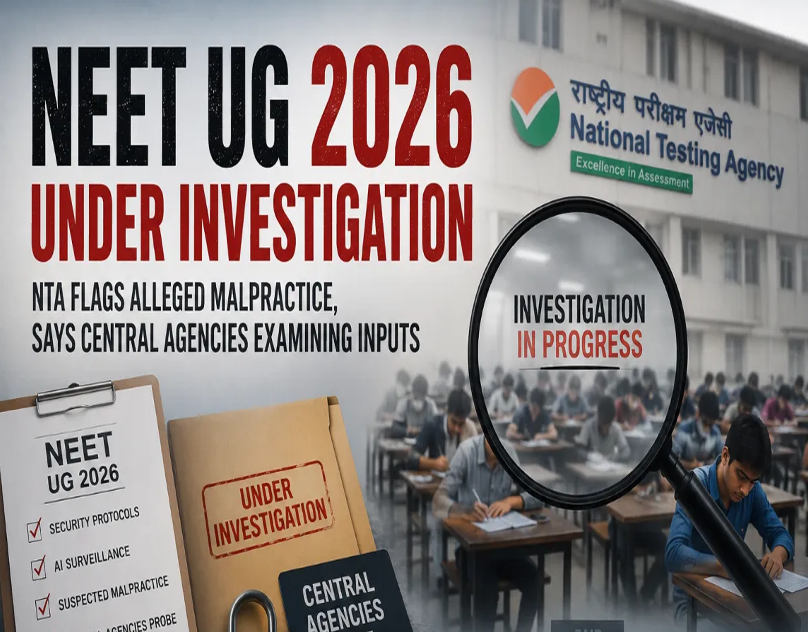
The National Eligibility-cum-Entrance Test Undergraduate (NEET UG) 2026, India’s most significant medical entrance examination, has once again come under intense scrutiny following allegations of irregularities and suspected malpractice. The National Testing Agency (NTA), which conducts the examination, has officially confirmed that inputs relating to possible misconduct have been forwarded to central investigative agencies for further examination.
The development has reignited nationwide debate surrounding the credibility, transparency and administrative robustness of high-stakes competitive examinations in India. For lakhs of students who dedicate years of preparation to secure admission into medical colleges, the controversy has introduced a renewed atmosphere of uncertainty, anxiety and frustration.
According to the NTA, information regarding alleged irregularities was received on the evening of May 7, four days after the examination was conducted. These inputs were subsequently escalated to central agencies on May 8 for independent verification and investigation. The agency has emphasised that no conclusions have yet been drawn and that the matter remains under active inquiry.
At a time when examination credibility has become a deeply sensitive issue within India’s educational landscape, the emergence of another NEET-related controversy carries implications far beyond administrative procedure. It touches upon public trust, student mental well-being and the larger question of fairness within one of the country’s most competitive academic systems.
India’s Largest Medical Entrance Examination
NEET UG occupies a uniquely powerful position within India’s education ecosystem. Conducted annually by the National Testing Agency, the examination serves as the single gateway for undergraduate medical admissions across government and private institutions nationwide. Millions of aspirants compete each year for a limited number of MBBS, BDS and allied healthcare seats, making NEET one of the most competitive examinations in the country.
For students, qualifying in NEET often represents years of sustained academic discipline, extensive coaching, financial investment and emotional endurance. Families frequently structure educational decisions, relocation plans and financial priorities around a child’s preparation for the examination.
Consequently, even the slightest suspicion regarding examination integrity carries enormous psychological and institutional consequences. Allegations of malpractice not only threaten administrative credibility but also undermine the sense of fairness upon which competitive examinations fundamentally depend.
The 2026 controversy emerges particularly sensitively in the aftermath of earlier national debates surrounding examination irregularities, paper leaks and evaluation disputes across multiple competitive examinations in India.
NTA Defends Security Measures Amid Growing Scrutiny
In response to rising concerns, the National Testing Agency has maintained that NEET UG 2026 was conducted under exceptionally stringent security arrangements designed to ensure transparency and prevent malpractice. According to official statements, the examination process incorporated multiple layers of technological and administrative safeguards.
Among the security measures reportedly implemented were GPS-tracked transportation systems for question papers, biometric verification of candidates, AI-assisted CCTV monitoring and the deployment of 5G jammers at examination centres. Authorities have stated that examination centres were monitored centrally to minimise opportunities for unauthorised communication or external interference.
The NTA has further clarified that it is fully cooperating with investigative agencies and sharing all relevant technical and operational information required for inquiry proceedings. Officials have repeatedly urged students and parents not to arrive at premature conclusions while investigations remain ongoing.
Yet despite these assurances, public concern has intensified precisely because the allegations surfaced despite the existence of such elaborate safeguards. Critics argue that repeated controversies surrounding competitive examinations reveal deeper systemic vulnerabilities that technology alone may not fully address.
Rajasthan Investigation and the “Guess Paper” Controversy
A major focus of the ongoing investigation appears linked to developments in Rajasthan, where the state’s Special Operations Group has reportedly initiated inquiries into suspected examination-related irregularities. Reports indicate that investigators are examining allegations connected to the circulation of “guess papers” before the examination.
According to emerging reports, certain documents circulated before the examination allegedly contained more than one hundred questions that closely resembled those appearing in the actual NEET paper. Authorities are currently examining whether this similarity resulted from coincidence, predictive coaching practices or unauthorised access to examination material.
While no definitive evidence has yet been publicly established, the allegations have nevertheless amplified suspicion among students and parents already sensitive to examination fairness issues.
The incident also illustrates how rapidly concerns surrounding paper leaks or malpractice can escalate in the digital era. Social media platforms, coaching networks and messaging applications enable rumours and unverified information to spread with extraordinary speed, often intensifying public anxiety before investigations are completed.
The Psychological Toll on Students
Beyond administrative investigations and official statements lies the human dimension of the controversy. For medical aspirants, NEET represents not merely an examination but a defining personal and emotional milestone.
Preparation for NEET often begins years in advance, with students navigating demanding academic schedules, coaching institutions, mock tests and immense societal expectations. The examination’s competitive nature already places considerable psychological pressure on candidates, many of whom experience anxiety, burnout and fear of failure.
In such a context, allegations of irregularities can significantly deepen emotional distress. Students who prepared honestly may begin questioning whether merit alone remains sufficient within highly competitive admission systems.
Educational psychologists have repeatedly warned that uncertainty surrounding examination credibility can have profound mental health consequences for adolescents. Feelings of helplessness, frustration and disillusionment may emerge when students perceive that fairness itself has become uncertain.
Parents, too, often experience emotional strain, particularly in households where educational achievement is closely tied to financial aspirations and long-term family expectations.
The Broader Crisis of Examination Credibility
The NEET UG 2026 controversy cannot be viewed in isolation. Over the past several years, multiple national-level examinations in India have faced allegations involving paper leaks, administrative discrepancies, grace marks controversies and technical irregularities.
These recurring incidents have gradually contributed to a broader crisis of public confidence surrounding examination governance. Critics increasingly argue that India’s examination ecosystem requires not only stronger technological safeguards but also deeper institutional reforms, greater accountability and improved transparency mechanisms.
The National Testing Agency itself has frequently found itself at the centre of public scrutiny over recent years. While the agency was established to streamline and professionalise entrance examination administration, controversies surrounding various examinations have repeatedly generated criticism from students, educators and policymakers.
Educational experts have pointed out that high-stakes examinations involving millions of candidates require exceptionally resilient systems capable of withstanding both operational and reputational challenges. In a country where examination results can shape career trajectories and socioeconomic mobility, public trust becomes as important as logistical efficiency itself.
Technology Alone Cannot Solve Structural Challenges
One of the most striking aspects of the NEET 2026 controversy is that allegations have emerged despite extensive deployment of advanced surveillance and security technologies.
Biometric systems, AI-enabled CCTV monitoring, GPS tracking and digital monitoring frameworks undoubtedly strengthen examination security. However, experts increasingly caution against assuming that technology alone can eliminate malpractice.
Human networks, insider leaks, coaching industry influence and organised misconduct often operate in ways that technological safeguards may struggle to anticipate fully. Consequently, examination reforms must also address governance structures, accountability systems and institutional transparency.
Many education analysts now advocate for more decentralised oversight mechanisms, independent audit processes and stronger whistleblower protections within examination administration frameworks.
Simultaneously, there is growing recognition that India’s intense dependence on a single high-stakes examination contributes to extraordinary pressure within the system itself. The enormous consequences attached to examinations like NEET create environments where even small irregularities can trigger widespread national concern.
Public Trust and the Future of Competitive Examinations
The ongoing investigation into NEET UG 2026 ultimately raises larger questions about the future of competitive examinations in India. As educational systems evolve under the broader vision of the National Education Policy 2020, policymakers are increasingly discussing the need for more flexible, multidimensional assessment frameworks.
Many educators argue that overreliance on singular examinations places excessive pressure on students while simultaneously concentrating enormous institutional responsibility within limited administrative systems.
At the same time, competitive examinations continue to remain deeply embedded within India’s meritocratic aspirations. For millions of students from diverse socioeconomic backgrounds, examinations such as NEET are still perceived as critical pathways towards upward mobility and professional achievement.
Maintaining the integrity of such systems is therefore not merely an administrative obligation but a societal necessity.
Awaiting Clarity Amid Continuing Uncertainty
At present, authorities have not announced any cancellation, re-examination or corrective action regarding NEET UG 2026. The NTA has reiterated that all future decisions will depend upon the findings of investigative agencies and consultations with the Ministry of Education. Until those findings emerge, students and families remain suspended in uncertainty, awaiting clarity regarding the examination’s credibility and possible implications for the admission process. The controversy surrounding NEET UG 2026 serves as another reminder of the immense responsibility associated with administering examinations that shape millions of futures. It highlights not only the operational complexities of conducting large-scale competitive tests but also the fragile nature of public trust within educational institutions. For India’s medical aspirants, the hope remains that fairness, transparency and accountability will ultimately prevail, ensuring that years of honest effort are neither overshadowed nor undermined by controversy.