Delhi Emerges as the World’s Most Affordable City for International Students: A New Chapter in Global Education Mobility
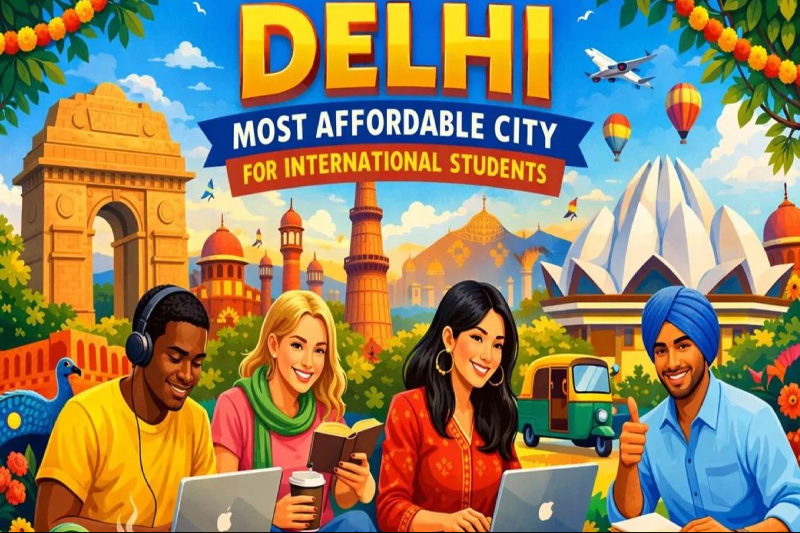
In an increasingly competitive global higher-education landscape, affordability has become one of the most decisive factors influencing where students choose to study. Against this backdrop, Delhi’s recent recognition as the world’s most affordable city for international students signals a significant shift in how India is positioned within global education networks. The ranking, highlighted in a joint report by Knight Frank, Deloitte India and QS, underscores the growing attractiveness of Indian cities not merely as sources of outbound students but as compelling destinations in their own right.
A Landmark Recognition for Delhi
The report, titled India’s 155 Million Student Mandate, places Delhi at the very top globally in terms of affordability for international students. Mumbai follows at 11th place and Bengaluru at 15th, reflecting a broader trend: Indian metropolitan centres are steadily gaining prominence as cost-effective academic hubs without compromising educational quality.
The assessment draws on the QS Best Student Cities rankings, which evaluate urban education destinations across several equally weighted parameters, including affordability, employer activity, university rankings, desirability, student experience and international diversity. Such multidimensional evaluation highlights that affordability alone is insufficient; rather, cities must provide a balanced ecosystem combining academic excellence, career opportunities and quality of life.
Affordability: India’s Strategic Advantage
One of the most striking conclusions from the report is that affordability remains India’s strongest competitive advantage in global higher education. Tuition fees, accommodation costs and day-to-day living expenses in Indian cities are markedly lower than those in traditional study destinations such as the United Kingdom, the United States, Australia and much of Europe.
For international students and their families, this translates into tangible financial benefits. Lower costs reduce dependence on student loans, minimise long-term debt burdens and often result in a stronger return on educational investment. In an era where the cost of higher education in Western countries has escalated dramatically, India’s comparatively economical framework presents a compelling alternative.
Moreover, favourable purchasing power further enhances this appeal. Students frequently find that their financial resources stretch further in Indian cities, allowing for a more comfortable lifestyle alongside academic pursuits.
Quality Without Compromise
Affordability alone would not sustain India’s growing reputation if it were not matched by educational quality. Over the past two decades, Indian universities and institutions have undergone significant transformation, investing in infrastructure, research capabilities and international collaborations.
Delhi, in particular, hosts several well-regarded universities and specialised institutions spanning engineering, management, humanities, medical sciences and emerging interdisciplinary fields. The city’s academic ecosystem is complemented by a vibrant intellectual culture, access to policy institutions, think tanks and multinational corporate headquarters, all of which enrich the student experience.
The city’s cultural diversity also plays a role. International students encounter a rich tapestry of languages, traditions and perspectives, contributing to a genuinely global educational environment without the prohibitive costs often associated with Western study destinations.
Demographics and the “155 Million Student Mandate”
A crucial dimension highlighted by the report is India’s demographic profile. The country is home to approximately 155 million individuals aged between 18 and 23, constituting one of the largest youth cohorts in the world. This demographic dividend positions India as both a major source of international students and an emerging destination for global education providers.
This vast student population has significant implications for higher education infrastructure, urban planning and economic development. Universities, policymakers and real-estate developers increasingly recognise that educational expansion is intertwined with city development strategies.
The Rise of India as an Education Destination
Historically, India has been perceived primarily as an outbound student market, with large numbers travelling abroad for higher education. However, the current trend suggests a gradual reversal. International universities are exploring opportunities to establish campuses, partnerships and research centres in Indian cities.
Policy reforms supporting foreign educational institutions, combined with urban infrastructure development and digital connectivity, are accelerating this shift. Experts argue that success in this new landscape will depend not merely on national policies but on city-specific strategies encompassing housing, transport, safety, academic clusters and industry linkages.
Delhi’s prominence in affordability rankings thus reinforces its potential to become a global academic hub, particularly for students seeking quality education at sustainable costs.
Real Estate and Urban Infrastructure: The Hidden Enablers
An often overlooked aspect of educational attractiveness is real estate. Student accommodation, campus infrastructure and urban amenities significantly influence the overall academic experience. The report emphasises that spatial planning, including proximity between campuses, residential areas and employment hubs plays a critical role in sustaining educational ecosystems.
Delhi’s expanding metro network, evolving co-living spaces and growing student-oriented neighbourhoods contribute to its affordability advantage. These developments not only reduce commuting costs but also enhance safety and convenience, factors increasingly valued by international students and their families.
Employability and Return on Investment
Another compelling dimension is employability. International students today evaluate educational destinations not solely on academic prestige but also on post-study career prospects. India’s rapidly growing economy, expanding technology sector and increasing global corporate presence offer promising employment opportunities.
Delhi, as a major political, economic and technological centre, provides access to internships, industry collaborations and professional networks. These opportunities strengthen the argument that studying in India can yield both academic and professional dividends.
Lower educational costs combined with competitive employment prospects create a powerful value proposition, particularly for students from developing economies seeking globally relevant qualifications without excessive financial strain.
Cultural Capital and Student Experience
Beyond economics and employment, the student experience remains central. Delhi offers a unique blend of historical heritage and modern urban dynamism. From world-class museums and cultural festivals to contemporary art, cuisine and nightlife, the city provides an enriching environment extending far beyond classrooms.
International students often cite cultural immersion as a major benefit of studying abroad. Delhi’s multicultural ethos, English-language academic environment and cosmopolitan social life make adaptation relatively seamless while still offering a distinctly Indian experience.
Challenges and Considerations
Despite its strengths, Delhi must address certain challenges to fully capitalise on its emerging status. Infrastructure pressure, environmental concerns and urban congestion remain persistent issues. Ensuring affordable yet high-quality student housing, maintaining safety standards and enhancing international student support services will be essential.
Additionally, sustained investment in academic research, global faculty recruitment and international collaborations will be crucial to maintaining credibility alongside affordability.
Looking Ahead: India’s Strategic Educational Moment
The recognition of Delhi as the world’s most affordable student city may well mark the beginning of a broader transformation in global higher education mobility. As economic uncertainties reshape study-abroad decisions, cost-effective destinations offering quality education are likely to gain prominence.
India’s demographic scale, policy reforms and urban readiness collectively position it as a strategic destination for educational expansion. Delhi’s leadership in affordability serves as both validation and opportunity, i.e - validation of India’s educational potential and opportunity to strengthen its global academic standing.
For international students seeking a balance between academic excellence, cultural richness and financial sustainability, Delhi increasingly emerges not merely as an alternative but as a compelling first choice.