Union Budget 2026: Education Allocation Rises By 8.2%, Highest Ever
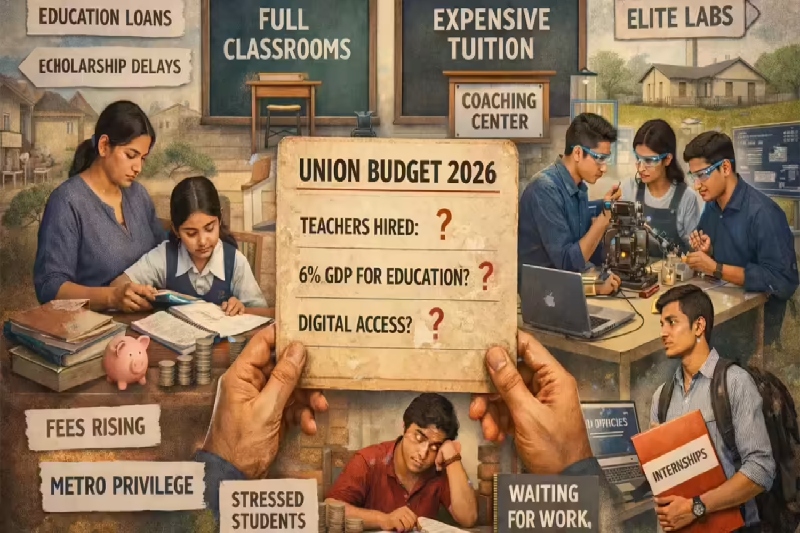
The Union Budget 2026-27 has placed education firmly in the spotlight, marking the highest-ever allocation for the sector at Rs 1.39 lakh crore, up from Rs 1.28 lakh crore in 2025-26. This represents an 8.27% year-on-year increase, signaling the government’s continued commitment to education. While this boost is noteworthy, experts caution that, when adjusted for inflation and compared to the National Education Policy (NEP) recommendation of 6% of GDP, the funding still falls short of meeting India’s long-term education goals.
This year’s Budget focuses not just on expanding financial resources but also on aligning education with the future needs of the economy, emphasizing skilling, digital learning, and research-led innovation. Here’s a detailed look at the key highlights and implications of the 2026-27 education allocation.
Higher Education Emerges as the Biggest Beneficiary
One of the most striking aspects of Budget 2026 is the noticeable increase in funding for higher education, which has outpaced school education in growth terms. Allocations for universities, technical institutions, and research-linked programmes have increased by around 11% compared to last year, underscoring a push to strengthen India’s higher education ecosystem.
Several strategic initiatives aim to create integrated educational and industrial hubs. The Budget proposes five new university townships along major industrial and logistics corridors. These townships will combine universities, research centres, residential facilities, and industry partnerships, fostering innovation and skill development in key sectors.
In addition, a new National Institute of Design (NID) will be set up in eastern India to promote design education, innovation, and creative skill development in regions that have historically had limited access to specialized education.
To improve female student retention and access, the Finance Minister announced the establishment of one girls’ hostel in every district, ensuring safer and more accessible accommodation for women pursuing higher education.
The Budget also addresses financial barriers for students studying abroad, including revisions to the tax collection at source (TCS) on overseas remittances, easing the burden on families seeking international education opportunities.
School Education Retains the Largest Share
Despite the higher growth for universities, school education continues to dominate the education budget, reflecting the government’s focus on foundational learning. Funding for schools has increased modestly, with continued support for flagship schemes that include:
- Integrated school development programmes
- Nutrition support through mid-day meal schemes
- Establishment of model schools
However, educationists point out that the Budget largely maintains existing programmes, without introducing targeted interventions for persistent challenges such as learning outcomes, teacher shortages, and regional disparities. While incremental, the measures do not yet address systemic gaps that affect quality education at the grassroots level.
Key New Initiatives: Access, Inclusion, and Innovation
Budget 2026 introduces several new measures aimed at expanding access and inclusion in education.
- Expanded student hostel facilities to support access to higher education
- Policy changes to ease financial stress on students pursuing education abroad
A notable innovation is the focus on creative and digital economy skills. The government announced the establishment of content creation labs in 15,000 schools and 500 colleges across India, focusing on animation, visual effects, gaming, and comics (AVGC). These labs aim to integrate creative skill development with traditional learning, preparing students for emerging sectors.
Digital infrastructure remains a priority, with plans for expanded broadband connectivity for schools and additional support for technology-enabled learning environments. These efforts reinforce the government’s commitment to bridging the digital divide and modernizing classroom experiences.
Greater Emphasis on Skilling, Research, and Future-Ready Education
Compared to last year, Budget 2026 places a stronger emphasis on skilling and future-ready education, reflecting an understanding that India’s workforce must be prepared for the demands of a rapidly changing economy.
Key areas of focus include:
- Vocational training programmes to enhance employability
- Digital learning infrastructure to support online and hybrid learning
- STEM facilities to nurture scientific and technological capabilities
- Teacher capacity building to improve classroom quality and student outcomes
A flagship initiative is the creation of a Centre of Excellence in Artificial Intelligence in Education, which will support AI-driven learning tools, adaptive platforms, and virtual labs across schools and higher education institutions. This marks a significant step toward integrating AI into the educational ecosystem, providing personalized learning and skill development opportunities at scale.
What Remains Missing: Unmet Expectations
Despite the positive steps, several expectations remain unfulfilled.
- Education spending as a share of GDP has not seen a structural increase, leaving India below the NEP target of 6%
- Foundational learning improvements, especially in early grades, remain underemphasized
- Teacher recruitment and training, crucial for quality improvement, are only modestly addressed
- Rural education infrastructure and interventions to reduce regional disparities remain limited
In short, while the Budget signals progress in terms of funding and targeted programs, it does not yet deliver a structural shift in policy direction. The allocation focuses on expansion and modernization rather than fundamental reforms that could bridge long-standing gaps in access, quality, and equity.
Conclusion
The Union Budget 2026 marks a historic high in education allocation, rising 8.2% year-on-year to Rs 1.39 lakh crore. It demonstrates a renewed focus on higher education, digital infrastructure, skilling, and innovation, positioning India to better prepare its students for the creative and technology-driven economy of the future.
Higher education receives a clear boost through university townships, research-focused programs, and new institutes like NID, while school education maintains steady support for existing programmes. Notable new initiatives include AVGC content labs, AI-driven education centers, and expanded hostel facilities, reflecting an emphasis on inclusion, creativity, and tech-enabled learning.
Yet, the Budget also highlights the limits of incremental increases, as India continues to fall short of the NEP’s 6% of GDP target and foundational reforms remain incomplete. Moving forward, a more structural and targeted approach—addressing teacher shortages, rural access, and early learning outcomes—will be crucial to achieving long-term educational transformation.
Budget 2026 thus represents a significant step forward, particularly in higher education and innovation, but it also underscores the need for sustained policy action to meet the aspirations of India’s growing student population.